
Thanks to a collaboration with Carl Malamud and the Public Resource organization, fifty-three books published by the IASc are now available in high-end digital format as an ‘Indian Academy of Sciences Collection’ on the Internet Archive, and more will be added soon. These digitized versions will soon also be available on the IASc website.
Peer Community In: A free recommendation process of unpublished scientific papers based on peer reviews
The current scientific publication system is afflicted with several serious problems: the cost and lack of transparency and, to a lesser extent, the time between obtaining scientific results and their publication. In addition, we believe that the economic model on which the current publication system is based creates a certain perversion of this system.
The cost
Most scientific journals are owned by large international publishing companies that take advantage of the needs of researchers to publish and read scientific articles. Indeed, research organizations and universities pay them very large sums of money each year by subscribing to their journals and paying the fees that these journals charge for the publication and/or open access of articles. While the development of IT tools and the dematerialization of items could have led to a reduction in costs, these costs have continued to increase in recent years. The size of the international market of scientific publication currently amounts to about $20 billions, paid in vast majority by public research institutions. In addition, this market is highly profitable, the profit margin of the six big publishers (Elsevier, Springer-Nature, Wiley, Thomson Reuters, Informa, Wolters Kluwer) being between 30 and 40% depending on the year, a figure comparable to Apple or Google.
In France, these costs are estimated to 150 million euros per year, which represents 25% of the budget of the National funding agency (ANR). This cost seems unjustifiable to us, given that most of the work leading to publication is carried out by the researchers themselves: writing articles, peer reviewing, making editorial decisions, proofreading and making corrections. The situation is even more complicated for researchers in developing countries. As most research institutes cannot afford such costs, the current publication system limits both their ability to publish and their access to scientific literature.
The lack of transparency
The peer review process, which ensures the quality of articles, is generally not public in journals. The reader of a scientific article does not have access to critical peer reviews. Its confidence in the validity of the article is therefore based on subjective elements disconnected from the quality of the article in question, such as the reputation of the journal – which is roughly estimated by its impact factor (IF).
We all have experience of reviewers’ critiques being sometimes insufficient to make it possible to increase the scientific quality of articles under review. It is sometimes hard to believe that editors can make a decision based on such low-quality reviews. It would be preferable to publish editorial decisions, reviewers’ criticisms and authors’ responses. This would give readers the material to evaluate the seriousness of the work done on each article and its scientific merit based on reviews. It would also be a very strong incentive for reviewers to perform uniformly thorough reviews since badly written or poorly constructive reports would be viewable by readers of the original article.
The deadlines
Between the time a research team obtains results and their eventual publication, there may be a delay of 6 months to several years, due to (i) the classic back-and-forth exchanges between authors, editor and reviewers to obtain an acceptable version of a manuscript and (ii) the “submission cycles” of papers being rejected outright or after reviews in different journals. The result is a very inefficient system: while one team tries to publish its results acquired months earlier, other teams working on the same subject could benefit from these results without knowing that they already exist. Proof of precedence is a sensitive subject in this context – how can one prove the novelty of their study when others can decrease publication time due to factors affecting review (e.g. authors’ fame and connection to the editorial board and referees) and/or circumvent them by publishing in less well-known venues? And finally, time to publication, and the ways to minimize it, affects the way scientists are hired because different publication strategies can lead to drastically different CVs, hence favoring candidates with a tendency to game the system.
Perversion of the system
Publishers are gradually moving from subscription towards an author-pay system by asking authors to pay article processing charges (APC) to ensure free reading access to their articles, in part because such articles are more likely read and cited and also because public grant agencies such as the NSF and ERC have made moves towards general open access of all publicly funded research. The turnover of publishers is thus more and more positively linked to the number of articles published. As a result, it becomes tempting for them to increase the proportion of articles accepted in their journals, to the detriment of their quality. This trend is not necessarily opposed by authors who themselves have an interest (for being hired, to get promoted in their careers, to obtain funding for their researches…) to publish quickly and massively.
Which opportunities?
The Internet provides free web publishing tools, which make it possible to publish on a very large scale at minimal cost (e.g. OJS). In addition, raw and not yet evaluated articles, called preprints, are increasingly being deposited directly and freely by researchers in open archives such as bioRxiv.org or arXiv.org, making research results quickly and freely available. This immediate availability also allows the use of social networks to comment on the results, thus promoting contact between science and the public. On the other hand, preprints are not evaluated and validated by the scientific community and this constitutes a problem.
The proposed solution
To solve this problem our idea is to establish communities of researchers (Peer Community In (PCI)) evaluating through peer-review and recommending articles in their scientific field (see the short video explaining the process). This initiative is based primarily on the deposit of preprints in open archives such as arXiv.org. The authors of a preprint deposited in these open archives may then request its evaluation by a PCI competent in a given discipline, for example Peer Community in Evolutionary Biology (PCI Evol Biol). The only condition will be that this preprint is not already published or being evaluated by a journal. Recommenders (scientists playing a role similar to that of editors in journals) of this PCI have access to the submission, and if one of them finds the article interesting, he/she can decide to handle its peer-review evaluation. On the basis of at least two reviewer reports, the recommender/editor in charge of the preprint may accept the preprint, ask for modifications or reject it. In case of acceptance by the recommender/editor, the reviews, a recommendation text signed by the recommender/editor, digital identifiers (DOIs) of the successive and corrected versions of the preprints, as well as the correspondence with the authors, are available free of charge to readers on the PCI website. The recommendation texts themselves have a DOI and can be cited (see an example of recommendation here). Importantly, the acceptance of a preprint by a PCI does not prevent its subsequent submission for publication in a journal. It is also noteworthy that a preprint can be recommended by several PCIs, specialized in different scientific fields, a situation particularly advantageous in case of multidisciplinary works.
A first community was launched in January 2017: PCI Evol Biol. PCI Evol Biol currently brings together 390 of the most eminent researchers in evolutionary biology. PCI Paleontology (79 recommenders/editors) and PCI Ecology (295 recommenders/editors) have been launched in January 2018. Our aim is to rapidly increase the number of new PCIs to cover many scientific topics. A large heterogeneity in the size of the scope of the future PCIs may be expected. Some PCI will be very specialized and have a narrow scope, and others will be multidisciplinary and have a wide readership.
In summary, the PCI system is based on the publication of critical assessments and recommendations of articles not yet published, but deposited – and freely accessible – in electronic form in an open archive available on the Internet. These evaluations and recommendations are carried out on a voluntary basis by researchers without any link with private publishers.
The publication costs disappear: PCI offers the possibility to validate, distribute and consult the articles submitted to it free of charge. The time limits for access to information are null and void: the scientific articles being evaluated are deposited in open archives as soon as they are written. The system becomes transparent: reviews, editorial decisions, authors’ responses and recommendations are published on the website of the scientific community concerned (such as PCI Evol Biol).
Transparency of article evaluations will surely lead to better practices, as critical article evaluation work is best done when it is publicly displayed. Problems of conflict of interest in critical evaluations will certainly be less frequent with this system. Indeed, conflict of interest situations are prohibited in PCIs (recommenders/editors and reviewers must declare that they have no conflict of interest with the authors or with the content of the preprint they are handling/reviewing), recommendations are signed and we encourage reviewers to sign their critical assessments. This mode of operation should curb any desire for “cronyism” or retaliation on the part of evaluators (see the criticisms of the system below).
Furthermore, it is not the purpose of PCIs to undertake the evaluation of all articles submitted to them. Evaluations are based on the voluntary work of community members, who choose the articles they consider relevant. This will limit the number of “food” items of no interest, intended to “inflate” the authors’ lists of publications.
Major criticisms of PCI
The first criticism concerns the originality and youth of the PCI initiative and the absence of an impact factor. PCI remains unknown and researchers, funding agencies and research institutes still tend to attach great importance to traditional scientific journals and associated Impact factors. Moreover, given that researchers are currently being recruited, evaluated and funded on the basis of their curricula vitae, it is understandable that they are reluctant to use this new system.
Indeed, PCI is not a publication medium and therefore has no impact factor. The consequence that critics mention is that authors may be afraid to submit their manuscripts to a system without an impact factor because it could harm their careers (recruitment, promotion, funding). The simplest answer is that the impact factor is not a measure of the quality of scientific work, but a measure of the reputation of the medium in which it is published, which is very different. However, it is possible to measure the number of citations of articles recommended by a PCI, for instance google scholar allowing to collect citations of preprints. There is therefore no obstacle to measuring the notoriety of items recommended by a PCI. In addition, it should be noted that in some disciplines (especially mathematics and physics), the open archives hosting preprints have impact factors that are comparable or superior to the best journals in these fields. Note also that the authors of an article recommended by a PCI can then submit their article to a journal displaying an impact factor. There is therefore no impossibility of being “assigned an impact factor” after receiving a recommendation from a PCI. Finally, and importantly, researchers and committees evaluating scientists’ projects and careers can change their mind and decide to consider articles recommended by PCI with the same value as “classic” articles published in journals. This is currently happening, for example in France, in several evaluation committees: at the National Council of the Universities, the ‘Comité national de la recherche scientifique’ (CoNRS), and the National Institute of Agronomic Research in the field of evolution and ecology.
The second common criticism is that, in the event of success, PCI may not be able to absorb a large number of submissions because it relies on low budget and does not have a managing editor. This criticism is unfounded for several reasons: 1) Recommenders/editors do not have to edit all submitted articles. Only articles that find a recommender/editor are evaluated. Articles that require heavy workload from a managing editor, because they are poorly written, presented, formatted, etc., will most likely not be handled by a PCI recommender/editor. 2) As PCI does not publish recommended articles (the articles stay in open archives), authors are responsible for the formatting and more generally for the aesthetic quality of their article. There is no correction and formatting work on the part of PCI (PCI only focuses on science) and this greatly reduces the workload, making unnecessary a managing editor. 3) Each PCI has a large number of recommenders/editors. This ensures the possibility of editing a large number of manuscripts without overwhelming those recommenders/editors with workload, as can be the case in traditional journals. In addition, this large number allows for a wide variety of topics for which recommenders/editors are specialists. This ensures that interesting and high-quality articles are handled and reviewed.
The third criticism concerns the fact that PCI may resemble a closed club in which cronyism flourishes. Regarding cronyism, it should be noted that recommenders/editors and reviewers must sign an ethical charter that prohibits cronyism, limits non-financial conflicts of interest and prohibits all financial conflicts of interest. In addition, each PCI has a managing board responsible, among other things, for verifying the absence of such a conflict of interest. Finally, transparency through the publication of editorial decisions (signed) and reviews (possibly signed) ensures that crony situations are detected and made difficult. Regarding the lack of openness of PCIs, it might be sufficient to note that the number of recommenders/editors is much higher at PCI than in traditional journals. The number of PCI recommenders /editors is simply not limited. Only the lack of expertise can limit their entry into a PCI.
The final criticism is that PCI cannot compete with well-established journals. PCI is not a journal because it does not publish scientific articles. It only publishes recommendations and critical comments of articles deposited in open archives. Thus, PCI does not directly compete with the current journal system, a property that increases its chances of success. Indeed, most journals nowadays accept the submission of articles whose preprints have been deposited in an open archive (http://www.sherpa.ac.uk/romeo/index.php). They should therefore accept and consider the preprints recommended by the PCIs. Some leading journals in the field of ecology and evolutionary biology (e.g. Ecology Letters, Trends in Ecology and Evolution, Molecular Ecology or Oikos) have publicly indicated that they will accept not only the submission of preprints recommended by PCI, but also take into account the reports of reviewers and the recommendation texts of these PCIs to speed up/improve/complete their evaluation process.
Conclusion: a call for institutional recognition
To enable this impetus and ensure the management of these PCIs, we hope to obtain the support – in terms of financial but also in terms of symbolic and intellectual resource – of research institutions (universities, major research institutes and funding agencies), at the international level. As already mentioned above, PCI needs to be recognized by leading research institutions. We call for a public recognition of PCIs and of the quality of the PCI article evaluation process by international research laboratories, departments, universities, research institutes, and funding agencies. It is only through such recognition that hiring, promotion and funding committees will change their habits and read PCI recommendations instead of looking at the Impact Factors of journals where articles are published. We also call for the creation of new PCIs. The goal is to cover all scientific disciplines from pure mathematics to history. It is noteworthy that existing PCIs are themselves an invitation for the creation of new PCIs and so forth: The more PCIs there will be, the more PCIs there will be created, and the more authors will trust a PCI to have their articles evaluated.
Thomas Guillemaud, Benoit Facon, and Denis Bourguet are researchers working in evolutionary ecology on pest insects at Inra, French National institute of agronomic research. They created Peer Community In. François Massol is an evolutionary ecologist working at the CNRS institute, France. He co-founded Peer Community in Ecology.
Curiosity as a Career
Every morning, I have an interesting task at home. I prepare filtered-coffee and boil milk as soon as I wake up in the morning. Both these processes are supposed to be mundane task, but over the years I have found it to be one of the most intriguing things one can do in kitchen. To make the task engaging, I have been measuring the rate at which half a liter of milk boils and when does it reach the point where it is about to spill over from the container (of course, I do not spill it over, else I will be devoid of my morning coffee…no way). Over many years of this task, I have found that the parameters of milk boiling vary as a function of temperature, humidity, shape of the container, the pressure of the gas supplied in the stove, the content and age of the milk. I have also found some interesting methods to stop the milk spill over even while it is still under boil. In an essence, I start my day with a curious-experiment in the kitchen, and I look forward to it every day.
Curiosity as life – Tasks like boiling milk, preparing coffee, playing with tooth-paste, running in rain, watching clouds, creating soap bubbles, watching water flow, slicing vegetables (see image), dusting the house, cleaning a window pane, washing shoes and drying an umbrella are common to all of us. If you look at these tasks closely, one can connect them to a lot of interesting science. I have found great joy in doing so, and have turned out be an integral part of my life. An important off-shoot of this way of looking at things is that I hardly get bored. Every trivial thing that I observe has something intriguing, and this has had a profound influence on how I approach my life. Invariably, while exploring my curiosities, I find myself losing the feel for time, and one goes into the state of flow. That is a happy place to park your mind.
Scientists’ dilemma – ‘Impact on society’ is touted as the modern mantra for doing research. A scientist is strongly encouraged, especially by funding agencies, to work on research problems that have relevance to a large community. Even among scientific communities, novel solutions to research problems are often encouraged and are highly valued and rewarded. So, a scientist is always looking for problems that can have greater impact, either conceptually or technically. Influenced by this external push, the priority of what one has to do is always under question. Critically, this puts a scientist in a dilemma: should I work on problems that are curiosity-driven or should I work on problems that have largest impact to the society? This conundrum is especially sharp if one is a scientist whose research requires large infrastructure and financial assistance. Related to this dilemma is the debate of basic vs applied research, and has inspired concepts such as Pasteur’s quadrant. I do research for my living and most of time is spent on it. I and my research group think on the “why and how” of our research, and it is important for us to resolve this dilemma.
Resolving the dilemma, personally – Given that we do laboratory-based experimental research, I have to ensure that we secure research funds to keep it up and running. Concomitantly, I have to cater to my curiosity, without which I will not be able to sustain my interest in the work I do. Over the years, balancing these concerns has influenced the work I do. An important aspect of resolving the above-mentioned dilemma has been to spend long hours on identifying and choosing a research problem that caters to my curiosity and has relevance to the research community. The process of choosing a research problem is not a simple one, but in my opinion, is perhaps the most important step in doing research. After all, the question one defines will eventually guide the answer we can find; hence every minute we spend on it is priceless.
Light and light scattering has been central to all the stuff I do in my research. I am also intrigued by science in everyday life. So, the best possible thing to do was to study light-matter interaction. This inspired me to look for problems that can cater to my interest and a large research community, and may potentially have applications that can impact the society -all of this without having to sacrifice my curiosity. Over the years, this intention has guided me to pursue research at the interface of optical physics and biochemistry; nano-plasmonics, advanced optical instrumentation, and in recent times on plasmon-soft matter interactions. All these areas that I have been working-on are strongly rooted in my curiosities. I have deliberately picked these fields such that I never have to sacrifice on what I like to do.
Parting thoughts – Generally, among research students, there is a concern about their future, and how they can retain their curiosity and pursue their career. Invariably, they are sandwiched between what they like and what the external-world tells them to like. If these two things do not overlap, there is always frustration. For such situations, I have a suggestion: follow your curiosity and be cognizant of the fact that curiosity-driven life not only feeds your brain, but also your stomach. Just by following curiosity, a lot of people including myself, have been able to build a career out of it. What is further encouraging is that there is enough room in the society for our curiosities to develop and flourish, provided we take the effort to connect our curiosity to a relevant research problem out there. This exploration will take time, and we must remain patient until it yields. The onus of connecting our curiosity to external relevance is ours, and we must take the initiative. As the saying goes:
IF IT IS TO BE, IT IS UP TO ME!
G.V. Pavan Kumar is a physicist at IISER Pune. This post first appeared on his blog here.
Science meets journalism: from balled fists to handshakes to high fives
There has been a fair debate raging between scientists and journalists over science journalism. Should journalists share text and quotes with scientists whom they have consulted in writing their articles? More importantly, why or why not? On the one hand, scientists are almost unanimous in agreeing that they have a right to see the copy. Journalists and many publications are equally adamant that they are not obliged to, or should not, share their copy.
Many scientists have expressed their struggles with journalists. Journalists will call to discuss one subject or another, take up a lot of their time, and then refuse to share what they have written based on these conversations. Scientists complain that this frequently results in their getting facts (major and minor) wrong, and more often, in getting a nuance or interpretation wrong.
While it might seem to scientists that they are up against journalists, its also important to keep in mind that the latter themselves have to negotiate their articles with publication editors, and sometimes have little control over headlines (for amusement, see here), and even the content of their articles. Often, journalists themselves do not get to see the final copy.
One is pretty certain that journalists are equally frustrated by their interaction with scientists. They likely feel that scientists look down on them (even though they may be science graduates), want to edit their writing though they may have little clue about writing for the public, and probably want to be given far more credit than they deserve. Certainly, scientists can rank amongst the most self centered, egotistical, opinionated, pompous and pampered people on the planet.
However, science does have some decent (and replicable) attributes. Scientists, natural and social, believe that their goal is to get at the ‘truth’. As fuzzy as the concept might be, the methods and processes are designed to reduce error and subjectivity, and one assumes that the goal of good journalism is the same. Regardless of whether one has a positivist (absolute truth or fact) or a post-modernist (its all subjective) view, few people will argue that a spectrum exists from opinion to interpretation to fact.
Some journalists have argued that there is an ethical reason for this refusal to share copy, but this is hard to fathom. Most, however, have pointed to two factors, one practical and one philosophical. The first is that of time: it is simply not possible to get feedback from all of one’s informants within the time frames that most journalists in newspapers and magazines work with. This is an acceptable reason but does not preclude requesting feedback with fixed time limits.
The second is one of journalistic independence. Without doubt, the notion that journalists must be free to report objectively is correct, and one must protect the freedom of the press. However, an important distinction needs to be made – scientists are both experts and stakeholder, and the relevance of conflict of interest is far greater in the latter case. In a piece about science, scientists may play either role, and making this critical distinction could result in better reporting and save heartache.
At the end of the day, one assumes that we all want to move forward towards better reporting of science. To move forward constructively, I have some suggestions for both parties. Journalists could decide (in consultation) which class the scientist belongs to with regard to the piece they are writing which would then determine whether they are willing to share what they have written.
The first is that of the subject expert, where the scientist is consulted for their knowledge about a particular system. If a scientist is consulted on a wide range of issues pertaining to the topic, and the piece is largely shaped by their inputs, then I believe that there is maximum benefit in sharing the entire piece. The scientist is likely a better judge of the nuances of the story (which they have spent years or perhaps decades studying) than the journalist. This will likely result in the reduction of blatant errors and introduce some nice detail. Perhaps some opinion does filter in, but it likely imposes a relatively low cost.
Sometimes, journalists may consult many scientists with either similar or opposing views. This is perfectly reasonable. Here, the journalist could share each of the sections that the expert has contributed to, not just the quotes, but the context as well as content relating to that expertise. In both of these instances, the article can benefit tremendously from fact and nuance checking, again while having little cost. There is no obligation for journalists to follow every edit or ‘instruction’.
Finally, the scientist (or politician or sportsperson) may simply be a stakeholder, a player in the larger story the journalist is telling. In this instance, I do not believe there is either obligation or utility in sharing the copy other than the quote. No doubt there is fuzziness in what role the scientist actually plays, but asking this question will get us one step closer to an accurately reported story and greater collegiality.
A good part of science journalism involves the coverage of research done by a scientist/lab, often pertaining to a single research paper. Here, the scientist’s role is a hybrid between expert and stakeholder. And while there may be relatively little conflict of interest for the scientist with regard to the results of the research, there is obviously a vested interest in reflecting how important it is. In this case, it would help to get the scientist’s inputs on the copy to ensure that the work has been accurately described, but journalists could also get an independent expert opinion of the salience of the science.
On the other side, scientists need to be careful not to edit the story or change the language to suit their sensibilities. They should be more respectful in general of journalists’ ability to grasp the science, and to write about it in a way that is appealing to a larger readership. Most importantly, they cannot be patronizing and imply that science journalism is a trivial afterthought to science. Reaching science to society is essential and perforce, a collaborative enterprise.
Peer review in science, warts and all, is in principle designed to improve logic, analysis and inference. In addition, most students work with mentors, and most papers are written with some input from colleagues and collaborators who have some knowledge of the subject. Unfortunately, in many editorial constructs, journalists have no formal input into the content of their pieces, just language editing. The idea of fact-checkers has not unfortunately made its way into Indian journalism.
In the spirit of collaboration, lets work together to improve science communication and journalism. The quality of the product can only improve by co-opting one of the paradigms in science that is worthwhile – the notion of review. This can surely be done with strict time limits, and without obligation to follow ‘instructions’ from scientists. Surely this will help in getting our stories right, and building a better relationship between journalists and scientists.
Kartik Shanker is Director of ATREE, Faculty at the Indian Institute of Science, and Founding Trustee of Dakshin Foundation. This article was greatly improved by inputs from numerous journalists, editors and scientists (but it did take a couple of months to pull together).
List of Science Communicators of India
In a recently concluded meeting between scientists and science communicators of India, the need was felt to create a list of science communicators as well as scientific experts of the country.
Therefore, as part of the Dialogue initiative, we have now created a Google form through which all science communicators who wish to be part of a list of science journalists, can upload their information. They control how much of their contact information they would like to make public. We shall have a quick check on that information to make sure that there is no spamming. We shall then make the information available through a public list.
The form can be found here
The public list can be found here.
This information is the crucial first step towards a more uninhibited dialogue between scientists and the science journalists of India. We are also in the process of creating a corresponding list of scientific experts who will pledge to at least have a dialogue with science communicators as and when needed.
In case of any queries, please write to confluence.caretakers@gmail.com
National Institutional Ranking and Institutions of Eminence
The national ranking of institutions of higher learning in India produced by the Ministry of Human Resource Development, attracted considerable attention in the context of the identification of five of them (and a private institution yet to be established) as Institutions of Eminence (IoE). In addition to its usefulness or otherwise for determining funding for a few institutions, the National Institutional Ranking Framework (NIRF) contains data which provide insights into the higher education sector in the country.
The 100 institutions listed in NIRF can be broadly divided into three categories: centrally funded institutions, institutions funded by states, which could be collectively referred to as state universities; and private institutions which may be called private universities. The 100 institutions are roughly equally divided among these three categories. However, 16 of the top 25 are centrally funded organizations. Happily, six state universities are among the top 25. The remaining three are private universities. Centrally funded institutions and state universities dominate the next 25 in the list as well. The two categories have equal share among the 25; private universities account for only five institutions. Nearly half in the bottom 50 are private universities; about a third of them are state universities; the remaining one sixth of the 50 are centrally funded institutions.
The above analysis makes it clear that centrally funded institutions occupy the pride of place in the higher education sector in India. In spite of severe constraints, the state universities continue to perform reasonably well. Private universities, though overall lower in quality compared to institutions in the other two categories, have a significant presence at the high table of the higher education set up. In terms of the number of students enrolled, much of the higher education sector is serviced by state universities. Although they are still performing reasonably well, the general perception is that their comparative eminence has deteriorated over the years. The emergence of private universities as a significant component of the higher education sector is perhaps a comparatively recent phenomenon, although a few of them have served the sector for long periods. Like state universities, the quality of private universities vary widely. As indicated by the NIRF, and also from personal experience, some of them are doing very well.
It is often said that there is no formula for success or leadership. The same is true about eminence. Yet, it might be instructive to examine our own undoubtedly eminent institutions. Indian Institute of Science (IISc), Bangalore is at the top of the MHRD rank list, closely followed by several Indian Institutes of Technology (IIT’s) and a few central universities. Any one of them could have been chosen for examination as an example. However, I am most familiar with IISc, an institution with which I have been associated for 55 years in different capacities. The ambience of an institution is an indefinable quantity. The only other institution in which I have worked is the University of Oxford. As far as ambience is concerned, but not in terms of accomplishments, I do not find any difference between the two institutions. Ambience is built and preserved over long periods of time. Many institutions in India have a tendency to start with a flourish and then decay over the years. IISc is now more than 100 years old. It is remarkable that it still remains vibrant.
One prerequisite for eminence of an institution of higher education and research is autonomy. Autonomy is of course within the overall framework of Government rules and regulations, and should go along with accountability in relation to the stated or perceived goal and financial management. IISc has been fortunate to have been granted substantial autonomy in letter and spirit. The Governing Council of the Institute has members of parliament as its members. I, like many others, have held the view that the role of representatives of people in relation to academic institutions is to help in formulating overall policy directions and sensitizing the organization to national and societal needs. It is not desirable for them to indulge in micro management. The members of parliament who served on the Council of the Institute have by and large followed this overall approach. This has been largely true of the representatives of the Government as well. The relation between the Council and the Senate, the highest internal body of the Institute, has also been cordial. It is only very rarely that the Council declines to accept a recommendation of the Senate. Even on the rare occasions when it did, the communications to that effect were couched in very polite language.
Autonomy percolates through the entire organization. The departments enjoy substantial functional autonomy. Within each department, individual faculty members are to a great extent autonomous. In fact, a faculty member and his/her group constitute the basic autonomous unit of the Institute. Unlike many other smaller institutions in the country, IISc is not Director-centric. The Director and other leaders are important, but the institution runs as a system. In fact, autonomy is most effective when it is accompanied by internal democracy. Decision making should be substantially a collective participatory process, without it degenerating into anarchy. In this respect also, the system has worked reasonably successfully. Participatory democracy, even within an overall framework, is sometimes inconvenient. However, in the long run, it is effective. As Professor Satish Dhawan used to say “we are perhaps a little ponderous, but ultimately get there”.
Appointments and admissions based on merit, made after due diligence, are important for maintaining the health of the institutions. At IISc, only the Director is appointed without the involvement of the Institute faculty including the out-going Director. Therefore, this appointment is susceptible to external influences. The selection committees for the appointment of faculty and support staff are chaired by the Director or his/her nominee. Subjective factors sometimes come into play, but by and large the system has served well. Faculty appointments are usually preceded by discussions at different levels to eliminate mishaps. Admission of students are also made through an elaborate process to ensure that best candidates are chosen. On the whole, the students of the Institute belong to the cream of young India.
Bureaucracy is a bane of science in India (I have complaints only about bureaucracy as a system and not about individual bureaucrats, many of whom are splendid persons). There is considerable flexibility within the rules and regulations of the Government. The effort in institutions of eminence should be to interpret the rules and regulations in the most liberal manner. For this to happen, it is important that academics occupying administrative positions are well versed in appropriate rules and regulations. Bureaucracy cannot be wished away, but in autonomous institutions with internal democracy, it can be honed to facilitate and not obstruct legitimate activities.
As in the case of liberty, the price of autonomy, internal democracy, emphasis on merit, absence of rigid bureaucracy etc., is eternal vigilance. Distortions of and deviations from these attributes can, and indeed do, occur in the best of institutions. They have to be continuously fought against. This is particularly important in view of the recent tendency to erode the positive attributes, particularly, autonomy. The traditions and quality of many of our institutions of higher learning and research, are worth fighting for.
Most of what I wrote is applicable to a substantial extent to IIT’s and some central universities as well. Most of them also suffer from some common disadvantages. IISc, IIT’s and some of the central universities are medium sized institutions by global standards. Their impact would have been greater, had they been larger. Although it is not an important issue, one of the reasons why they do not figure high up in international rankings, has to do with size. The humanities component of IISc and IIT’s also needs to be enlarged.
Research in IISc, IIT’s and universities are carried out primarily using competitive grants obtained from different government agencies. The internal support for research is extremely small. This of course keeps the faculty alert and competitive. However, often one is obliged to align one’s research activities with the requirements of the agencies. Perhaps, an ideal situation would be one in which assured support of half the research expenses comes from the parent institution. The other half could be met from competitive grants.
Research programmes in institutions of the type we are discussing tend to be highly individualistic. This is the price one pays for autonomy at the faculty level and unlimited academic freedom. This often comes in the way of tackling large problems in a concerted manner. The way to get around this difficulty is to collaborate extensively and share facilities. The culture of collaboration is now developing, which needs to be further strengthened.
Autonomy, internal democracy, emphasis on quality in appointments and admission, flexibility in administration, ability of the faculty to attract funds, academic freedom etc. are pre-requisites for eminence in institutions of higher learning and research. These attributes are shared to a lesser or greater extent by such institutions funded centrally. The same cannot be said about state universities. There is considerable variation in the attributes among these universities. The nexus between academics, bureaucrats, politicians and other local interests sometimes causes great damage to institutions. It is remarkable that even under adverse circumstances, some state universities have done so well. Great variation in quality is observed among private universities as well. Some of them have done exceedingly well while some others are commercially oriented teaching shops.
IISc and two IIT’s have been identified as Institutions of Eminence, which is good. However, it is surprising that several other IIT’s and universities which appear at the top of the NIRF ranking, have not been accorded this recognition. At the same time, two private universities which are ranked 18 and 26, have been given this recognition. It would have been fairer if all the top 25 institutions had also been identified as Institutions of Eminence. In fact, the whole approach of treating a priori public and private institutions as two equally meritorious streams, is fundamentally flawed. The basis of recognition should be rooted in proven merit of individual Institutions, irrespective of whether they are public or private. There should be a level playing field for all concerned. Private institutions need to be encouraged, but not at the expense of institutions supported by the government. IISc, IIT’s and many universities which appear at the top of the NIRF ranking have done the nation proud and are acclaimed in India and abroad. It is unfortunate that many of them have not been chosen as Institutions of Eminence.
M. Vijayan is a Professor in the Molecular Biophysics Unit, Indian Institute of Science, Bengaluru, 560 012, India.
This article first appeared in Current Science here.
Visualizing cellular and molecular science for science communication
Scientists talk science for most of their day. Their audience is mainly their peers, and research students. With growing encouragement, a lot of scientists are making an effort to communicate to public. Different modalities are exploited to this effect, from writing in popular magazines and blogs to public speaking. Apart from talking to general audiences, scientists often give talks about their world in high schools and colleges with the purpose of getting students interested in science as a career choice. These engagements have forced scientists to write and speak in a jargon-free and lucid manner.
Scientists involved in science communication and science outreach have developed methods and strategies to speak and write about their work in a comprehensive to their audience. Visuals are not aesthetic tools for attention grabbing, but are useful tools in science storytelling. Biased by nature of my work, I make a special case for the large domain of cell and molecular biology.
Cellular scale is beyond the perceptive scale of human visual system. That makes it harder for an untrained audience to imagine the dynamic processes that are happening inside cells. They depend on our words and visual clues to form microscopic universes in their imagination, wherein the processes we describe seem plausible.
What kind of visuals are used in these cases? Beautiful microscopic images accompany articles and are pasted on first slides. They are perfect for grabbing eye balls and creating interest. Very often, (may not be true for all) scientists recycle their presentations meant for scientific peers for public and younger students as well. The schematics used there range from symbolic shapes, 2-D schematics, cartoons and realistic graphics. Most used among them are symbolic shapes or 2-D schematics developed on abstract shapes of circles, and rectangles in different colors represent different biomolecules. This method of 2-D schematics, often abused, was developed with careful thought and deliberation 30 years ago. This uniform code of schematic representation was developed by Keith Roberts, the chief illustrator of the iconic text “Molecular Biology of the Cell”. For the development of this teaching tool, the team of authors decided to keep a uniform code of representation, such that same representations of molecules could feature in different subjects. These were simplistic drawings based on hand drawing that were later adapted for printing by primitive digital methods. Despite the limitations of digital methods and printing techniques, this style of schematics was helpful and continues to be so. There was an attempt to portray form, scale and interaction surfaces.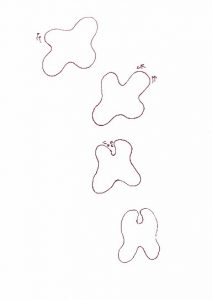
A hypothetical protein changing conformation, based on Keith Robert’s style. Notice the shift in forms and use of strokes outside the protein to indicate motion.
As the information on structural and function has become increasingly available, there are possibilities for incorporating more accurate details within illustrations. With the development of visualization tools, there is possibility for more realistic representations. Some of these tools, for both 2-D and 3-D representations incorporate structure-based information from cryo-EM and crystallography to concepts like molecular crowding and thermal motion (Goodsell et al., 2018). However, scientists continue to adopt insufficient methods. The figures are simplified derivatives of 2-D schematics developed by Keith Roberts and others. Apart from relationship to each other, these schematics often provide no information about the process.
In such a case, the imagination of the audience falls short. Scientists assume, and the audience is compelled to imagine the cell and molecules with insufficient clues. Imagine this story about RNA polymerase transcribing this piece of coding DNA. Which one is relevant to the audience?
In various schematics on DNA transcription on left hand side an increasing level of information conveyed.
Schematic 1 shows a physical interaction between RNA polymerase and DNA.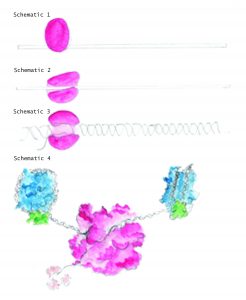
Schematic 2 hints at the groove of RNA polymerase that interacts with the DNA.
Schematic 3 depicts double helical DNA, transcription bubble formation, RNA polymer synthesis, and form of RNA polymerase.
Schematic 4 depict the RNA polymerase interaction with DNA in context of chromatin/histone octamers. It also hints transcription bubble, overall form of the proteins, RNA-binding proteins, bend in DNA during the process.
In public science talks delivered by PhD students and postdoctoral fellows under the ScienceHigh platform to an audience of mostly non-scientists, several have been based on cell and molecular biology. As a coordinator, my qualitative observation has been that people who use poorly developed 2-D schematics are poorly understood by the audience. This has also been asserted by other science communicators and educators as well.
Even while talking to young students, use of these circles and rectangles, limit the questions they can ask. That rectangle bar representing a piece of DNA, it tells you that it is a linear sequence and that is a physical entity. The relationship with sizes are not respected. With the information about width of DNA, length of DNA, length of minimal promoter and dimensions of RNA polymerase, it is plausible to draw a schematic that respects these scales and orientation of other molecules in the complex. It is similarly possible to show the double helical molecule, the context of being wrapped and unwrapped from around histones, the buildup of physical strain. Without these clues, the students might find it harder to imagine how transcription process is energy consuming and can cause DNA damage. One could also imagine a situation where someone who recognizes and remembers DNA as a double helical structure is confused. Such schematics limit the information that is understood, retained, and the questions that are asked based on it. Lack of comprehension can deter interest in sciences.
As someone who is working on visual mode of science communication, I believe that scientists need to carefully think what they want to convey and ask will their audience understand this. Apart from language, the practice of representations and schematics also need attention. It is perhaps not possible to incorporate each aspect of cell or molecule in our schematics, but these have to developed with much deliberation and contemplation.
With the growing interest in science communication among scientists, a parallel interest in visualizing science for the purpose of science communication and education is required. Scientists should work with artists and illustrators and animators. Scientists seek help from them often only to make neater schematics for reviews etc. Instead, they should engage in dialogue with mutual respect, where both parties appreciate each other’s talent and skill and work together to build representations of the processes that is comprehensive and legible to larger audience across specializations. Having been part of such processes, I can assure that scientists would realize that making such collaborations allow not only for greater comprehension of the subject for them and their team itself, it also raises several questions that they never thought of. Working with artists, and the question the latter ask would push the boundaries of current science by forcing them to think beyond their niche.
With much to be gained, the scientific community should try to spend thought, time and resources in developing right images for the intended audience.
Further reading:
Goodsell, D.S., Franzen, M.A., and Herman, T. (2018). From atoms to molecules: Using mesoscale landscapes to construct visual narratives. J. Mol. Biol.
About author:
Ipsa Jain is artist in residence at Cytoskeleton lab, InStem (www.cytoskeleton-lab.org ). Find out more about ScienceHigh at www.facebook.com/csgsciencehigh. You can see some of her science inspired artwork at www.ipsawonders.com . She will be happy to hear from you at ipsajain.31@gmail.com. The ideas discussed here have their origin in discussions with fellow science visualizers from across the world.
Event report: “Telling Your Research Story”
Event Report
“Telling Your Research Story”: Workshop on effective science communication as a prelude to the DST-AWSAR Awards
Venue: Shanti Swaroop Bhatnagar Lecture Theatre, Polymer and Advanced Materials Laboratory, CSIR-National Chemical Laboratory
Date: 18th September 2018
Over 40 students from different institutions like CSIR-NCL, IISER-Pune, and Savitribai Phule Pune University took a break from their monotonous routine on a Monday afternoon, 18th September 2018 to take part in improving their story-telling skills. The event co-organized by CSIR-NCL’s Technology and Entrepreneurship Club, Venture Center, and Dialogue (A journal by Indian Academy of Science) was held at CSIR-NCL with the objective of helping students communicate their research stories in a lucid and effective manner to the general audience.
The organizers hosted three speakers for the event in order to cover different verticals of scientific communication viz. writing an article for a scientific journal, for a blog or newspaper, oral presentations etc. The speakers hosted were
- Amitabh Sinha, Resident Editor, The Indian Express Pune.
- Magesh Nandagopal, Scientist and Technology Manager, NCL Innovations.
- Bhas Bapat, Associate Professor, IISER-Pune.
The event was conducted in three sessions:
Session 1 (2.00 – 4.00 pm): Talks from invited speakers.
The individual speaker presented the audience with their views on telling a good research story.
Highlights from Prof. Bhas Bapat’s talk
- Know your audience.
- State motivation and goals clearly
- Structure your presentation, spend a lot of time on building a skeleton for your article or talk.
- Form follows function i.e. the structure of the article or talk must be in consonance with the content.
- Well begun is half done
- Practice, practice, and
- Speak slowly, clearly and loud enough
- Watch out for audience response and react accordingly.
Highlights from Dr. Magesh Nandagopal’s talk
- Keep it simple and easy. Don’t show off.
- Locate the central idea of your article or talk.
- The audience does not owe their attention to your article or talk, you must earn it.
- Make the idea relatable to the audience. Find the hook.
- Revise, edit, re-write.
Highlights from Mr. Amitabh Sinha’s talk
- Try to get the message across by providing the context and achieving a good trade-off between accuracy and simplification.
- Unfamiliar subjects need more explanation.
- Don’t over-simplify
- Use analogies for making the content relatable.
The session was followed by a 15 min Q & A session with speakers. The students received good set of tips on improving their scientific communication. The first session was concluded by presenting mementos to the three speakers by Dr. K. Guruswamy, Scientist, CSIR-NCL
Session 2 (4.00 – 5.00 pm): Tea break and write-up preparation
The students who volunteered for receiving feedback on their own research stories were given 1 hour to prepare a one-page write-up.
Session 3 (5.00 – 6.00 pm): Mentoring Session
Nearly 13 students prepared write-ups for obtaining feedback from the mentors. Three scientists, Dr. K. Guruswamy, Dr. Chetan Gadgil and Dr. Kumar Vanka from CSIR-NCL volunteered to attend the mentoring session and provide feedback to the interested students. The students received tips and suggestions in a one-to-one mentoring on their prepared write-ups.
The event ended with concluding remarks and a vote of thanks from Mr. Ramendra Pandey, Vice-President, NCL-TEC.
इयत्ता तिसरी शिकलेला क्रांतिकारी संशोधक – दादाजी खोब्रागडे
तुमच्यातील बऱ्याच लोकांना “इयत्ता तिसरी शिकलेला क्रांतिकारी संशोधक” – असे शीर्षक वाचून आश्चर्य वाटणे स्वाभाविक आहे . खरे पाहता संशोधन कार्यासाठी असावी लागेते ती इछा शक्ती , जिज्ञासू वृत्ती आणि काहीतरी नवीन शिकण्याची मनोवृत्ती. याच्याच बळावर नांदेड येथील , इयत्ता तिसरी शिकलेल्या श्री दादाजी खोब्रागडे यांनी तब्ब्ल ९ तांदळाच्या जातींचा शोध लावला. त्यांचे रविवारी , दिनांक ३ जून २०१८ रोजी निधन झाले.
चंद्रपूर जिल्ह्यात भाताची लागवड करण्यासाठी तसे अनुकूल हवामान नाही परंतु अशा ठिकाणी दादाजी खोब्रागडे ह्या अत्यंत गरीब आणि जिज्ञासू शेतकऱ्याने त्यांच्या लहान जमिनीच्या तुकड्यात संशोधन करून काही वर्षात तब्ब्ल एक नाही तर ९ तांदळाच्या जाती विकसित केल्या . दादाजी खोब्रागडे यांना शिकण्याची अतोनात इछा होती परुंतु घरातील प्रतिकूल परिस्थिमुळे त्यांना इयत्ता तिसरी पर्यंतच शिकता आले . अगदी लहानपणासूनच दादाजी त्यांच्या वडिलांसोबत शेतीविषयक ज्ञान मिळवू लागले. सन १९८३ मध्ये शेतात काम करत असताना दादाजी खोब्रागडे यांना काही वेगळ्या प्रकारच्या भाताची लोम्बी निरीक्षणास आल्या , दादाजींनी त्या लोम्बी योग्य प्रकारे वाढवल्या आणि त्यांचे काही कालावधीसाठी निरीक्षण केले. त्यांच्या असे निदर्शनास आले कि ह्या वेगळया भाताच्या लोम्बीची लागवड केल्यास भाताचे खूप चांगले उत्पादन मिळू शकते , म्हणून दादाजींनी ह्या नवीन भाताची लागवड केली ज्यातून त्यांना ४ एकरामधून तब्बल ९० पोती एवढे उत्पादन मिळाले. सन १९८९ मध्ये दादाजींनी हे नवीन धान्य कृषी उत्पन्न बाजार समितीत विकायला नेले, परुंतु धानाला कोणतेच नाव नसल्याने , दादाजींना धान्याची विक्री करताना थोड्या अडचणी आल्या . त्याकाळी HMT कंपनीची घड्याळे खूप प्रसिद्धी होती म्हणून या सर्वोत्तम आणि सुवासिक भाताच्या जातीला HMT हे नाव देण्यात आले . मोठ्या मनाच्या असणाऱ्या दादाजींनी ह्या भाताच्या धानाचे बीज गावातील इतर शेतकऱ्यांना देऊ केले ज्यातून त्या शेतकऱ्यांचा आर्थिक फायदा झाला आणि दादाजींच गाव HMT तांदळाच्या धानासाठी प्रसिद्द झाले.
दादाजी खोब्रागडे एवढ्यावरच थांबले नाहीत , त्यांनी त्यांच्या जिज्ञासूवृत्तीला नेहमीच खात पाणी घातले. दादाजी खोब्रागडेह्यांनी त्यांची ४ एकराची शेतजमीन हीच प्रयोगशाळा समजून , कोणत्याही फॅन्सी तंत्रज्ञाचा वापर न करता ,आपले शेतीतील प्रयोग चालूच ठेवले , पुढील दहा वर्षाच्या काळात दादाजींनी आणखी ९ धान्याच्या जाती विकसती केल्या , दादाजींनी त्या धान्याला त्यांच्या नातवंडांची आणि त्यांचा गावाची नावे दिली – एचएमटी, विजय नांदेड, नांदेड ९२, नांदेड हिरा, डीआरके, नांदेड चेन्नूर, नांदेड दीपक, काटे एचएमटी आणि डीआरके -२ , ह्या नऊ तांदळाच्या वाणाच्या जाती दादाजी खोब्रागडे यांनी विकसित केल्या.
आज विविध राज्यांतील शेकतकऱ्यांना याच नवीन तांदळाच्या जातीचे उत्पादन घेऊन खूप चांगला आर्थिक मोबदला मिळत आहे. ह्या शेतकऱ्यांसाठी भात शेतीचे उत्पादन तर वाढलेच आणि लोकांची पसंतीहि ह्या नवीन धानांना मिळत गेली. परुंतु इयत्ता तिसरी शिकलेल्या दादाजींना त्यांनी विकसित केलेल्या ह्या नवीन भाताच्या जातींचे पेटंट कसे रजिस्टर करायचे ह्याचे ज्ञान नव्हते, त्यांच्या ह्या अज्ञानाचा अनेकांनी गैरफायदा घेतला , परिणामी दादाजी खोब्रागडे ह्यांना त्यांच्या संशोधनाचा योग्य तो मोबदला कधीच मिळाला नाही . दादाजी ह्यांना हे संशोधन कार्य पुढे नेताना अनेक आर्थिक अडचणी आल्या तरी देखील त्यांनी न डगमगता त्यांचे संशोधन सुरूच ठेवले. कालांतराने त्यांच्या मुलाच्या आजारासाठी त्यांना त्यांची प्रयोगशाळा असणारी शेत जमीनसुद्धा गहाण ठेवावी लागली . दिवसेंदिवस दादाजींनी परिस्थिती अधिकच बळावली. या सर्व परिस्थितीमधून मार्ग काढण्यासाठी दादाजींना नाइलाजाने त्यांची शेतजमीनरूपी प्रयोगशाळा विकावी लागली.
आता मात्र दादाजींचे संशोधन थांबणार कि काय असे वाटत असतानाच त्यांना त्यांच्या एका नातेवाईकाने दिड एकर शेतजमीन देऊ केली. दादाजींची हि नवीन प्रयोगशाळा नक्कीच त्यांच्या पहिल्या प्रयोगशाळेपेक्षा लहान होती परत्नू प्रबळ इछाशक्ती आणि द्धेयाची कास दादाजींना सतत नवीन काहीतरी शोधण्यासाठी उत्तेजित करत राहिल्या . लोकांकडून त्यांच्या ज्ञानाची आणि संशोधनाची सतत उपेक्षाच होत गेली परुंतु बिकट आर्थिक परिस्थितीमध्ये दादाजींनी कोणत्याही मान सन्मानाची अपेक्षा केली नाही .
छोट्याशा गावातून त्यांचे संशोधन अविरतपणे करणाऱ्या दादाजींना सन २००५ मध्ये ‘नॅशनल इनोव्हेशन फाऊंडेशन’चा पुरस्कार प्रदान करण्यात आला . तसेच तेंव्हाचे राष्ट्रपती डॉक्टर अब्दुल कलाम ह्यांच्या हस्ते देखील राष्ट्रीय पुरस्कार प्रदान करण्यात आला . त्यानंतर मात्र दादाजींचं नाव संपूर्ण देशपातळीवर झालं. सन २००६ मध्ये महाराष्ट्र शासनातर्फे दादाजी खोब्रागडे यांना “कृषिभूषण” पुरस्काराने गौरवण्यात आलं. दादाजींना पुरस्कार म्हणून फक्त रोख २५ हजार रुपये आणि सोन्याचे पदक देऊन सत्कार करण्यात आला. कालांतराने दादाजींना पैशाची चणचण भासु लागली , त्यांची आर्थिक परिस्थिती अधिक बिकट झाली , म्हणून त्यांनी त्यांना मिळालेलं सुवर्णपदक विकण्याचा विचार केला , परुंतु तेथेही त्यांच्या संशोधनाची उपेक्षाच झाली, दादाजींना त्यांना मिळालेले सुपर्णपदक हे संपूर्णतः सोन्याचे नसल्याचे कळाल्यावर धक्का बसला. ज्याची पुढे मीडिया आणि लोकप्रतिनिधींद्वारे दखल घेण्यात आली आणि दादाजींना योग्य न्याय देण्यात आला.
सन २०१० मध्ये आंतरराष्ट्रीय स्तरावर सुप्रसिद्ध असणाऱ्या “फोर्ब्स” मासिकाने जगातील सर्वोत्तम ग्रामीण उद्योजकांच्या यादीत दादाजींच्या कार्याचा गौरव केला . तेंव्हा आपल्या येथील प्रशासनाला जाग आली आणि मग काय दादाजींना ह्या ना त्या कारणाने सत्कार , समारंभ , सोहळे करण्यात सर्व यंत्रणा अगदी गुंगून गेल्या . पण त्याचा उपयोग फारसा काही झाला नाही. दादाजींना जरी शंभरहुन अधिक पुरस्कार मिळाले , असंख्य शाली, पुष्पगुच्छे आणि भेटी मिळाल्या तरीदेखील त्यांचे संशोधन नावारूपाला येण्यासाठी आणि पुढे त्यामध्ये आणखी प्रगती करण्यासाठी म्हणावी तशी आर्थिक मदत मिळाली नाही. अगदी त्यांच्या आयुष्यच्या शेवटच्या टप्पात देखील दारिद्र आणि विवंचना ह्यात घालवत , त्यांचा मृत्यू झाला.
आज संपूर्ण भारतातच नव्हे तर जगभरामधून अनेक संशोधक नावारूपाला येतात . परंतु आजही अनेक संशोधकांना त्यांच्या संशोधनाचा म्हणावा असा आर्थिक मोबदला आणि सामाजिक प्रतिष्ठा मिळत नाही. आपल्या देशात अनेक प्रयोगशील शेकतरी आहेत परुंतु केवळ त्यांच्या अज्ञानभावी त्यांनी विकसित केलेल्या नवीन धान्याला म्हणावी तशी ओळख मिळत नाही आणि त्यांचे हे ज्ञान फक्त त्यांच्या पुरतेच मर्यादित राहू शकते. आज त्यांच्या ह्या अनुभवी ज्ञानाचा विकास करून जतन करणेदेखील तितकेच महत्वाचे आहे. दादाजी खोब्रागडे यांसारख्या अनेक अशिक्षित संशोधक आणि चिकित्सक वृत्ती अंगी बाळगणाऱ्या आणि आपल्या संशोधांमार्फत खऱ्याअर्थाने समाजविकासाठी धडपड करणाऱ्या व्यक्तीना सर्वस्थरातून मदत मिळाली तर अनेक नवीन संशोधनानां चालना मिळू शकते.
भारताला खऱ्या अर्थाने एक विकसित देश म्हणून नावारूपाला आणण्यासाठी अगदी तळागाळातील व्यक्तींपर्यंत संशोधनाबद्दल आवड निर्माण होणे हे महत्वाचे आहे . तसेच सामाजिक दृष्टीकोन बदलून खेडोपाडी, छोट्यामोठ्या शहरात दादाजी खोब्रागडे सारख्या अनेक संशोधक आणि चिकित्सक वृत्ती असणाऱ्या व्यक्तींचा आणि त्यांच्या ज्ञानाचा गौरव करून आणि योग्य तो मोबदला देऊन त्यांना न्याय मिळवून देणे देखील तेवढेच महत्वाचे आहे.
गायत्री क्षीरसागर हिने नॅशनल इन्स्टिट्यूट ऑफ व्हायरोलॉजी, पुणे येथून “विषाणूशास्त्र” या विषयात पदवी शिक्षण घेतले आणि सध्या ती इंडियन इन्स्टिट्यूट ऑफ सायन्स एज्युकेशन अँड रिसर्च (आयआयएसईआर), पुणे येथील एक्सायटिंग सायन्स ग्रुप , सायन्स आऊटरीचसाठी, असोसिएट म्हणून काम करत आहे.
Workshop on Scientific Project Financial Management
Indian Institute of Science Education and Research (IISER Pune) along with the Department of Science and Technology (DST), Government of India, are inviting nominations (1-2 max per organization) from Junior and Midcareer scientists- both administrators and technologists from various Academic, Scientific research and Govt. funding bodies in the country. In this regard, IISER PUNE proposes a two-week IISER PUNE-DST training programme on Scientific Project Financial Management from October 1 to 12, 2018 at the IISER PUNE campus in Pune.
The main goal of this program is to sensitize stake holders in effective grants management, financial management, online funds management via PFMS, communicating research findings to general audience, policy for science, how to effectively form industry-academia partnerships, set up international offices for strengthening collaborative research etc. All these development skills are aimed at equipping scientists and administrators to contribute in effective planning for utilization of government resources. The USP of this program is the IISER Academic and Administrative leadership understand the need to share this learning with budding leaders of Indian Science. There will be sessions by experts with case studies which will make the experience useful and applicable to daily work.
The last date for submitting applications has been extended to 15 September 2018.
More details about the program and the speakers can be found here and here (4 MB pdf).