Where mediocres fear to tread

Catch them young and teach them not to think

I start this bit of sharing my mind with a question to all readers: What is the most common visual that crops in your mind when you are asked to describe children learning in a school in India? My firm belief is that seven out of ten of you will immediately visualize a classroom filled with kids (boys and girls mixed, most likely, for young readers, and perhaps only boys or girls for those who – like me – grew up in a uni-gender school) swaying in unison while they are reciting ‘five one zaa five, five two zaa ten, five three zaa…’, with a mostly disinterested and forced-to-be-benevolent teacher either leading the chorus, or supervising it. I grew up being part of that omnipresent picture in Indian schools. So is my daughter growing up now, and very smilingly asks me how on earth I knew how she learned her tables. There is a difference though. It was only much much later that I realized that the phrase which I parroted was actually ‘five ones ARE’, and not ‘five one zaa’ – whatever the latter means. Telling isn’t it? I hadn’t ever bothered to even find out what I recited unthinkingly meant, and persisted with utter gibberish in my childhood, and never bothered to think about it even when I grew up.


Until of course, I had to teach it to my son around ten years back. What on earth was “zaa”? I asked myself. And then it dawned, of course – what an idiot I had been!


But whose fault was it? Mine, or that of those utterly disinterested teachers? Teaching – especially at schools – has always been a thoroughly ill-paying job in India, and considered a career option of losers – those that failed in the competition and had nothing else to do. The result was straightforward. You did not like what you did. Not passionately at least. Nor with a fervor strong enough to really think about what your actual job was. Was it just to finish a mostly ill-planned syllabus, or was it to teach people to think!


One moment – I am sure a practicing teacher of even these times would say – what was that? Teach students to think? What vague intellectual skulduggery is that? How would the kids clear the JEE if they are taught to think and not complete the syllabus, and then do some stuff from outside as well, so as to increase the probability of cracking the most holy JEE?! Of what value is thinking if you get 60% in your school-leaving exams and do not crack at least the state JEE to get into a private engineering college? How can students become good engineers, doctors, lawyers, bankers, stockmarketeers, business-people, chartered accountants, scientists, etc – basically be defined as a success in society – if they do not perform well in exams?


Thus, we create successful people who are actually trained not to think. Just parrot what is written in books. Learn the stuff, cram it all into an ever-protesting brain, and then vomit during exam time. Who cares if you forget what you learned in a month after the exam? Or even two days, as long as you cracked the written exam and the interview and got the dream job? You won the battle, the war is not your concern.


And thus, successful people are created. Successful people in society who do not know how to think, how to analyse a situation rationally. Any situation.


But there is a catch in my argument, you would say – in the list of professions I provided in my rant a little while ago – I also included scientists! What was that, now?! That scientists are also created in this system proves that it is working – doesn’t it? For surely, scientists know how to think! Otherwise, how on earth are they scientists?


The ‘un-thinking’ scientist

Right you are, I would say. And wrong as well. For in our system, we do create scientists who cannot ‘think’. Of course for scientists, the bar is different. A scientist can write complicated computer programmes and perform complex measurements with state of the art equipment worth crores. But when I talk about thinking, I imply being creative, coming up with out-of-the-box brilliant new ideas that can change how science is practiced in the world. That can bring about a paradigm shift.


By saying this, I am actually being cannibalistic and even self-deprecating. For I too belong to the very clan of scientists that I refer to here, and I seem to admit that even though I make tall claims in talks in conferences and (especially) in front of funding agencies, what I have done till now has been largely incremental. Of course that is not for me to judge, but I have no qualms in admitting that I have really learnt to think in the science way and understand the science method a considerable time after I had finished curricular education – perhaps at the late stages of my PhD, and that too – by myself.  I found out independently that the method of science – namely to question, investigate, experiment, analyse, and finally conclude, strictly on the basis of the findings from the last step of the chain and within the limits allowed by the accuracy of the measurement – could be used in any sphere of life. The system did not ever teach me that. The system was actually not too particular about my getting involved in any of the spheres of life other than the small space where I did my science – for what have scientists to do with things that do not concern the instrument or the computer which is their daily bread. The system never told me that creativity cannot have bounds, and creativity in science is not too drastically different from creativity in theatre or painting or poetry. There too you need to learn the techniques and particular skills involved, but after that you need to let go, and express your very own creativity in the language of your art. But even there, you need to be aware of your surroundings, be conscious of what is happening in the world around you, react to that – and then let the thought process that drives you come up with something novel.


In the case of science, we often address problems that tend to be abstract, and the techniques we use to understand nature do not necessarily make too much sense or impact in the daily affairs of the world. But the crucial point is the choice – as a creative person, I cannot be told what to think, what to indulge in and what not to indulge in – I shall make my own decision. I shall absorb anything which intrigues me, excites me – I shall reject what does not. And here is where the quasi-feudal social settings we have still in India get bothered about – allowing a creative person too much creative space. Allowing a thinking person to analyse things supposedly beyond their exact subject of interest. The reason is simple – the ones in power are straightaway afraid of creative, intelligent, yet free minds – who would more often than not see through their connivances and intrigues, and indeed the dastardly ruses they employ to ensure that their power remains intact and safe.


The science of the politics

So can we go to the basics, and try to dig at the roots? Politics – if you search for it in Google – is primarily defined as ‘the activities associated with the governance of a country or area, especially the debate between parties having power.’ Thus, there are two major points here – governance and debate. The former is carried out by a set of people called politicians universally. However, there is a difference between what happens in the developed world, and what happens in our country. In the former, one takes up politics as a career mostly after one is successful in a particular profession and has really learnt how to make things work in their favour. Who want to now widen their sphere of influence and power. They hold strong political opinions, though, for most of their adult lives – and these opinions are formed and nurtured mostly during their college/university days. In India, we have a very different situation. We mostly have professional politicians. Those that only indulge in politicking all their lives. Who more often than not (especially in these days) have never spent a single moment in their lives studying political science (or anything, to that matter) with any seriousness. Politicians are thus a separate class of people who reside in the havens of their respective parties, and contest, and even conduct elections. For elections in India are often an exercise in ensuring that ‘your’ voters come out and vote – and while this is certainly not rigging, it is not a very clean manifestation of a thinking democracy either.


As a result, for a considerable majority of our politicians, education is unimportant. Their concern is only and only power. Interestingly though, at the time when India was formed – this was not the case. We had a bunch of politician-philosophers who shaped this country, wrote its constitution, and ensured that it did not break into pieces after it was formed. And that it was democratic and the state did not revere a particular religion unlike most of its immediate neighbours. As time passed, the complexities in managing a country as diverse as a continent and being acceptable to all its very different people in order to win the national elections, possibly led to the acceptance of desperate means to achieve the ends. Thus, governance became more of an exercise in ensuring that the party did not lose elections. Ethics became a barrier than a best practice. Politicians therefore needed to recruit cadres in order to ensure that the election tests were passed. The recruitment of these cadres commenced in colleges. And thus, when we talk about politics in educational institutions, we imply the politics of desperate power-mongering. The politics of political parties.


Not the politics of governance.


And certainly not of debate. Since we do not think that the curricular education we force our students to swallow whole has any scope of debate. You are not really supposed to challenge the teacher – the legacy of the ‘gurukul’ continues still. Guru is virtual God, you should respect and therefore ‘Sir’-ify or ‘Madam’-ify them, make them happy by obeying, respecting, and honouring them. And thereby ensure that you never use your own mind to think. The materially denied guru is thus emotionally compensated. They too had never been taught to think, and they continue creating clones of themselves. And yet, the very essence of democracy is asking questions, displaying righteous dissent when necessary, creating institutions where rules are obeyed irrespective of the person implementing the rules. And where the rules are created after much thought and argument and finally, a consensus, or at least the consent of the majority. This is how our country had been created. And yet, this is not how we are running presently.


Students hold the key

The students of today shall become the leaders of tomorrow. Today they are energetic, they are impressionable, they are creative, they are restless. Their tomorrows are being shaped by our handling of them today. But even today, they hold immense power. To bring about change. Across the world, France and Japan saw tumultuous student movements late last century, during the sixties. In France, the movement changed the way the country ran forever. In Japan, it was brutally crushed at that time, but the strains did not die out, and now – the Japanese educational system has been almost entirely overhauled.


In India, we believe that education can only be obtained by the studying of books, taking notes, asking docile questions which would not insult the teacher in any way, and getting good marks in exams. For students studying science, the lab is an add-on. When you are a student, you should thus put your heart and soul only in the study of your subject. Learn it well, know everything possible of it.


Undoubtedly, you should do that. You will, automatically, if you love the subject you study. But not at the cost of shutting out your mind to the rest of the world. Having zero political consciousness and social awareness. Thinking that history is for those who failed to get science after school. And certainly by not protesting against authority irrespective of the latter’s high-handedness.


‘We are like your fathers’ – we were told several times at IISc where I was a graduate student. And where I was once part of a student crowd that had the Registrar (a very good friend now) get out of his abode and address it at two in the night when we caught mess-workers red-handed for stealing from the supplies and thought that the institute was turning a blind eye. Thankfully, the Registrar did not rebuke us as his naughty children at two o’clock in the morning, but there were others who did. And I still remember the irritation we all felt when a particularly insidious act (according to us) would be watered down and rationalized by this unapologetically patronizing statement. But I must say – though one of the Directors during my time did try to intimidate us by reaching out to our advisors to try threaten us (most of our advisors laughed with us on the complete inefficacy of that move), the institute was never high-handed. We too marched for salary hikes, and went berserk when the institute was apparently cutting trees on the sly – the institute mostly observed benignly. There was no question of the police. Everything was finally ever so civil. We indulged freely in the politics of our existence in the institute. We did not back down till we thought our demands were met. At least given grave hearings.


But even then, there were some of our own ilk ridiculing us. Some of our friends for whom life was a continuous cycle of lab, hostel, mess, and back to lab. I don’t think any of these non-politicking friends of mine are world-leading scientists now. I do not claim to be one myself, but I now edit international journals in my field of research after having started on it only after I joined my institute after five years in the industry. I think I would have done better had I been taught the art of thinking in my formative years in school and college.


Creativity: Proportional to freedom of the mind

Good science needs an open, unfettered mind. A mind that challenges existing ideas, that debunks stereotypes. And it cannot be that if you have a mind open in one direction, it is completely closed in another. Then, you possibly bear close resemblance to a robot that is programmed in a certain way. Most human beings are not like that. Of course, you can choose to be disinterested in anything else but your subject. But let that be only after you know your choices, and make a conscious decision.


To all those that shout out incessantly these days that students indulge in too much of completely ‘unnecessary’ politics, I have the following to say:


  1. a) Politics is not political parties.


  1. b) Showing dissent in a civil manner is not


  1. c) We deserve to be governed by intelligent, educated Please note that I do not mean curricular education here – I mean education that leads to analytical thinking which can even be taught by life to its eager student – indeed several of our most capable politicians such as Maulana Azad or Kamaraj or MGR have had no formal education as such. We need leaders of their ilk – leaders who, during their tenure as students, learned to think. We do not want parrots who recite what their political messiah teach them.


I do not advocate that political parties invade educational institutions. That has spelt disaster in many of our colleges, our universities, where everything is available but a proper education. Let the spaces that still attempt to mete out education be out of bounds for political parties. But that does not mean throwing the baby out with the bath-water.


Let students think. Let them make their own choice. Do not ridicule their dissent as ‘dirty politics’. Of course, they have to know that violence in any form is disallowed. But to the intelligent, physical violence is redundant anyway.


After all, a democracy cannot run close to full steam while being governed by mediocres. Mediocrity often merges with insecurity and even complete idiocy – and these cause irreparable harm to democracy. Students, that way, act as guardians to a democratic nation for they react strongly, and often immediately to any sign of democracy being compromised.


Gag your students, and you are probably gagging your democracy itself.


Ayan Banerjee is a Professor at the Department of Physical Sciences, IISER Kolkata. The views expressed are personal.


This article is part of a Confluence series on Students and Political Protests. The remaining articles in this series can be found here.
Towards an Academia of Empathy: Political Unrests and Mental Health

When my friends were marching towards the MHRD against the fee hike, at the verge of thesis submission, I was in the library with a heavy heart for not being able to join them. The fact that many of my friends will drop-out if the proposed hike is implemented made me guilty for not adding up to the number of protesters. While anxiously waiting for the outcome of the agitation I saw my phone ringing twice, flashing the number of my research scholar- friend who is a student of Humanities. I disconnected the call and even before I could message her there came her SMS; ‘Want to talk to you. Urgent’. While trying to comprehend the urgency of the message, at the back of my mind, I remembered that she was supposed to meet her PhD supervisor that day. We have had long conversations on the repeated humiliations she faced at the hands of her guide for not meeting the deadlines and how she could not write a single sentence for weeks together after each such meeting. Eventually these meetings made her a social recluse culminating in her losing confidence in herself and the world around. She had confided to me that coming from a minority community the political unrest on campus made her mind hazy, which started reflecting in her work, making it impossible for her to meet the deadlines.


One always thought in vein that after the nation-wide protests triggered by the suicide of Rohith Vemula, the Indian academia will make an effort to re-imagine the academic spaces to forge a better democratic environment. Soon after the onslaught on Jawaharlal Nehru University (JNU) after the much controversial ‘anti-national’ sloganeering and arrest of student leaders, the death of Vemula and the subsequent turmoil in Hyderabad Central University, and numerous similar incidents, scores of students could not focus on their studies and researches — while some dropped out, some of them had to start therapy. In a context where even in normal situations mental health in academia is often overlooked, we are yet to identify and address mental health issues triggered by the political ambiance on the campuses as well as the country in general, which is taking a toll on our students.


Our campuses are facing unprecedented direct attacks from undemocratic pseudo- scientific forces like never before in the history of free India. In this context, we have seen many academicians asking the students to remain apolitical in public. Universities are spaces where asking questions and protesting against injustices are meant to happen for the fostering of a healthy democratic attitude in the new generation of the country. One should not forget that the youth with impressionable minds have always ushered in the wave of change worldwide. In Indian context, the society is entrenched in class-caste-gender discriminations which lead to graded inequality, for most of the young adults, entering a campus for higher education signifies upward mobility at different levels. Post-Mandal period has facilitated the opening-up of gates of higher education for large number of students from backward and dalit communities. When students are constantly protesting against these injustices meted upon them it is natural to be mentally exhausted. As a student who is sensitive towards her political surroundings, which essentially decides every sphere of her life, one of the pertinent questions which should be raised in this context is how one should deal/manage mental health issues triggered by the political situation. And as professors, who are the only authority in the university with whom students interact at personal level on a day-to-day basis, how could they extend a helping hand at individual level? The pertinent question here is how an educator can help in facilitating the work of a student who is keen to do his work but at the same time mentally overburdened by the socio-political unrests in her immediate surroundings. When even in a normal situation mental health issues are avoided from being addressed, it becomes all the more difficult to initiate talks about unsettling political events and their impact on politically conscious students.


Like my friend, many others also have guides who are largely from privileged backgrounds, who might/not be researching and publishing on underprivileged/politically charged realities with radical outcomes. At personal levels, these academicians keep themselves insulated from/ignorant about their students’ political sensitivities and graded privileges of class-caste-gender locations. When the market logic of customer-service provider creeps into higher education, the pressure to constantly be productive in a circumstance where your basic existence as a student is under threat due to political reasons becomes a mental burden. Not every student is lazy to break the deadlines; she might be dealing with her own personal demons while political/policy level interventions might be adding to her burden. Degeneration of democratic values in a society will always be met with questions and protests from the youth because the future in which they imagine themselves to age into will always be an idealist place. In this scenario the pertinent question is how do academicians become more sensitive towards mental health issues in general and also specially those triggered due to political reasons. Also, how can professors help in facilitating a support group within the academic system (or could also be at the classroom level) for both academic as well as personal nourishment and enrichment of their students? Can professors build trust in their students by becoming positive commentators rather than just being rote critics? Is it possible for the professors to include books/discussions in the classroom to address the political anxieties of students?


When goons were rampaging and physically attacking anyone and everyone they saw on the JNU campus on January 5th night, seeing some of us getting panic calls and messages from our supervisors, I heard one of my friends exclaiming with a forlorn look; “my guide must be busy typing his paper for publication”.  Engaging oneself in the process of knowledge production and dissemination involving research, publication and teaching are primarily required to enrich the academia as well as the academicians/students. For students who are engaged in knowledge production it is the responsibility of the system in which they are to provide them with an ecosystem that would facilitate their work. Definitely, educators need not be mental health experts/therapists but the significant question here is how much sensibility and nuanced understanding of the situation as an academic, and care/empathy should she have to understand the desperation of her students.


Jomy Abraham is a PhD Research Scholar at the Centre for English Studies, School of Language, Literature and Cultural Studies, Jawaharlal Nehru University, New Delhi. The views expressed are personal.

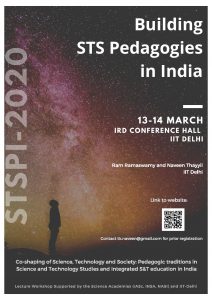
Workshop on Building STS Pedagogies in India (March 13-14, 2020)

How should undergraduate science and technology education in India evolve in order to meet the challenges of the future? There has been considerable thought in this direction in the past few decades, resulting various steps like the inclusion of humanities and social sciences in the IITs and NITs as stand-alone courses for engineering students, increase in the number of integrated undergraduate science programs in older institutions like the IITs as well as the growth of new institutions such as IISERs, NISERs, CEBS. Some other institutions such as central universities, as well as some deemed-to-be universities, have also introduced basic science/technology programmes that integrate the Bachelors and Masters degrees. A salient feature of these “integrated” programmes are an increasing strong component of humanities and social science courses in these integrated science curricula, and a second feature is that atleast some of these programmes are strongly interdisciplinary. It is in this context that we would like to propose having a two-day workshop on Science and Technology Studies (STS), focusing specifically on pedagogy.

Science and Technology Studies have been crucial in developing existing traditions of Science, Technology Society scholarship into a cogent, interdisciplinary, and broad pedagogic program within the Humanities and Social Sciences. STS traditions across the world including India have brought together philosophical, historical and sociological enquiries in science/ technology/ medicine/ health/environment to emphasize the social nature of the scientific and technological enterprises. What are the contours and methods of an appropriate STS program in India that takes these concerns, multiple sites and disciplinary approaches seriously, both inside and outside the classroom?

A two-day workshop on STS at the IIT Delhi will serve several purposes. Pedagogic exposure to STS traditions can offer (future) scientists and technologists a perspective on the ways in which technical, scientific and social phenomena interact and influence each other. Humanities faculty who teach such courses within pure sciences/technology programs therefore need to reflect on the proper pedagogic methodologies that need to be employed for the purpose. While this will make for more engaged and reflexive scientists and technologists, it can also pave the way for a more engaged program within the Humanities and Social sciences – an engaged research program that takes the social institutions of technology and the sciences more seriously in their social analyses. What models of using STS for such integration of S&T education are available for us, what challenges and opportunities do we see before us, and what gaps and resources can we identify?  And in what ways would such an exercise contribute to identifying the contours and methods of an appropriate STS program in India?

The conference website can be accessed for registration and tentative schedule.

Apolitical: To Be or Not To Be

In the last few weeks, many of my learned and eminent colleagues from the scientific and academic community have discussed their viewpoints about the topic of politics in the academic arena. They have eloquently presented many pertinent points as to why freedom of speech and thought is absolutely necessary for the progress of science. Prof. Venki Ramakrishnan, Nobel Laureate in chemistry, also expressed a similar opinion. At the same time, I also got vibes from different people about how much they are worried regarding violence happening in our academic campuses. These people are neither active members of any political party nor do they subscribe rigidly to any political ideology, left or right. They are “aam” people whose first and foremost concerns are “roti, kapda, aur makaan”, bread, butter, and shelter. They know that a sound academic base is the only survival tool for their children. As a result, they are disturbed when they see campus violence over politics. They get worried about the future of their children and out of that concern, they feel that academic spaces should be free from politics. In this article, I will try to understand and analyze their concerns.


The first question they ask is why we should do politics in universities. They argue that a student has gone there to study. So, the student should finish that, get their degree and leave. Universities are not the place for politics. Well, it is absolutely correct on the surface. But, let me ask you a different question. Academic spaces such as IITs have annual cultural festivals, sports meets, and many other events that have nothing to with their stated stream of study i.e. the purpose to “earn a degree”. These activities also demand quite a bit of engagement from the students, consuming significant person-hours. Then why don’t we object to them? Why don’t we say that you are here to get your engineering degree and not to participate in a dance club? We don’t, because we see those co-curricular activities as part of the overall holistic development of a student. If we don’t object in that instance but object only to student politics, then clearly our real objection is not about students doing other things than studies; our objection is specific to politics. Let us first admit that. We are not bothered that the students are doing “other” things; we are only bothered if they get involved in politics.


Why is this so? Either we don’t see socio-political awareness as part of a person’s overall development, or we are afraid of the potential danger associated with “dirty” politics. If your argument is the first, my question then is: what sort of a chemical engineer is one who is not aware of the politics surrounding environmental concerns or how can an electrical engineer not be aware of international energy politics? Can we consider a person’s intellect well developed if that person is not aware of different national level political ideologies or does not have any opinion regarding what is happening around them? If they are aware and touched by political developments around them, and feel strongly about a cause, can we ask them to keep their mouths shut? What sort of human is one who can’t feel or can’t express their feelings? If you want them to be aware, they will react as well. And the reaction will take the form of demonstrations, protests, writing, delivering lectures, etc. No restriction is powerful enough to suppress the voices of dissent for long.


If we come to the second argument that we are concerned about the volatility of political discourse, and hence we want to stop any political expression inside our campuses, are not we throwing out the baby with the bath water? Should we not, rather, make sure that politics inside campuses (and outside) remains civil and non-violent? Should not we replace the politics of power with politics of rights and responsibilities? Should not we teach our students how to discuss politics with rational arguments and not using brute force? If the purpose of an academic institution is to equip a person to deal with struggles in life, should not we also prepare them for civilized political discourse?


We often complain that we don’t have educated and good politicians. If we keep our institutes “apolitical”, from where will we get educated politicians? Or aware policymakers?


There are many examples in history where students and teachers led movements against war mongers, fascists and colonial oppressors. Many world-renowned academic institutions became boiling pots of anti-oppression movements. Even closer home, would we have obtained our freedom from colonial rule if students never took part in active politics?


Another argument given by the administrators (mostly driven by their own compulsions) is that as an academic body, we should remain apolitical and neutral. While I agree that the Institute as a body can (and most of the time should) remain neutral in a political debate, its members, faculty and students alike, must have the freedom to take a stand and express their views, inside or outside the campus. We should not forget that there exists a strong distinction between the institute and its members.  We also should not forget that suppressing the voices of dissent is not apolitical but essentially being aligned with the axis of power.


I’ll end this article with two quotations and in my opinion no argument is stronger than these two quotes.


“If you are neutral in situations of injustice, you have chosen the side of the oppressor. If an elephant has its foot on the tail of a mouse, and you say that you are neutral, the mouse will not appreciate your neutrality.” ― Desmond Tutu


“Justice consists not in being neutral between right and wrong, but finding out the right and upholding it, wherever found, against the wrong.” ― Theodore Roosevelt


We must remember, remaining silent is also a political statement.


Abhijit Majumder is an Associate Professor at the Department of Chemical Engineering, IIT Bombay.  The views expressed are personal.


This article is part of a Confluence series on Students and Political Protests. The remaining articles in this series can be found here.

“Dude! You not going to the rally?”

It is always hard to write an opinion when it is the most unpopular one on any forum. I am not in favor of long drawn out student protests. I am not in favor of activism, which I think is of limited use when done in the comfort of one’s institute when there are clearly more important things to be done. So, I am writing this as an opinion piece primarily based on the observations of one individual. Just to be clear, I have never been a ‘model’ student. If I ever were accused of this, it would not be the model everyone is thinking about when applied to this context. I was always told that students should be ‘good.’ This roughly translated to, “Do well as a student, then you will be successful.” The problem was that no one successful has ever said this.


On the other hand, Politics was always a dirty garment to be left untouched by ‘sensible’ people. And as a ‘sensible’ student, I left it alone. Growing up in Pune helped. In any of the hundreds of colleges and the three major universities, there is practically zero political influence. So I encountered protesting students for the first time in my life in IISER-Pune last year. And my first reaction, to be candid, was “OK,” followed by a shrug of my shoulders.


Student protests are not new or unique to India. Indeed some of the significant changes in human history have been brought about by students leading the change. But, this is where the cynic that lives in the real world comes alive. For me, any kind of social reform was always broken up into two main types. Either someone was really desperate for a change and willing to do anything for it. Or, someone was really desperate to gain any kind of mileage from fostering the protest.


Situations like Tiananmen Square and the Velvet March in Soviet Russia are clearly cases of the first kind where people had had enough. I would like to point out that this was in the absence of any ‘Social Media’ (or as I prefer to think of it, community S & M). In today’s world, students get access to a world of information at a very young age, which is wonderful. And this is where the second category of fostering protests is made possible.


Students are on social media; why would they not be! It is the best place to be when you are young and want to be noticed! For whatever reason, for or against, true or false, students protested against police brutality in JMU. Based on information that was spread by social media. Then it slowly came to light that the original miscreants may not be students of JMU but just hid inside it. What the police did was vile, but then all the student protesters saw was the reaction and not the original action. Is student opinion so readily convertible that not one of the protesters took a deep breath and tried to sort the facts? Maybe they did. I do not know.


My only problem is this. Students protested, they held a lot of rallies, made a massive splash of opinions in the public mind. But, all I see as an outcome, is intelligentsia on social media reaching new heights of pedagogy.


And nothing else.


Would there be a new level of informed opinion among students? Or is this just another of those trends that come and goes?  That remains to be seen.

If a change happens, it is terrific! But to assume that it happens just by protesting the way things have been going on is foolish. Or worse, to assume that without protesting, it won’t happen is equally inane. All I see when I look at the ‘coverage’ of the protests is a cachet of ‘coolness’ or ‘being woke’ attached to this. In other words, ‘Selfies of holding placards get likes.’
Students can be shamed into joining protests by saying things like the title of this post. I don’t know how often it happens, but to assume that it doesn’t is just narrow-minded. I would like to believe that all of those who protest are genuinely doing it for their cause, but knowing how human beings are, I find that hard to accept.


Of course, that is true for any protest or public endeavor, but I think for students, it is especially important to think about this. Don’t’ get me wrong. I will love it if a generation learns to question any government. But, I would hate it that same generation is doing absolutely nothing else.


To do anything else, one needs to study in their chosen field of endeavor. When one is a student, get better at what you want to do.  Then, there is the practical side of protests as well. Protests consume resources. Not money necessarily, but energy and time. Students may not know that both are limited and that as they grow out of being students, the demands on both are going to be more intense than they could have believed possible.


If one has a goal to achieve, it is logical that all the energy and time one can spare is invested in it. I am NOT saying a student should only aim at academic excellence. What I am saying is that a student should aim at figuring out what their goal is while they are a student. If the two statements seem contradictory, then it is because one just does not accept the fact that there is a whole world of enterprise outside of protests. If some student does not include social conditions into their sphere of enterprise, it should be perfectly acceptable. But it is seen as a sign of selfishness to even voice an opinion like mine and that is a just sad.


Studenthood is the best time of life to explore but exploration should be without peer pressure. Protests, in this case, can be a distraction, something you did because it felt nice at that time, or were goaded into, but then, later on, you moved to other things.
I happen to be a taxpayer, who pays in some small part for the scholarships and salaries of the student and staff in central government funded research institutes. I would like my investment to bear fruit in the form of brilliant young minds taking on real problems of the universe. Not churning out brainwashed, hair-triggered, activism-hyped, pseudo-self-aware drones. However, intelligent they are, drones are still drones.


Just as the quintessential ‘good’ student models we had in the last two decades are drones, these new ones, who live on the very edge of skepticism and are ingrained with radical activism, are of limited use to a healthy society. With the current way, where protests are treated like some kind of hallowed practice, and it is a genuine possibility that it becomes a fashion. This would kill the meaning of demonstrations. Or probably already has!

A student, especially one of science, would be lost in the wonder of the natural world. As a former science student and then researcher, I find it impossible for this not to be the case. This, for me, was the single most beautiful thing about being a student, not marred by anything else. In that case, in my head, there was no space for anything else. Students who feel this way may not bother about anything else, in my opinion.


While it is perfectly OK to get angry and then give voice to that emotion, it is equally silly to rate that as ‘the most’ significant contribution of one’s life when one is a student. A lot more is undoubtedly going to happen. And most importantly, opinions change. When one is in protest mode, one is seldom ready to listen to an argument and go out of protest mode. So one needs to be careful in entering this state of mind. For students, this is easy to slip into and then may not be the best outcome.


Among the student community in research institutes, a sense of moral superiority in the fact that one is protesting could easily arise and in my opinion does arise. This is sheer nonsense. Protests are held for change, not so that you can look good in a photo and then reminisce about it twenty years later. Or make cool sounding noises when you pass each other in the halls.


I feel that those who see the idealized outcome of students protesting changing the world, often forget that protesters are also human beings. Often young human beings. A set of morals and rights may not drive them for the rest of their lives as the pro-protest lobby believes. In this case, they are just wasting their own and everyone’s time.  All of the above, of course, is when the second type of social reform, the one that is fueled by political motivation rather than a rational expectation of change, is the case. Which currently in India, I think is.


And now the other side of the coin, the staff. The taxpayer argument applies to them more intensely. If they are spending their energy protesting, then who is doing the research/education they are supposed to be undertaking? Protesting is definitely not doing cognitive neuroscience. Nitpickers would say, “I only did that on weekends” but that is a specious argument.  If some reader responds to my statement above by saying that just because I am a taxpayer, I don’t own them. I would remind them of this opinion whenever they are complaining about any government servant/agency which is taking too long to do something. The next time one complains that the granting agency is taking too long to process their applications, I would gently remind them of the fact that none of the government servants are owned by the applicant so they should respectfully shut up.


The government funds research, for better or for worse. Then if protests are the mainstay of one’s career, then one should not be in the career of academia. This does not mean one bows to the government at its every beck and call. But there is an accountability to be had in terms of training young minds. Somehow most academicians in India believe that they should be judged by a different set of standards than almost any other government enterprise. But this is a fallacy.


Academicians like to make cliques (one cannot think of a reason why seeing as to how rational they are), but this can be and most probably is, another criterion for inclusion or exclusion from one — your political views.  In my (obviously limited) experience of Indian Academia, a scientist who wears the Rudraksha is likely to be taken less seriously because of his overt expression of belief in being a Hindu. As opposed to another who is an atheist and is schooled in the whole ‘left-liberal’ ideology. I am not saying one is better. I am just saying that it should not matter.  But it does. If political protests are a measure of one’s civic duty or citizen’s rights or something equally righteous, the ‘contribution’ of a person engaged in academic research is not only measured by their quality of work but by their political views. And this is just stupid.


Protests are not a problem by themselves. Making protests into something special is a genuine problem. It may seem I am trivializing protests, but in reality I am trivializing the cachet of ‘something necessary to being a ‘good’ student’ being attached to protesting. This post is an opinion for all practical purposes. I do not have objective data about whether students think protests are cool or not etc. but I believe most do.


So asking someone, “Dude! you are not coming to the rally?”, with a shocked face, is unfair. It is the same as asking someone, “Dude! You gay?” with the same shocked face. Students are easily impressionable and once convinced of something capable of performing great feats for it. When students are led to protests, the sources should be held responsible as well. In our country, this has not happened, and then the sad events of JMU occur.


Ashwin Kelkar is an ex-Wellcome Trust fellow at IISER Pune, currently an entrepreneur and a hopeful scientist. Not a liberal in the usual sense of the word. The views expressed are personal.


This article is part of a Confluence series on Students and Political Protests. The remaining articles in this series can be found here.

Bhagat Singh on Students and Politics

We are going through a huge political and social turmoil these days and students from diverse universities are up in arms to defend our constitutional values under attack. The involvement of students, for many of us, is neither surprising nor anything new. The youth have a future to look up to and they have always defended it whenever they perceived any threat. These student protests have often faced state repression. Historically, nationalism had been a convenient tool for all the fascist governments globally, at least from the nineteenth century onwards.


We often hear these days that students need to shun politics; the universities are not meant for political mobilization/protest as the students imperil their future by such wasteful indulgence. Most of those who say this are themselves products of the student movements, so this amnesia is clearly motivated by political expediency. Many in the ruling party today and also among its allies, are the erstwhile student leaders of the JP movement. Can’t even start naming them as the list is really huge.

They are also oblivious of the fact that many nationalist icons that they love to venerate, like Bhagat Singh for example, were students themselves who began their revolutionary careers from their colleges. The colonial government used similar arguments to curb their right to protest in the 1920s/30s.  Let us delve a little more into Bhagat Singh’s emphasis on the role of students in politics.


Bhagat Singh joined DAV College, Lahore after his father Sardar Kishan Singh moved to the city from his village Banga. Bhagat Singh was a politically aware child, being born in a family of committed nationalists. His uncle Ajit Singh was involved with the peasantry, founded the Bharat Mata Society and spent most of his life in exile, fighting against imperialism. His other uncle Swaran Singh spent many years in prison and died young due to tuberculosis. Bhagat Singh’s father was an active Congressman who also spent time in British jail. Given this background, Bhagat Singh evolved as a political being early in his life and thus participation in anti-colonial struggle came to him naturally.


In 1928 Bhagat Singh wrote an article ‘Students and Politics’ in response to some suggestions that students should keep away from politics. He says “We concede that the basic duty of the students is to study, so he should not let his attention waver in that regard. But is it not part of the education that the youth should know what the conditions are in their country and be enabled to think of solutions for their improvement?” And Bhagat Singh did not prescribe this only for the struggle against British imperialism but any situation where exploitation is palpable. In an explicit message from prison, just a few days before his martyrdom in 1931 he exhorted the youth to continue their struggle, even if their exploiters were purely Indian. He wrote: “…the struggle in India would continue so long as a handful of exploiters go on exploiting the labour of the common people for their own ends. It matters little whether these exploiters are purely British capitalists, or British and Indians in alliance, or even purely Indians.” So he was clear that the students and the youth in general have to be in the vanguard of all struggles, even if the British are gone and Indians are in command.


In 1926, Bhagat Singh and his comrades founded Naujawan Bharat Sabha, a platform from where an overt campaign was possible amongst the students and the youth. The colonial government didn’t allow many student unions to exist so the Sabha used to be the student’s platform in Punjab, Western UP and Rajasthan during the 1920s and early 30s. All those who want to revere him merely as a martyr need to follow his vision and track his political profile as a student leader and later as an iconic young revolutionary. They also need to remember that the Naujawan Bharat Sabha admitted members who committed themselves to secularism and kept the interests of the country above those of the community. The revolutionary ideas Sabha espoused, the ideas of freedom, equality and economic emancipation stirred the youth to an unprecedented degree. It’s activities led to the founding of youth leagues and Student Unions in several towns throughout India.


Bhagat Singh’s Naujawan Bharat Sabha influenced the students of D. A. V College, Lahore to an extent that the government was chary of recruiting youth educated there. Many students were found to be instilled with a revolutionary spirit, undaunted by state repression, leading to even the ruining of many careers. Mindful of the possibility that it would ruin their careers, the students participated enthusiastically in the activities of Naujawan Bharat Sabha.


In the context of the ongoing communalization of our polity and life in general, we need to recall that the students under Bhagat Singh’s leadership confronted bitter sectarian politics in the 1920s and 30s as well. They devised a concerted plan to counter it, including the slogans they used. The Naujawan Bharat Sabha took a categorical position on the slogans rejecting the common ones used by the Congress like “Allaho Akbar,” “Sat Sri Akal” and “Vande Mataram,” which were used to project unity in diversity. Bhagat Singh, however, saw them as divisive, as they made Indians conscious of their religious identities. Instead, they raised two slogans: “Inquilab Zindabad” and “Hindustan Zindabad,” hailing the revolution and the country. All those who insist on slogans of their choice today and want to impose them on all as the ultimate test of nationalism should care to comprehend the diversity and variety of slogans we have used during our freedom struggle.


The students/youth fought for freedom, democracy and secular values during the freedom struggle. They defended these values even after independence, whenever they perceived any threat like they did against the imposition of emergency in 1975. Bhagat Singh and the political values he bequeathed, should be the guiding spirit for students and the youth today. It is an opportune moment to rebuild an India Bhagat Singh aspired for.


Syed Irfan Habib is an Indian historian of science and was the former Abul Kalam Azad Chair at the National Institute of Educational Planning and Administration. The views expressed are personal.


This article is part of a Confluence series on Students and Political Protests. The remaining articles in this series can be found here.

Campuses must be free and fair for all

Recent events have resulted in a lively debate on the place of student politics in modern India. Let me summarize my views in five simple points.


1. Students on campuses of public universities have an inalienable right to freely express themselves on all matters, including politics.

This derives from their fundamental rights as citizens of India. A thriving democracy such as ours cannot afford anything else.


2. Disruption of academic activities for political expression is unacceptable

Too often, there are suggestions to confer some kind of elevated moral standing to student politics. This is insulting both to students and to other citizens of India. This is because fundamental rights by their very definition apply to every citizen and no one citizen can claim that their fundamental rights are morally superior to that of another.


Simply put, this means that classes, examinations and research activity cannot be disrupted, nor rescheduled in any way due to ongoing political activity. For instance, an examination boycott should lead to an uncompromising zero for every student who refuses to show up. Any case of physical violence, littering of campus, preventing others from going about their work, no matter how small, should be dealt with as per law.


This uncompromising attitude is important because student politics can pose serious threats to academic standards. For instance, one of the first moves made by Mulayam Singh Yadav after becoming Chief Minister of Uttar Pradesh in 1993 was to repeal the Anti-Copying Law passed by the previous government. A section of students rejoiced and the percentage of candidates passing exams jumped by almost 20 percent that year (see here and here). Such politics can only be seen as unfortunate and damaging for the future of the nation.


3. What happens when it is not clear whether the campus is actually a public university?

This is where it gets really topical in the context of recent anti-CAA protests and anti-CAA riots that have happened in many parts of the country.


Some of the most vocal protests were held at campuses whose “public university status” seems confusing at the very least. While these universities are publicly funded, many of them also have the status of “minority institution”. At first glance, it is not clear whether this is constitutional.


For instance, the Supreme Court ruled in the 1960s that Aligarh Muslim University is not a minority institution. An act of Parliament in 1981 restored the minority status of the university. This provision of the act was later declared unconstitutional by the Allahabad High Court in the 2000s. As of now, the matter appears to be sub judice.


In the meanwhile, what principles apply when it is not clear whether the campus is a public university at all? Due to my limited legal knowledge, I am unable to comment.


4. There is a compelling public interest in making sure that students of all backgrounds are heard

As with any other form of political activity in India, there is a real danger of a vocal and/or powerful minority usurping a space where all voices must be free. In order to avoid this, the Lok Sabha and Assemblies of states and union territories have provided reservations for disadvantaged castes and tribal groups. At the level of local self-governance, one-third of offices have also been reserved for women in Panchayati Raj institutions.


I believe that campuses should seriously consider extending the same principles to student organizations. People might remember the case of one student politician at a renowned university in Delhi who had exposed himself before a woman in a threatening and lewd manner. It is obvious that such behavior would be enabled by a sense of power in campus politics. The same person went on to win national adulation as a student leader. His fame would have emboldened many other potential predators among student political activists everywhere. This is just one example of how campus politics can create an intimidating atmosphere for members of certain sections. Unless everyone feels welcome, we cannot have a thriving democratic culture.


In the case of CAA, a large number of potential beneficiaries of the new law would be from disadvantaged castes. For instance, it is estimated that as much as 80 percent of the Pakistani Hindu population could be Dalits. As such, it is particularly important that campuses ensure that students of all backgrounds are heard.


5. Some amount of precautionary security measures might be needed on particularly sensitive campuses with a history of violence

As with most things about India, we have to strike a balance. On a case by case basis, it should be up to administrators to judge the potential for harm and curtail some student political activity if necessary. This applies especially to campuses with a history of violence.


In fact, a 2019 report by Retd. High Court Justice P K Shamsuddin found that many colleges in Kerala have torture rooms, where dissenters are forced to comply with student unions, often the CPI(M) affiliated Students’ Federation of India (SFI).


Another disturbing example is that of a nationally renowned university in Bengal where a Vice Chancellor had been murdered on campus by members of a certain political persuasion. On a campus such as that, it would be understandable if the administrators put some curbs on political activity as a precautionary measure. We cannot judge them.


Abhishek Banerjee is a faculty member of the department of Mathematics at the Indian Institute of Science, Bengaluru. The above views were written in a strictly personal capacity. The writer also wishes to emphasize that he is not a legal expert and has talked about law and constitution on a best effort basis.


This article is part of a Confluence series on Students and Political Protests. The remaining articles in this series can be found here.

Science, Galileo and Student Protests

Protest is an extraordinary act in extraordinary times. It cannot be judged from the perspective of everyday norms that hold under normal circumstances. But we must understand its place in the broader spectrum of social engagement that we deem constructive and congenial. Political protest by students – most often those at colleges, universities, and similar institutes of higher learning – should be viewed through this prism, and we must ask whether it forms a desirable, perhaps even essential, part of their education, and a fulfillment of their social role.  An affirmative answer entails further questions concerning how educational institutions and society must view and respond to political protest by students.


To state my view at the outset, political protest by students concerning significant social issues is a natural corollary of their ethical and political awareness, and is a part of the self-correcting process that democratic societies see as an essential element of their constitution. But political awareness and protest among students is special, in comparison with that of the broader population. By some tokens more precious, it is also poses particular questions and challenges for us to grapple with. It should to be nurtured, suitably guided and circumscribed by principles of civil conduct, and not discouraged. There is a grand tradition to look back upon for support, from the Indian national struggle to anti-war protests, peace and social justice movements world-wide. But rather than dwelling on these examples, I will try to present a line of thinking in support of the view that I have stated.


Being a student at a university or an institution of higher learning is an exhilarating phase in the life of those fortunate enough to have the opportunity. As young adults, it is the time when students develop a sense of themselves, who they want to be, what their aspirations are for themselves, and for the societies they live in. Not many would dispute, I trust, that a mature world view that includes an awareness of social and political realities and institutions is a central part of the students’ development in this phase. Yet, even in very good educational institutions – this is true particularly of many technical and professional degree programmes —   students can go through their schooling without burdening their minds with anything other than the courses they study, the examinations they take, and the theses they have to write, in order to graduate and to have the CVs to testify to their eligibility for the careers they wish to pursue. If students were merely to do so, we can ask, will they emerge as well-rounded persons, with a balanced comprehension of the world, fully equipped to play the diverse roles we would wish them to play, and to discharge all the responsibilities we would wish to have them undertake? The most blinkered of visions of modern education would acknowledge as among its goals the preparation of students to be good citizens.  Minimally, in democratic societies, education should enable them with awareness and sound judgment to participate responsibly in the electoral process. A view that in order to be conducive to learning, a university should be a socially disengaged space, a cloister or an ashrama, does not conform to a modern view of education. Nor does an infantalizing expectation that students should not concern themselves with matters beyond their curricula.  Although I emphasize political awareness and participation to be concrete, an ethical awareness is indeed both overarching in importance, and is essentially a part of political and social awareness as I am discussing them. If the mandatory requirements of educational programmes do not address these aspects of a student’s development, how else do we enable it? Is it the role of educational institutions to cater to this aspect?  Answers to the latter question may vary, but in my view, it is very much part of the responsibility of institutions of higher education to enable the development of an ethical and political consciousness. We understand, in practice, that various activities associated with college and university life — general lectures, reading, debates, societies, participation in student organizations, etc. – cater to the overall development of students’ views and abilities. This is an acceptable, if not necessarily ideal, solution. Indeed, many good institutions do provide platforms for these activities, but opinions vary on how essential they are. If one accepts a broader view of education, however, these activities must be understood as integral to  what educational institutions must facilitate, and at a minimum, allow.


But these extra-curricular activities that may contribute to social and political awareness may not necessarily be seen to include protest. Should they? Isn’t reading newspapers and books, attending talks, and browsing the web adequate for developing a healthy awareness? Why should students take part in protests? To answer this, we must first ask under what conditions protest can be seen as a legitimate act in general. Broadly, there are two situations to consider. The first is when we are faced with events that have occurred which are not tolerable. In such a situation, even if there is general agreement that such an event is not acceptable, what may be in question is the urgency and earnestness with which governance and legal measures are pursued. An expression of outrage and a demand for justice is often a necessary prod for action, an appeal to individual and institutional sense of duty and diligence.  A second situation is when actions or decisions are willfully taken by the authorities – governments, administrations – that are seen to violate fundamental principles, one’s understanding of general welfare, etc, even when the same authorities may claim fulfillment of due process. An expression of disagreement, an appeal for re-examination, to conscience, then becomes warranted.  Protest, as a broad term, may then take multiple forms – public debate, appeals, petitions, protest gatherings, disobedience, etc – and which form is appropriate depends very much on how responsive the relevant institutions are.


It is important to be clear about what place such protests occupy in properly judging their desirability. We must keep in mind that no institution entertains disagreement and negation as a basic ingredient of how it is conceived and how it functions. Educational institutions by and large are not an exception to this. Institutions are designed to meet specific purposes. Their members are expected to understand their roles and function within the established framework. Protest has no place in this idealised picture, and many conservative skeptical views of dissent and protest arises simply from the assumption of good faith and good design, which we are expected to trust and obey. But, to state the obvious, human institutions are not perfect.  The gamut of concrete situations that may arise are impossible to imagine and address in advance.  Society and its collective view of what is desirable evolves and changes, as we endlessly grapple with fundamental existential and ethical ambiguities. A static view of common well-being and purpose is not tenable. Disagreement and protest are among the instruments of correction and change, and however messy and inconvenient, enlightened institutions tolerate them. And tolerate they must. As Yudhisthira asserts, pithy and eloquent, in answer to the Yaksha’s question “what is the path?”  in the celebrated episode of Yakshaprashna in the Mahabharata, “Arguments are inconclusive; the scriptures hold varied views; there isn’t a rishi whose words can be taken as pramana, and the truth about dharma is hidden in the cave”. His conclusion, that “the path trod by great ones is the true path” is enigmatic inasmuch as it is circular, but indeed, one must ever contemplate the path trodden by the great souls that have come before us. And we should not be surprised if we find the engagement with the world and society of many great souls, from Nachiketa to Gandhi,  was marked by questioning and conscientious disobedience.


Some institutions do indeed embody questioning and disagreement with authority in their essence, and thrive. Scientific investigation, as an example of a broader range of intellectual inquiry and creative endeavour, privileges questioning of received wisdom as its animating trait. It is cliché in this context that progress emerges from questioning past thinking, and formulating arguments and evidence that may constitute developing and going beyond received wisdom. We teach our students to take this spirit to heart and practice it. We also teach them about their responsibilities – scientific ethics, rigor of argumentation and evidence – and we should. But we are clear about the fundamental fact – responsibilities are there to guide us along a constructive path, but the driving force is free thinking and expression. Human and political affairs are more ticklish, the rules for what we must accept as given and as conventions are more arbitrary, but surely, there is an essential place for fresh thinking, taking a position, stating one’s opposition, and protesting, even in this realm. If nothing else, there is no better motivation for clear and honest thinking than a felt need to disagree with a received position.


Beyond these general thoughts, there are considerations that are special to thinking about students that are paramount. The first is to be fully cognizant of the fact that students are, indeed, learning to learn — in their classroom learning, in how they investigate, create, and in how they conduct themselves in diverse situations including those of protest. They do need instruction and guidance, but not of the kind that will suffocate. Vandalism and violence are not tolerable, but peaceful forms of expression and protest should not be unduly constrained. Being a student is a period of passage and it should be so treated. The second is to take to heart the idea that the freshness of perspective, the more intimate involvement with ideas and idealism not burdened yet with the demands of real life, can lead the student population to possibilities and approaches that may escape the jaded and encumbered senses of older adults. In this sense, students can be teachers, and teachers, and the society at large should be receptive to learning from a vocal student population. Students can be conscience keepers, who prompt us to look beyond the narrow confines of what our imagination has become in the process of accommodating the realities, dull or harsh, of our adult lives. Silent, obedient students, even if aware, will not fulfill this role. The third consideration is one of what we owe, in terms of voice and freedom of action, to those that literally represent the future. A concern for what we leave behind for future generations is a powerful and visceral force that drives our actions. The most immediate of concerns in this regard has to be what we allow them to be, and to become.


Yet, all these considerations may not address a brass tacks worry: Isn’t it best for students to focus on their chosen field of study, and become as good as they can be at it? Isn’t everything else a distraction? These are not trivial questions. Those of us engaged with research, teaching, and various other forms of scholarship and creativity, are painfully aware of the frequent need for total immersion, in order to reach an intellectually satisfactory engagement. But, does real life – even normal, everyday life — permit us to be so immersed and detached from our surroundings? The answer is a clear no, but we learn, as adults, to apportion our attention to what we deem important, according to their merits. In a good life, its different dimensions sustain and not intrude upon, each other, but sadly, not always. In thinking about this, I am reminded of a poignant scene from Bertolt Brecht’s play “The life of Galileo”. After Galileo has recanted his teachings under pressure from the Church, a former pupil exclaims in disappointment “Unhappy the land that has no heroes”. Galileo responds, “No. Unhappy is the land that is in need of heroes”.  In times of unhappiness among some about student protests, we must deeply ponder what we really ought to be unhappy about.


Srikanth Sastry is a Professor at the Jawaharlal Nehru Centre for Advanced Scientific Research, Bengaluru. The views expressed are personal.


This article is part of a Confluence series on Students and Political Protests. The remaining articles in this series can be found here.

Disturbing your peace

One of the themes of Mishima’s The Sailor who fell from Grace with the Sea is that there is a natural order in the world, and when that is disturbed, actions must be taken to restore that order. This is a simplistic summary of course, but one that is in keeping with a view (that is prevalent in some sections of society) of our universities today – students should study, teachers should teach, administrative instructions should be followed, and all will then be well with this world.


The consequences of such a simple world view – which then asserts that students should not participate in protests, even if they are peaceful – is that it poses a ridiculous binary: good students would attend classes, and bad students are out there protesting. One of the things this view does not factor in, is that for all to be truly well with the world, many others have to do their bit too. One of the great advantages of an education – any education – is that it forces one to think. and free thought can have unintended consequences. Especially at a university, it is dangerous to infantilize students.


We carry within us so  many different identities – our language, religion, class, caste, politics, and is simplistic to assume that one can overshadow others.  In The Idea of Justice [1] Amartya Sen eloquently alerted us to the dangers of a solitarist view of humankind saying “The increasing tendency towards seeing people in terms of one dominant identity is not only an imposition of an external and arbitrary priority, but also the denial of an important liberty of a person who can decide on their respective loyalties to different groups (to all of which he or she belongs).”


For those that are fortunate enough to have access to higher education, it is a commonplace that the period of young adulthood largely overlaps with the period of university education. It is almost inevitable, therefore, that students would participate in all activities that impact their future, be it the more mundane aspect of classroom learning or the more public role of speaking out against policies and actions that have more long-term implications.


This set of essays in Confluence addresses contemporary events, of course, but also in historical context. Student uprisings have been a constant feature of public life over the last several decades, going back several centuries even. Anybody who has taught at a University knows that the best students are the ones who are capable of independent thought and articulation. Students can obviously concentrate on their studies as well as take part in political issues– and can do them both well as recent events can testify. It is not always given that the political events of one’s times will be of great magnitude, but if – as in 1968 or now – they are, then it is inevitable that strong voices will be heard from academia. Universities have played such important parts in various political events in our country – the language agitation of the mid 1960’s, the protests against the Emergency, the agitation against the Mandal Commission Report, to name a few. And outside India, there is Paris 1968 though one does not have to go far either in distance or in time, given the agitations that have been rocking Hong Kong and Santiago over the past few months, to see the important role of students in public protests worldwide.


The agitations and protests in our country today are centered around two different issues. One is a discussion of the Constitution of India, its scope, ambit and its meaning, and the repeated attempts to trivialize the issue. The second is the siege on all bastions of higher education, crystallized as it were on the Kristallnacht of  5 January, 2020 when imported violence erupted on the campus of the Jawaharlal Nehru University.


Who else would speak against such violence on our campuses? This may be an issue for society at large, but beset as we are with our own niche worries, it stands to reason that the most affected parties should be the loudest in speaking up. Not surprisingly, therefore, students all across the country and indeed across the world have spontaneously and publicly condemned the violence, underscoring the feeling of vulnerability that all students feel at this time but at the same time reflecting the fearlessness of youth and their willingness to risk much for their future by the simple act of speaking out.


Confrontation with the state is always expensive, and students in our central universities are today paying the price for this. Given that our universities are funded by the government (central or state) the university administration can appear as an extension of the state itself, the autonomy of our temples of learning being more an idea than the reality. There is a surreal atmosphere though, as each of the different groups of players seems to be acting in isolation even when their actions are linked. As remarked by Jayati Ghosh in an article in Times Higher Education, Indian higher education is now withering on the vine.


Campus agitations (and now campus violence) are a consequence of the breakdown of communications between the administration and the student body, not the cause. Especially after  months of a lack of communication, patience can wear thin. When one hears the different sides of the story, it can seem like a contemporary re-enactment of Rashomon, and a slightly fantastic one at that.


There is a upside to all this too. Protests that arise on the campus have a way of sharpening an observer’s logic. Seeing and hearing students argue and debate issues, the freshness of the minds, the passion that they bring to the argument, the earnestness with which debates are carried out. A simple “How dare you”, voiced by a teenager, bringing anguish and outrage together on the issue of climate change, can hone the discussion in a way that more refined protests do not. Personal experience apart, every academic administrator of any standing can recall that one moment when a protesting student made a clinching argument that helped to change their point of view. It does not take much more than the willingness of the administration to learn, to concede that they are not infallible or omniscient. But minds have to be open, and ears have to be willing to hear.


The other issue is a larger one, and those that have been protesting in the recent past and – uniquely on a Constitutional matter –  are speaking not just for themselves as students but as members of society, as citizens. They speak for their families, their communities and those related to them by the extended kinship of schools of thought. And this is a consequence of the multiple identities that they carry. Regardless of where one stands on the issues per se, it goes without saying that all of us should have the freedom to express ourselves without fear.


But to speak of now,  there is something unique happening at this time, something unexpected and something that should fill one with hope. Across the country, in addition to the  student uprisings, there have been quiet and brave expressions of dissent by people of different social groups, of different age groups, and of different histories. The events of the recent past impact each one of us in different ways and in different ways we all are finding the courage to express ourselves and not always in agreement. A democracy is ultimately about its people, and what should triumph in the end is their will. As Faiz says in Hum Dekhenge


Aur raaj karegi Khalq-e-Khuda

Jo Main Bhi Hoon, Aur Tum Bhi Ho.

Loosely translated (“And then God’s creation – we the people – will rule, both you and I.”)


If the young voices raised publicly make us think and see these issues in fresh light, they will have served a part of their purpose.


References

[1] Amartya Sen, The Idea of Justice (Penguin, 2010).


Ram Ramaswamy is the ex-President of Indian Academy of Sciences, Bengaluru and is currently associated with IIT Delhi. The views expressed here are his own.


This article is part of a Confluence series on Students and Political Protests. The remaining articles in this series can be found here.

Science and Scientists: Portrayals in Tamil Cinema

Cinema is one of the most radical scientific inventions of late nineteenth century though it does lie outside formal academic institutions of science. The little known Lumiere Brothers in Paris could steal a march on the self-styled inventor and an American emblem of enterprise, Thomas Alva Edison, to take credit for actualizing moving images on screen that came to acquire the name “cinema” in most parts of the world. In the course of the multi local race to the invention of moving images, it was not clear what would be the purposes of making moving images possible on screen. It was an advancement over photography in recording events. It could be a source of amusement. However, it was also promoted as an instrument of science to help study phenomena. Finally, its most celebrated purpose was to become another addition to the art of story-telling and creative vocation. One of the persons who bought the camera-projector machine from Lumiere Brothers, Georges Melies, was also a magician who used cinematography as an extension of the magical to narrate fantastic stories on screen. In such a function, it became the cornerstone of popular culture that would reach out to the masses all over the world. When film production came to India and Tamil Nadu, the urge was to see Gods walk on the screen. Even if it were the actors who did the walking in front of camera, the realization of movement on screen from the frozen images on the film strip had a touch of magic to it that it appeared aligned to the super natural. Hence, mythological films and devotional films in which Gods appeared formed essential part of early cinema in following the direction Milies took.  The first Tamil silent film was Keechaga Vatham narrating a story from Mahabharata.


However, in due course of time, cinema in Tamil Nadu had to confront social realities as well as its own self-realization as scientific invention by reflecting on science and technology. Science, particularly in the field of medicine was highly regarded as boon to humanity. However, Faustus syndrome, that scientists go for knowledge for the sake of knowledge, extinguishing the “soul” in the process, which could be dangerous for humanity, was also an idea that would often rear its head. While both science-philia and science-phobia could be seen in many films as an element of the main narration or that of comic sub plot, the basic line is while science is good, men, the scientists could often deploy science for destructive purposes out of greed or self-aggrandizement. In fact, this has rather been a persistent theme. We need to take a brief note of three important films in the history of Tamil cinema to see how this conundrum of science is played out. The first film is the offbeat experiment Andha Naal (1952) directed by S.Balachandar that was critically acclaimed, the second a box office extravaganza, Ulagam Sutrum Valiban (1972) featuring  M.G.Ramachandran and the third, another national block buster, Enthiran/Robot (2012) directed by  Shankar. In all these three, what should have been a scientific advancement in the interest of humanity turns out to be a force of destruction.


Andhaa Naal was one of the early films of Sivaji Ganesan who plays the role of radio engineer Rajan. Rajan, a man consumed by passion for science, was killed one day, early in the morning. The film develops into a whodunit plot with a detective forming a hypothesis on the basis of flashback accounts rendered by four suspects. The real culprit is, however, the unsuspected soft-spoken and genteel wife of Rajan. It is in her account of what happened that the unbridled passion for mastering nature through science comes to be seen as self-aggrandizement at the cost of others. Rajan and his wife Usha were in college together. Usha was involved in the freedom struggle. When students wanted to cancel classes due to a call for protest on behalf of freedom fighters, a debate was organized. Usha advocated the need for students to support the nationalist cause. Rajan dissuades her saying education, knowledge and advancement are far more important to humanity than such political strife as the independence struggle. Rajan hails from a humble background; his passion for studies is not lost on Usha, though she feels it necessary to be part of the struggle for independence. This difference does not come in the way of their attraction to each other that blossoms into love. Usha’s father tries to mobilize support for Rajan’s aspirations in scientific research. However, Rajan does not get the support in the scale in which he needs it. Being disgruntled about the apathy of his fellow nationals, Rajan, an expert in communication, establishes contact with the Japanese through the use of radio and begins to spy for them. He places his hopes on a Japanese conquest  of India as the Japanese had promised him full support for his research. As he was about to leave to join the Japanese forces after guiding them to bomb Chennai and several dams in South India, Usha finds out his design. In the scuffle to stop him from proceeding with his plans, the revolver held by her accidentally fires, killing Rajan.


Andha Naal is fascinating in the complex relationship it seeks to establish between the ethical priorities of national life and scientific advancement. While there should be no conflict between the two as both are invested in betterment of the life of the people, Gandhian priorities of ensuring life attuned with nature appear to come in the way of a greedy conquest of nature by science and technology. It is this philosophical difference between the paradigms of “attunement with” vis-à-vis “mastery of nature”, fleetingly mentioned in the arguments between Usha and Rajan, that leads Rajan to align with Japanese conquest by betraying the nation. Being a Gandhian, Usha does not kill him; it is Rajan who tries to wrench the revolver from Usha’s hands who inadvertently pulls the trigger to have himself shot. Such is the manipulative side of science and technology that leads to self-destruction as per the film.


A similar theme of science as both a boon and a curse returns with a sensational hit film of a mature M.G.Ramachandran in Ulagam Sutram Valiban (An Young Man who Travelled Around the World). The matinee idol played a double role in the film, as brothers. The elder brother Murugan is a scientist, and Raju, hero of the film, is his younger brother. In the opening sequence of the film, Murugan succeeds in a radical invention of harnessing the energy produced by lightening in some contraption that can be placed in a capsule. When released, it produces tremendous energy like a powerful bomb. When he shares the information with his fellow scientists, they turn greedy and villainous wanting to appropriate it as a weapon for purposes of war and destruction instead of employing it for constructive purposes. Murugan who had anticipated such greedy usurping had separated the formulae required to make this energy capsule/bomb into three parts, sequestering them in three different secret locations in the world, mainly East Asia, namely, Singapore, Thailand and Japan. The younger brother is assigned with the task of recovering them before the villains do. Given his heroic abilities, Raju not only manages to do this but also secures the release of Murugan held captive by the villains. The  film was a mass entertainer, shot on exquisite foreign locales including the world fair Expo 70 held in Osaka with the theme of “Progress and Harmony for Mankind”, adequately interspersed with romantic interludes and long fight sequences. However, the film did succeed in making the uneducated or rather illiterate masses reckon with the possibility of science as something that can place great potential in the hands of humanity which may be used creatively or destructively.


Released three decades later, Shankar’s Enthiran/ Robot that ran to packed houses all over India, returned to the same theme with a fantastic breakthrough in robotics, a robot with infinite capacity for memory-action synthesis created by the scientist Vaseegaran, played by super star Rajnikanth. The scientist spends all his youth to create the neural circuit required to create the superhuman robot. The purpose was to use the robot in the defense of the nation and save hundreds of human lives, as the robot can achieve what  a thousand soldiers can do. However, the villainous colleague of Vaseegaran points out that the robot could easily be manipulated as it simply obeys command rather than discriminate between them. Thus challenged, Vaseegaran works to create in Chitti, the robot that looks exactly like him, human feelings. Alas, this ability to feel results in the robot Chitti falling in love with Vaseegaran’s girl friend Sana. Having fallen in love, Chitti refuses to fight in the audition with defense authorities who laugh at Vaseegaran for the strange outcome his breakthrough had produced. In total frustration at the impossible transgression the robot attempts, Vaseegaran dismantles the robot throwing the scrap away. This however gets picked up by the rival scientist, who then empowers the robot with destructive abilities to be sold to foreign mercenaries. Now fully empowered with independent thought, ruthlessness and single-minded pursuit of union with Sana, the robot creates thousands of replicas of itself, creating a well-guarded autonomous zone of rule into which it kidnaps Sana. How Vaseegaran manages to break through into the miniature kingdom run by his look alike robots controlled by Chitti, rescues Sana in a spell binding show down with the robot army and finally dismantles Chitti is the rest of the story.


The juxtaposition created between feeling on the one hand, knowledge and power on the other in Robot is very reminiscent of the conflict between nationalism and science in Andhaa Naal. Strangely, robot adds a rider: it is that the feeling of narcissism can turn one into an all-conquering spirit. While the role of the villainous scientist is very similar to the self-serving corrupt souls in Ulagam Sutrum Valiban, what is new in Enthiran/Robot is that the root of the conflict is within a person whose narcissism can undo every human potential as much as it is the very turf of compassion and love. In such an outlook, scientific discoveries seem to place too dangerous a toy in the hands of all too vulnerable human beings.


Such popular tropes in Tamil cinema, however, does not hint or reproduce the dystopian futures that science fiction in the West is known for. For very many reasons, science is not yet linked to totalizing powers of governance in Tamil popular imagination, though a little bit of that has been tried out by a few writers in prose fiction, in what might be deemed as pale imitation of Western imagination. In that sense, in so far as Tamil cinema is concerned, science is still linked with human enterprise for betterment, though there are many a risk that hinder the process due to human vulnerabilities like greed and narcissism. In the recent years, a new crop of light-hearted small budget films are being made with familiar themes like time travel, meteorites and super consciousness. It is possible that more positive and educative narratives may come by in the days to come.


Rajan Kurai Krishnan is an Associate Professor at School of Culture and Creative Expressions, Ambedkar University, New Delhi.

This article is a part of the Confluence series on Perceiving and Reacting to Science. The other articles in the series can be found here.