Feminist Mentoring: Reflections from the Classroom and Beyond

The womens studies classroom: freedoms and constraints

The women’s studies classroom by itself may not be a reassuring one; in fact it can be as alienating as any mainstream classroom, especially for students from marginalized backgrounds. Feminist texts and discourses can be daunting, and distanced from one’s life. For students from regional language background, the English itself becomes a barrier. A subversive reading in the curriculum—Judith Butler’s Gender Trouble, for instance—may in fact emerge as an unsurmountable obstacle for many students. The text questions the biological foundations of normative gender identities and allows us to think of gender as performative; it is the very act of performing gender that constitutes who we are, there is no stable or biological gender prior to this. Butler troubles the “givenness” of gender by bringing out its constructed, coerced and performative nature and thus her texts have the potential to lead to a sense of freedom and excitement in those not completely at home in the gendered regimes that we inhabit. However, texts like Butler’s may just as easily have the opposite effect—generate dread and incomprehension in a student, and a sense of not quite belonging in the class. No text is inherently radical. It needs to be mediated and related to the lived realities—linguistic, regional and community contexts of students—for it to be meaningful and emancipatory. If this does not happen, the women’s studies classroom may end up reinforcing the pre-existing socio-cultural and linguistic hierarchies.


Framing success/failure

In this piece, I will spend some time reflecting over the nature of the mediation by a teacher in the women’s studies pedagogic space. This mediation cannot be reduced to simplification of texts and concepts that are meant to challenge the apparent simplicity/naturalness of the world around us. I remain wary of teaching approaches that introduce all texts and ideas in frameworks of either the agency or victimization of women. The current media brouhaha over Indra Nooyi’s biography My LIfe in Full is a case in point but one also witnesses the readiness with which such figures are often adopted as role models in mainstream women’s studies discourse. This is not to say that such life stories are to be ignored, they can be important reading. But a story like Nooyi’s cannot be read simply as a “success story”; the media columns do enough of that. It is necessary to locate it within the structures of caste/class that facilitated the narrator’s gendered and spatial mobility, notwithstanding the familial and racial biases she faced. Representing it solely as the success of a “woman of color” in a white, male-dominated corporate world is not merely reductive but may in fact prove disheartening for other women from the third world settings, signalling that the failure to overcome debilitating inequalities is a “lack” within themselves.


Conversations across disciplines

Let me now reflect on my continuing struggle to mentor students, in ways that are not simply about examinations, assignments and research.  Women’s studies, as an interdisciplinary subject, coupled with the institutional assumption that students should be exposed to some form of “gender sensitization,” is offered at various levels in the university where I teach. While I draw mainly from my experience of teaching students at the masters’ and doctoral levels in gender studies, I am heartened by the unexpected connections made with students from a range of disciplines. Sometimes students from mathematics might opt for an elective course on gender studies over electronics simply because they think it is a soft option, and would not add much to their already impossible workload. Every once in a while, happily for me, the subject ends up being not so trivial for some of these students! I steer them to think about the invisibility of women at the top levels of science; do they ever wonder about it? As students of mathematics, does the #MeToo movement hold any significance for them? It has been extremely important for me to communicate to students from the sciences that I value having them in the class, and in turn, they tentatively voice issues and questions that they would otherwise relegate to the background as “waste of valuable academic time.” Feminist mentoring allows students to relate the classroom to their lives and contexts; and find ways of navigating those psychological pressures which go unrecognized in academia, especially in the sciences.


Beyond traditional mentoring

At what point does teaching/supervising become mentoring? If we discount the most insipid, disinterested and exam-driven instruction, most teachers do mentor their students to some degree or the other, by nurturing academic interests and professional aspirations. But traditional mentoring is implicated in the power imbalances between the teacher and the student. A mentor-mentee structure is rarely devoid of hierarchy, even when it enhances the knowledge and professional prospects of the mentee. As McGuire and Reger (2003) point out: “The traditional mentor relationship is a hierarchical one in which one person serves as a teacher, sage, and sponsor to another one in order to facilitate the other’s professional and career goals” (56). This is not always a bad bargain, and many of us will agree to have gained intellectually and materially by associating with a traditional scholar-mentor. But “traditional mentoring is not equally accessible to all groups within academia, and members of dominant groups (i.e., white, male, heterosexual) receive more benefits from traditional mentoring relationships than do members of underrepresented groups” (McGuire and Reger 2003, 59). Such a relationship works when there is a match between the mentor and mentee in terms of backgrounds and priorities; but runs the risk of breaking down when there is a yawning gap between a successful, high-achieving mentor and a less privileged student for whom survival in academics is forever imbricated in social and economic vulnerabilities.


Students/researchers from marginalized locations require a kind of mentoring that goes beyond singleminded dedication to academics. This might sound strange if not undesirable to certain established scholar-teachers with an unwavering faith in “merit.” I recall a rant from a well-respected colleague from the sciences: “They [potential research students] look at my CV and they come here to work with me. The School assigns just about anyone to me! I want to tell this guy [the student], look buddy, this is not what I do!” He sounded terribly frustrated with a process that landed him with research students who did not quite match up to the high standard he believed in, notwithstanding their aspiration to work with a dazzling scholar like him. While he vented, he clearly had no curiosity about the experience of a women’s studies colleague like me. One of my students had just submitted her final draft in the midst of battling domestic abuse. In order for the thesis to reach a submissible shape, I read between the lines as much as the lines themselves, trying to make sense in the light of the discussions we had over years. I was tired of doing very basic language correction and proofing over and over again. But I was reluctant to return the draft for protracted corrections as I would have in case of any other student. I realized what she had done was phenomenal in the face of crushing personal obstacles. I also understood the thesis would in all likelihood open up choices for her including a way out of difficult personal circumstances. At a certain point, I asked my other research scholars to pitch in with preparation of the bibliography, formatting and such tasks. They were happy to help notwithstanding their own trying schedules; their feminist training had moulded them as a community of researchers.


Over years, I have learnt that quite a few of my colleagues in the Social Sciences routinely carry out laborious correction of English before they can even begin to engage with the argument of the drafts submitted. Perhaps the larger presence of rural and first generation learners in the Social Sciences prepares us for this. In an increasingly impact-factor driven academia, this investment has no chance of figuring as “academic achievement.” I feel sheepish each year as I fill up the annual report with not much to show! A rueful thought crosses my mind, “Where did all that labour go!”


The personal in academia

Mentoring is more than helping a student submit her thesis or get through examinations. The feminist principle of “The personal is political” helps us to think of mentoring as a way of validating experiences and lives that are mostly invisible in curricula and academic culture. The centrality of “experience” as a category in the feminist discourse questions the hegemonic mind-body dualism in academia. As many feminist scholars have pointed out, “this dualism reinforces the idea that men are ‘naturally’ equipped to be intellectuals and that feminine qualities (in men or women), such as the expression of emotion, caring for others, and attention to relationships impede scholarly activity” (McGuire and Reger 2003, 55, Jaggar 1989, 145).


Revisiting my own experience as a doctoral student, I remember feeling diminished by my motherhood responsibilities and would look at the impressive reading lists of my fellow research scholars, especially that of my male batchmates, with some envy. I worked late into the night after my toddler slept, and snatched moments here and there during the day, literally “from the jaws of time” as a woman friend put it. Yet this was never enough and I was forever underslept, exhausted and guilt-ridden because I felt my research was not good enough (and it probably wasn’t!). What kept me going? My advisor, a known feminist scholar, demanded rigour but communicated that her expectations stemmed from a certain faith in my abilities. She also nurtured a warm connection with my daughter and me. While her expectations were trying, I never felt that my personal life was devalued. I recall an incident from the early days of my doctoral research. I was reading a complex text by the French philosopher Michel Foucault with my advisor and kept seeking explanation literally after every sentence! I had hastily looked over the piece just the night before, despite having had two weeks’ notice to go through it. Frustrated, she said, “Don’t expect me to spoon feed!” I was shamefaced and would have liked the painful session to end, but responded with some hesitation, “Just spoon feed the first ten pages and then I will read the rest.” No more was said about this and we continued reading the text. This memory brings a smile to my face because six months before the submission of my thesis, I could read complex theoretical texts with speed and without too much anxiety. To this date, I attempt to teach a difficult text by situating it in the experiences of students, like my mentor did decades back. I believe that I survived the demands of my Ph.D. at a difficult juncture in my life because I shared a space of equality and frankness with my advisor.


Nurturing-Mentoring

Mentoring carries the responsibility of enabling someone to move out of debilitating circumstances; it is much more than the term that has emerged as a catchphrase in an NGO-ized women’s studies discourse—“capacity building.” I will draw from the qualitative study conducted by Gail A. Okawa to substantiate this point. As part of this study, Okawa (2002) interviewed Geneva Smitherman, Distinguished Professor, and director of the African American Language and Literacy Program at Michigan State University. For Smitherman, mentoring was an “inheritance.” Her father brought up her and her siblings “under the great hardship of being Black and poor in America.” He was the one who instilled a faith in her abilities inspite of the white, Eurocentric school system. He pushed her to become the spelling bee champ of her school and excel in everything including extracurricular activities. He helped her with the homework in elementary school up until the eighth or ninth grade. Smitherman’s father remained a model for her through her own course of mentoring students of color: high expectations combined with attention to “the intellectual, social, developmental, and other needs of the mentee—helping the whole person to the extent possible” (Okawa 2002, 512).


I believe this precisely points to the labour as well as the gains of engaged, nurturing forms of mentoring. As Okawa puts it: “The mentor sets standards of achievement and excellence for mentees as well as motivates them to stay on task so they can complete the journey. On occasion, this might mean nagging and butt-kickin (especially when/if the mentee starts half-steppin—which is normal, but it has to be overcome). Finally, mentoring is a kind of nurturing whereby the mentor helps/ motivates the mentee to construct a vision of possibilities beyond the present moment” (Okawa 2002, 512). In such a framework of mentoring, a teacher-mentor ensures that a mentee from a disadvantaged background learns to deal with an intellectual culture that can be deeply alienating in terms of its language, practice and protocol, without succumbing to a sense of non-belonging. But this calls for sustained academic and emotional labour on part of the mentor. It is easier said than done.


Mentoring: failures, disillusions, and small rewards

I look at the whiteboard in my room, it is a bit like a palimpsest with submission deadlines for my research scholars—written, erased, struck through, and rewritten. The overshooting of academic deadlines is sometimes owing to slackness but there are often other deeper reasons. With fewer scholarships available, many students juggle between a job and research. This is not unusual, teachers like me will recall having done this during our student days. But a shrinking job market, increased stress on “merit” (defined by social and cultural capital) and pre-submission publication requirements add to the anxiety of young researchers today. Some advisors may publish with their students, and their credentials and familiarity with the world of academic publishing might be of help. The advisor’s name generally figures as first author even in cases where the article draws substantively on the student’s research, field data and academic labour. However there is a heartening trend—a relatively smaller section of senior scholars co-publish with students while choosing to be second author notwithstanding their significant contribution in shaping the theoretical frame and other aspects. As a colleague put it, “She needs it more than I do.”


The home and the class: womens studies in online mode

The pandemic and the resultant shift to online mode of teaching has brought new challenges to those of us who teach gender in a graduate or post graduate classrooms to students in their early twenties. The line between the home and the outside (the classroom, the university campus, the hostel, a different city) is blurred in the online pedagogic context. A feminist text deepens the chasm between the emancipatory aspirations of young students and the patriarchal site of the home with expectations of gender appropriate, heteronormative behaviour. This sometimes results in severe turmoil and mental health crisis in a student located in the familial space, ironically stemming from the transformative potential of the subject being taught online. As campuses remained closed, women students spoke of being pressurized to get married since they were “sitting at home” anyways. As a teacher I can only listen, trying to provide a space that they do not find at home. I try to communicate that feminist resilience often means simply holding on. I feel grateful when some student assignments relate such dilemmas to the texts discussed in class, even though our pedagogic engagement is only on a distanced, digitized medium.


Mentoring and goal-driven womens studies: A difficult balance

It is necessary to look at the disciplinary context of women’s studies, beyond the individual ability or failure of a teacher to be an empathetic mentor. Located on the margins of mainstream academia, and bogged down by the struggle for ever-diminishing funding, women’s studies carries the burden of justifying its very existence. A teacher gets caught in endless cycle of projects, extension activities, gender training and mainstreaming programmes and so on. Feminist mentoring on the other hand is a slow job, and a mentor/advisor needs to push beyond the given meanings of mainstream/governance feminism, if she were to relate to the lives and aspirations of students from heterogeneous contexts. However, especially in the current scenario of a market driven knowledge economy, one constantly faces the pressure to make women’s studies “relevant”—without disturbing the status quo. An uncritical alignment with state-centred/global development discourses and NGO-ized welfare models—boosted by the objectives of enhancing employability or vocationalization of students—constitutes the dominant mode of women’s studies today.


As Mohanty (2013) argues, alongside increased privatization and commodification of higher education “[r]adical theory can in fact become a commodity to be consumed; no longer seen as a product of activist scholarship or connected to emancipatory knowledge, it can circulate as a sign of prestige in an elitist, neoliberal landscape”(971). Further, “Knowledge projects are detached from their historical and local moorings and reattached to the global market as “this place” becomes “every other place” and this subject becomes “every other subject” (Mohanty 2013, 972), . If mentoring is about validating the personal and historical locations of students, especially of those from marginalized contexts, such a pedagogic approach can be deeply alienating.


As a faculty member with a permanent position in a central university, I have relatively more freedom to design my courses and not completely succumb to a goal/skill-driven idea of women’s studies pedagogy.  But even in the worst possible scenario, I believe that feminist mentoring will continue to find relevance, perhaps now more than before. In a market-driven neoliberal university, students from marginalized backgrounds will need a validation of the self more than ever, to be able to negotiate new forms of exclusion. Feminist ideas have unexpected and transformative possibilities, even when “contained” within outcome based syllabuses and institutional straightjackets. I am sure I and many other teachers like me will continue to search for ways to make feminist and enabling connections with our students, inside the classroom and outside.


References

Jaggar, Alison M. 1989. “Love and Knowledge: Emotion in Feminist Epistemology.” Inquiry 32 (2): 145 quoted in McGuire and Reger 2003, 55.

McGuire, Gail M., and Jo Reger. 2003. “Feminist Co-Mentoring: A Model of Academic Professional Development.” NWSA Journal 15 (1): 54–72.

Mohanty, Chandra Talpade. 2013. “Transnational Feminist Crossings: On Neoliberalism and Radical Critique.” Signs: Journal of Women in Culture and Society 38 (4): 967–91.

Okawa, Gail.Y. 2002. “Diving for Pearls: Mentoring as Cultural and Activist Practice among Academics of Color.” College Composition and Communication 53 (3): 507–32.


Deepa Sreenivas teaches at the Centre for Women’s Studies, School of Social Sciences, at the University of Hyderabad. Views expressed are personal and do not necessarily reflect those of Confluence, its editorial board or the Academy.


This article is part of a Confluence series called “Mentor-Mentee Relationships in Academia: Nature, Problems and Solutions”

Practising Art Teaching

Art practice and teaching as practice in art is a stimulating process that shapes itself within formal and informal creative environments. The dynamic nature and meaning of art as an expanded idea is being experimented within class rooms, artist studios and more often within the limitations of social spaces that artists can occupy. Being an artist and educator the ever-alive question that I have had to constantly negotiate is how do you teach art? A question that most artists, art teachers and students engage with on the daily basis. The question that very often follows is how do you learn art? The age-old discipline that has flexed itself to shape the various processes of human existence still presents as an elusive entity waiting to be unraveled and discovered. It is a challenge, which, if encountered, can have rewarding consequences, not just to strengthen individual values but to build a collective imaginative future. But taking the provocation forward has its dynamics, as it can present an emerging territory yet to be mediated and embraced without fear.


Within the postcolonial context of a Nation struggling to assert and re-imagine the notions of freedom, particularly through the practice of different disciplines, art as a possible inclusive tool is still distanced from its potential stakeholders and larger audiences. For young aspiring artists, these negotiations are brutal, very often forcing them to fit into conventional practices of delivering convincing outcomes to match the disproportionate resource accessibility within art patronage. The alternative is to work within a corporate framework also generating deliverables that have a removed relationship to one’s personal experience.


This leaves limited options for artists wanting to take on the social production of art as a possible full-time practice. A few individuals and institutions, formal and alternative, are taking on the challenge to bridge gaps. It is mostly done through personal vision and mobilizing of little available funds. Within the State mechanism, a detailed review of its accessible support be it teaching, infrastructure, harnessing of contemporary knowledge, cultural forms for social engagement and creating a sustainable creative livelihood need to be addressed. In this context, recognizing and teaching art as a source of knowledge production for building a diverse social environment becomes significant.


With this scenario setting the real tone for my discussion, I am going to put down possible ways to understand the process of learning from my collected knowledge, particularly of and from the gaps that I have experienced.


Art as knowledge production

 Here I must mention Joseph Beuys, a German artist who contributed significantly to art, pedagogy and theory in later half of the 20th century. He saw his art practice deeply intertwined with art education. In the context of the post-World War II shock, he conceived the notion of ‘social sculpture’ that invited the participation of an informed social engagement. He believed, ‘Every Human is an artist’, acknowledging the ability of individuals and communities to produce knowledge through the practice of art.


Art is commonly seen as a tool for self-expression but more often it embodies as a device shaping complex social and political positions that at times can be only articulated through the many possibilities that art practices can accommodate. This can sometimes become an overwhelming experience for the artist and at times for the audiences or social groups engaging with it. But at the same time for the artist, teacher or art student it opens up unlimited possibilities.


For example, historically the use of diverse mediums in art has been a way for artists to make a statement. The shift from using traditional materials like paint, canvas, clay etc. have been challenged by presenting for example found objects or materials from everyday use. For instance, Joseph Beuys used fat or specifically tallow to make large abstract sculptural pieces with devises to measure its core temperature which is in constant flux. He saw fat as a substance providing heat, as a natural healing material and as one that is alive and responsive to its environment. In this context the artist is bringing alive his personal experience and a collective call for healing. He is presenting an everyday material as one that has a sociopolitical meaning and shaping it as an object to invigorate a conversation within a public space. For the artist and the audience, it is a challenge to engage with the possibilities that emerge from a stimulus like this. It asks to rethink knowledge of a familiar material in one way to imagine and experience new meanings. When such historic artist’s contributions come into the classroom, for young artists it can be a difficult provocation to respond to. The individual object can no longer be interpreted without the understanding of its historical context requiring an intense engagement. But a certain rigor of this nature can expose a student or teacher to various possibilities that experiments with mediums can evoke.


The expanse of knowledge and its dimensions can become communication channels through multiple ways, not necessarily only visually. Audiences and communities can also be included in these conversations to initiate an informed exchange of knowledge, as this criticality brings a generative rhizomatic growth adding to the process of art producing knowledge, for and by the community. The practice of teaching art can align with the process of making and emerging as multiples ways of learning, as an integrated practice.


My personal artistic practice has developed around teaching different learning groups from young children to early practising artists. Most artists engage with teaching at some point of time in their practice. Some artists take on teaching as their focused practice repeatedly nurturing learning environments that also might transform into spaces for experimentations. Contemporary and radical emerging practices very often develop in formal institutional or semi-formal experimental art spaces. Mentors within these places play a significant role in building ethical blueprints for such emerging practices. It is in these incubators that diverse approaches can translate and transform.


For the Students’ Biennale 2016-17 and 2018-19 my partner Narendran, an artist and I mentored a group of young artists studying in the Govt. College of Fine Arts, Chennai and Kumbakonam. Students’ Biennale is an interesting platform as part of the Koch Muziris Biennale, Kochi, for young student artists, studying in Government art institutions to exhibit their works, exposing them to an international audience. Before the outcomes emerged, the student artists participated in a series of workshops initiated by us and the Students’ Biennale. These workshops were central to the development of the works for the exhibition.  It involved extensive collective researching, reading, site visits, interviews, interactions, discussing and working together. This gave way for processed based devised projects to emerge. For the 2016-17 Edition of the Students’ Biennale a project archiving labour was exhibited in Kochi. The collection of works touched upon the various aspects of labour recorded as artistic experiences. The project gave all of us insights into the radical ways in which personal and social narratives can be articulated.


Artist train themselves to see their environments in unique and complex ways, this is part of their process of becoming. Even though the artist community is very small they tend to be very diverse with individual approaches. When each artist nurtures a learning and teaching space, they tend to shape their process as artists within the context of teaching. The young and emerging artists respond to these spaces and people, observing and contributing in layered ways. Exploration of ideas, experimenting with new mediums and responding to immediate concerns can accumulate to slowly develop a refined practice.


Teaching art practice

 Artists describe their everyday engagements in relation to the work that they do as ‘practice’. This notion, as generic as it sounds denotes that it is dynamically evolving and very often as responses to social, political and personal environments. I have often felt that my art practice is constantly shaping itself because of my engagement with teaching. Teaching art or initiating creative responses might be very different from nurturing most other disciplines.


Art as an expanded discipline can overlap with various subjects, very often this aspect makes it difficult to define and tech art, expect in the way of specialized practices or as individual approaches. When teaching, a certain introspection with the notion of the ‘self’ is initiated. Individual existential awareness needs to be explored to identify the grey areas of the self and its expression. Along with a layered understanding of sociopolitical environments ones emerges as a specialist exploring in art. Teaching here can only be creating triggers that students might respond to. Very often these are endless experiments with words, images, approaches and interpretations.


When initiating a learning environment, I would start by making individual students aware of their located identity. Then to further reflect on what their conscious choices are, in terms of what their imaginations, what mediums they have explored and gravitate towards. This process also involves a lot of unlearning of what one already perceives as art. For instance, within the labour project, mentioned earlier, we were collectively thinking about bodily labour and sweat. We discussed the nature of the substance and its meaning as a medium. What emerged in the discussion was to think about collecting sweat as a conceptual exercise. Each of the student artists engaging with this idea collected their sweat when doing intense bodily work, like helping in the kitchen, building something and so on. The collected sweat was bottled and exhibited in the exhibition along with notes on the hours of labour that went into generating the sweat. This process can be seen as a collective exercise that produced an object and raised many questions. What is art? Can sweat become art? Maybe art is a process of awareness that helps us build narratives for collective sharing? How do acknowledge or archive labour and particularly invisible labour?


The locating of one’s identity helps shape a highly sensitive understanding of the ‘self’ to further observe its relationship with the larger environment. The emerging art works in a learning context like this doesn’t necessarily have to be about the identified ‘self’ but this awareness allows for an insight into the layered ways in which each of us relate socially, politically and/or aesthetically. Very often it is this experience that allows for individual artistic experiences to emerge. For me the learning teaching space has been one that is experimental and spontaneous, it moves from individual questions to collective articulation.


Mutually enriching

 The schema of learning and teaching presents itself as a mutual experience for both the artist and the one who wants to be an artist, distinctions that are difficult to make sometimes. Perhaps the artist here has certain tested devices to trigger certain approaches. Even though this is mostly the case, often I have had to reimagine processes to be more inclusive and sensitive when diverse groups are being addressed. These provocations also emerge as circumstances demand, sometimes it is spontaneous and at other times it is a struggle to challenge fixed positions. But it is one that is evolving and accumulating momentum.


The more you realize diversity is present in every group, you see that making space for these voices can shape in many different ways the sensorial experiences and the different locations that each work comes from. This is reaised sometimes by means of the subjective choices, sometimes through the various mediums.


Historically, artists have been using a range of materials and mediums to bring context to their spectrum of expression. These various experiences have been and can be evoked through the selection and use of material. The experimentation with these complex processes asks for responses from multiple stand points.


Critical thinking

To imbibe critical thinking in making practices might help in building layered understanding of the present, influenced by the past and future. This is a process that presents as an interesting discussion in any learning space particularly in art, as it has the possibility and exhilaration to touch upon a range of content. Weaving in aspects of criticality and resistance can build strong narratives. Learning environments can shape into spaces where hidden or ignored narratives can find a valid voice, having the potential for these spaces to turn into socially and politically charged discussion spaces.


With inclusiveness becoming increasingly important, critical thinking can open doors to allow for more dynamic perspectives. Allowing to reimagine and challenge dominant narratives that have occupied the central spaces invariably creating margins. What can then possibly be a nurturing space for an emergent practice-based teaching? This question has been a point of enquiry for me and a few fellow artists. These notions have emerged as experiments with art making, exhibiting and in finding ways to activate this temporal space that come alive. We are increasingly realizing that it is through community engagement, be it within the artist community or in relationship with the larger community, that we will be able to device a more organic practice of learning and teaching. As art is not always a practice that can be initiated and nurtured in isolation, it needs an evolving ecosystem of responses and giving.


Krishnapriya C P is a practising artist, educator and cultural producer based in Chennai. Views expressed are personal and do not necessarily reflect those of Confluence, its editorial board or the Academy.


This article is part of a Confluence series called “Mentor-Mentee Relationships in Academia: Nature, Problems and Solutions”

Educated by the Pandemic

The pandemic of 2020 forced educational systems into a unique social experiment with  technology that would never have been conducted or even contemplated in this all-encompassing manner in any single country, let alone on a global scale. With schools and college classrooms emptied by the pandemic, both rich and poor countries were forced to move students and teachers into virtual classrooms. What was originally expected to be a short term measure likely to last weeks has continued for over a year with no clear end in sight.


It is too early to draw a conclusive or final picture of this astonishing and disturbing saga. Researchers, policymakers and educators are likely to spend the next decade teasing out the short term and long term impact of this period and the details of the way in which students, teachers, households and school systems responded to and coped with the upheaval. This analysis needs to be conducted at multiple levels of educational outcomes ranging from the micro level of classrooms and households to national and international contexts. In addition, a related but intersecting level of analysis needs to be conducted on the social, economic, political, and technological factors that have influenced these outcomes.


Technology has been the factor most proximate to the experience of the student and the  teacher and most prominent in the discourse of educational policy making in this period. Let us  pause for a moment to recognise the enormity of this development. Technology companies have announced the arrival of tectonic change to education frequently in the last twenty-five years. Gurus have waxed eloquently about the myriad ways in which technology would enrich, democratise and make learning available on tap. In the bargain it could be expected to render the teacher somewhat superfluous, a mere shadow in the background as opposed to the central role she occupies today. But not even the most ardent technophile would have hoped for an  opportunity as radical as the pandemic wrought. That the educational world was profoundly unprepared, would be an understatement.


In fairness, we should accept and recognise that technology has saved formal education  from being totally eliminated from the life of students during the pandemic. This itself is a great  accomplishment. If the pandemic had arrived in 1990 instead of thirty years later, the impact on  education, not to speak of the rest of society, would have been far more stark and total. Millions  of students did receive some form of educational input and had consistent contact, albeit  virtually, with their peers and teachers. While the complex question of effectiveness remains  open, there is no doubt that communication and instruction technologies made at least some  education possible.


It should come as no surprise that the ease with which education systems moved online  and the effectiveness of the process have varied dramatically. The usual fault lines of unequal  resources, capacities and policy action between countries, communities and households played  out its inexorable logic here too. While the struggle to learn through an unfamiliar medium is a  common motif for rich and poor, that has been compounded by loss of health, livelihood and  opportunities for the poorer countries and households in a way that foreshadows years of  added burdens.


Strangely enough, the pandemic also presages the world that awaits us when the impact  of climate change is fully on us. Like climate change, across the world the pandemic affects all social strata: everybody is a victim. There is no personal enemy to fight, just an inexorable force of nature, indifferent to human concerns. The impact too, as mentioned earlier, is filtered through the inequities of the human world, not the result of the intrinsic nature of the virus.  Solutions can only be global, but the lesson is poorly accepted and responses have been piecemeal and fractured. The science of coping with the pandemic progressed far faster than  anyone could hope for, but socio-political and cultural worlds have struggled to keep pace.  Culture and politics have clashed with science, leaving everyone worse off. We are nowhere near the final chapter of this real-life drama.


This India, that is Bharat

The rest of this essay will focus on higher education based on a set of observations from my  vantage point, in Azim Premji University. Needless to say, the impact on school education has  been profound too, and there are credible reports of large scale loss of learning and distress  around the country, especially outside big cities.


The observations and ideas presented here are those of a small group of faculty members in  the university who used all the ingenuity in their command to adapt to the situation. I will, in  the last part of the essay, link these experiences to the challenges faced by our educational  systems at the macro level and the reasons for scepticism that adaptive responses have been  robust enough. The following aspects, again at different levels, are key to understanding the  situation.

  • Local responses – in the classroom and university
  • Socio-economic influences
  • Politics and policy making


It is not possible to address or completely analyse all three of the above themes in this short essay. I will focus instead on the first, with some reference to the other two as contributing  influences on the actions that individuals and institutions have adopted.


Altered Realities

The classrooms that students and teachers entered last year, after the first national  lockdown, was nothing like the one they left a few weeks ago. A new vocabulary full of  references to Zoom, Teams, bandwidth, signal strengths and computers took over everyone’s  conversations and consciousness. No one was fully prepared for the situation. We do know that  the story repeated all over the country. The administrative and policy responses needed to start  classes online would not have been possible swiftly for a majority of colleges. The process was  even more complicated for locations where communication networks are patchy or even  missing.


I will present and discuss some of the issues involved under five broad headings. These  are not comprehensive. They range from the structural to every day practice to policy. Many  regions in the country could have entirely different experiences based on local factors. However,  these issues are general enough to find some resonance with most audiences.


It is a new world 

Students and teachers entered a new world after the first wave of the pandemic. Many of us  could be excused for thinking that practices that work well in the normal classroom can be  transferred with little change to the virtual classroom. All you need is the technology to work as  advertised. Both these turned out to be poor assumptions. Teachers soon realised that they are  confronting a different reality altogether. Old pedagogical approaches do not work well in this new world. Usually attentive students disappear from the teacher’s field of view, as it were.  Teaching and learning slow down. And videos, many of them rich content, do not get viewed at  all. Secondly, technology never works as advertised; computers, networks, software and  bandwidth are all unpredictable. The students’ homes are often in turmoil.


The instructors soon reached the conclusion, individually and in discussions within the  university, that an entirely novel approach has to be evolved to make the online experience  effective. Unless institutions and instructors recognise this, a lot of time and energy may be  spent in struggling with the challenges instead of rethinking and inventing new approaches.


There is one area where the virtual classroom fails entirely. In the early days of techno nirvana, in the 1990s and early 2000s, this aspect was not recognised by the technologists.  Today there is greater recognition of this dimension, at least among educators. It is this.  Education happens within a complex social context. The relational element, that between  teachers and students and among student peer groups, is not an optional dimension. It is central  to educating and learning. Aspects of everyday interaction that we take for granted, such as  visual contact, tone and tenor of voice, interactions that involve mentoring, care, play and disciplining are all crucial elements that are the necessary backdrop to the activities of teachers  and learners. In one stroke, the virtual classroom erases most of these. While some elements can be recouped, albeit imperfectly, some others are lost irrevocably. Teachers and policy makers can and must try to compensate for these.


The conclusion is that the physical classroom and the virtual one are not two ends of one  spectrum. They can be thought of as intersecting planes that can inform and aid each other, but  one is not a replacement for the other.


Changing our practice – Curriculum, Pedagogy and Assessment

We recognised early on that significant changes to the curriculum are needed. The  University quickly constituted committees that went into and proposed changes to curricula,  courses and also to the academic calendar. Our faculty members have significant autonomy to  define course content, readings and assessment schemes. Instructors quickly reviewed their  courses and presented revised specifications to Course Review Committees within programmes  for peer review. Content was lightened, and assessment schemes were adjusted. Programme  coordinators worked with administrative officers to restructure the calendar. The  undergraduate programme quickly shifted to a trimester mode in 2020-21. The trimester  permitted students and faculty to take on fewer courses and credits in a term without  sacrificing rigour.


What happens in colleges that are part of a large public collegiate university? Decision making is often more centralised than in our context and infrastructure budgets are stretched tight. Unsurprisingly, faculty members may have less autonomy to change courses and assessment, and less incentive to adopt alternative pedagogies.


Innovative pedagogy, however, is the single most important factor that made the learning  process less of a burden for our students. Hopefully our faculty will publish reports of the  various steps they took to construct more inclusive and vibrant virtual classrooms. Here are  examples of innovative pedagogical responses by our faculty members.


Science courses and learning are especially hampered by the move online. Observation, experiment and theory building are integral to the scientific method. Our science programmes, right from the first course, attempt to involve students in these activities, both in the laboratory, field and the classroom. The pandemic put an end to that. What ensued was a series of attempts by science faculty to ensure that students are able to do experiments and observations from home. The science faculty devised experiments that could be conducted at home by students.  Students were asked to take photographs and send in their lab reports as pdf files. Equipment kits required for experiments were couriered to students all over the country by the University. The University ensured that all students had access to laptops and those who needed financial  help for internet access were provided that assistance.


Biology students were asked to make systematic observations at home. In one Introductory Biology course, students had to isolate bacteria from their surroundings, make observations and report. In the Electricity & Magnetism course, students were asked to calculate the temperature coefficient of resistance by estimating the colour temperature of a lighted filament. Connection boards, multi-meters, batteries and lights were couriered to student homes. In Mechanics, students were asked to set up a simple home setup to investigate collisions. The set up involved a table, some boards to hold objects, a cell phone camera and a free open-source software to track objects.


I cite the above examples to illustrate the idea that tremendous ingenuity and organisation are needed from the instructors and institutions to sustain the learning process in the face of the disruption caused by the pandemic. The resources, including and most importantly the availability of faculty capable of such innovation may not be easily accessible outside a few educational institutions. What of the rest of the country, the silent majority? This perhaps is the biggest and sobering lesson from the pandemic, that there is high likelihood that we will face a  long silent crisis of lost learning at all levels of education.


Students and their responses

Policy makers, and we may add, tech evangelists, often naively assume that classrooms are  static spaces full of eager but faceless students waiting to absorb “knowledge” from the teacher or the helpful video. This understanding is tested to the limit by the virtual classroom. The effect  of the pandemic on household wellbeing complicates matters even further.


While a bit dramatic, I would not be far wrong to paraphrase the pre-Socratic Heraclitus to claim that no teacher ever steps into the same classroom twice. The students, individually and collectively, could be more attentive or less, some troubled, some alive and excited. Moods and feelings ebb and flow. Strategies to gauge and respond appropriately to the energy that students bring to class on any given day are part of every adept teacher’s repertoire. All kinds of cues, verbal, non-verbal, facial expressions and signs of distraction serve as signals that the teacher is alive to. The virtual classroom throws a spanner in these works. There is huge loss of information and contact, and the teacher-student relationship is at risk of becoming more transactional.


What about the student who refuses to ever turn their video on? And what about those who seem troubled, whose father has lost his job? We had students, once they returned home when the campus closed, had to take up MGNREGA work to sustain the family. Can we force that student onto the screen?


Our instructors tried to enrich the process by producing asynchronous content – lectures recorded in advance, that would help the regular class to be a “flipped classroom”. In many cases this worked well. But it would be a mistake to assume that students eagerly lap up the videos. Organising time and work efficiently is not a major strength in late adolescence, let alone adulthood. Many instructors may have wondered why all their hard effort to produce rich multimedia content was not getting the traction that it deserved.


Policy and administration

My colleagues and I are fortunate to work in a University that is well funded and nimble  footed. We could pull together multiple groups in the University, academic review groups,  infrastructure and technology teams, academic administration and student support teams to  rapidly adapt to changed circumstances. This is a luxury for a large part of the educational  system. It suffices to point out that teachers and students who are poorly supported by institutional leadership and policy makers are likely to struggle. When these students and teachers succeed, to whatever extent, we should gratefully remember that they do so at great  personal cost and after relentless struggle.


It is not all doom and gloom

Is there a silver lining at all? Like I mentioned earlier in this essay, the fact that most  students did encounter their peers and teachers virtually counts as a success. Even if learning suffered, it is likely that significant learning took place. In addition, the experiments that this crisis has triggered are likely to be a rich source of insights in the years to come. Conversations about technology and virtual learning need not be conducted under adversarial circumstances.  Researchers, once they produce peer reviewed research on effective pedagogy and use of technology during the pandemic, can help policy makers make sensible decisions. The explosion of online learning may have faults and imperfections but it produces one unmitigated good; that  is the access it provides to students who probably had no access to higher education at all.  Faced with a choice between no education and an online version of it, we should choose the latter any time. However there is a risk. Harried policy makers who are constantly on the lookout for opportunities to whittle down budgets may be seduced into not allocating money for  brick and mortar colleges and living breathing teachers, with the claim that they can be replaced  with videos on the internet. This, in the light of our experience during this pandemic, will be to  the detriment of education and the future of our youth.


I will end this essay with a few comments on what we began with. Has the brave new  world of technology overtaken education too? Are the prognostications of techno-evangelists  and the venture capitalists who fund them about to come true? Are all professions of care to be  populated by humanoid robots? Not so fast. The upheaval in education during the pandemic, and the successes and failures of technology have demonstrated that good teaching and learning do remain quintessentially activities predicated on healthy mutuality and supportive relationships. Information technology has indeed proved itself a worthy contender to be among the most useful educational resources, along with books and laboratory equipment. Technology may even automate learning when what is learned are easily taught skills that depend largely on  self-learning by adult or expert learners. But in the elementary school, or in the undergraduate classroom, there is no alternative to the richness of human interaction and all the muddles and challenges that teachers and learners encounter. Even when such classroom environments are found wanting or imperfect, the alternative is not replacement of people by technology, but a  consistent effort to improve and reinvent the learning space and its vital relationships.


Venu Narayan is Professor of Education at Azim Premji University. Views expressed are personal and do not necessarily reflect those of Confluence, its editorial board or the Academy.


This article is part of a Confluence series called “Still Online: Higher Education in India”. The remaining articles of the series can be found here.

The Impact of Virtual Labs during the Pandemic Period

INTRODUCTION

Laboratory experiments form an integral part of the curriculum of every science and engineering student. As on March 2021, “India annually produces one million engineering graduates, has 3500 engineering colleges, 3400 polytechnics, and 200 schools of planning and architecture, and many times more industrial training institutes”. [1] Each engineering college student is expected to cover 160-170 credits [2] during the  undergraduate program of 4 years of which 20-25% credits come from practicals and laboratory experiments  done during the course [3] At a high level this translates to 7-8 hours of practical work per working week.  Informal understanding of this implies each student does about 10 experiments per subject per semester physically in college laboratories, as a curricular requirement. The contribution of doing experiments to understanding and learning is definite and hence their importance. Given the scenario imposed by the Pandemic and frequent lockdowns after 25th March 2020, reaching college laboratories physically has been a major  constraint for the student. This became a constraint for lecture and tutorial sessions too for colleges and educational institutes across the globe.


Online learning programs have been in use since many years, but more as a supplement to the formal graduate and undergraduate courses. During the pandemic period, with some innovation, existing tools were adopted and classes conducted online in most engineering colleges. Also, this met the requirements of state education boards.  For doing lab experiments, use of online simulated Virtual experiments presented an immediate alternative.


Questions on their effectiveness, availability, alignment to the curriculum and the mechanisms to reach out to  the large number of students are, however, points that need understanding.


Objectives

We examine the impact that the Virtual Labs, of the Ministry of Education, Government of India [4]  has had on engineering colleges and how it enabled online simulated practicals being done by the students  during the pandemic. How this need was met by the Virtual Labs and the accompanying outreach activities, is the main focus. The impact will be assessed using data from the Virtual Lab Portal, data from Google Analytics, survey results and feedback data from users.


About Virtual Labs

Online laboratories are known to strongly aid learning in science [5]. The Virtual Labs [4], built under the  National Mission on Education through Information and Communication Technology (NMEICT) program of  the Ministry of Education [6]of the Government of India, is a repository of over 140 labs, containing more than  1400 simulated experiments [7] “Physical distances and the lack of resources often make it difficult for students  to perform experiments, especially when they involve sophisticated instruments. Also, good teachers are always a scarce resource. The Virtual Labs project addresses the issue of lack of good lab facilities, as well as trained teachers, by making remote and simulation based experimentation possible through World Wide Web.”[8]


These labs have been developed by a consortium of eleven academic institutes since 2009. They span 13 science and engineering disciplines and are aligned with several undergraduate courses in those disciplines. The labs are available free at https://vlab.co.in. , and do not require a login. The source code for almost all the labs is available on GitHub at https://github.com/virtual-labs. With over 1.0 million (1.0M) students graduating from Indian engineering colleges every year, Virtual Labs aim to provide a strong supplement to laboratory experiments for these students and the other 3.0M pursuing the courses.


Before the Pandemic started i.e., between July 2014 and March 2020, over 0.3M students and faculty performed 3M person experiments (Usages) using Virtual Labs. A Network of over 1000 committed colleges as nodal centres, interested in using these experiments have benefited from this portal.[9] Students and Faculty were introduced to the portal via face to face workshops conducted by the Virtual Labs Outreach Program.  Each experiment is a self-contained resource of theory, simulation, and self-assessment enabling the student to perform the experiment anywhere anytime free of cost. The virtual experiments enhance the overall experience of doing physical experiment. The enhancement of learning and concepts is achieved by allowing students to repeat, play around with data and procedure and do what-if analysis. At the same time many experiments can be used standalone in domains such as computer science. Even in normal circumstances, doing virtual experiments eliminate constraints on time, schedule and space. The repository of experiments has been constantly improved in scope and range by adding new experiments each year since 2014. From an engineering college perspective Virtual Labs is one of the largest repositories of experiments available to students in the country.


IMPACT OF VIRTUAL LABS

Among the many parameters that signify the impact of the Virtual Labs are:

  1. The usage as number of person experiments
  2. Number of users and extent of engagement
  3. Spread of usages in terms geography and domains,
  4. Satisfaction of the users


The major factors that have influenced the impact of Virtual Labs on the students and faculty have been relevance and alignment of the experiments to curricula, faculty mandates, and student motivation, physical and local constraints due to the pandemic. Alignment of Virtual Labs varies with different domains. For instance, 83% of the labs mentioned in the curricula of Computer Science are available as simulated experiments on the portal. [10]


Enthusing students in the use of Virtual Labs 

The usage of Virtual Labs experiments till March 2020 was primarily driven by an accompanying outreach program, which ran workshops across colleges in the country. Over 2,000 workshops were conducted and over 2.8 million usages of virtual labs were reported. While these are good numbers, given the size of the student population, much more can be done. Since March 2020, however, with the advent of COVID-19, and the subsequent closure of colleges and migration to online teaching, this outreach model has been significantly attenuated. This has been accompanied, however, by a dramatic increase in usage. The user base of Virtual Labs went up as reported in subsequent paras, having more than 49 million cumulative page views as of August 2021.


The pandemic period has imposed a certain compulsion on the colleges, students and the faculty to use virtual experiments to meet the needs of the curriculum. However, it is important for them to note that the benefit in doing virtual lab experiments goes beyond just meeting curricular requirements and enhancing learning. This was adequately conveyed to the students and faculty through workshops and Nodal Centres. Motivation of the users is therefore for sustaining the interest and use of the portal. This is triggered and nurtured by good experience and a comfort in the usability of the Virtual Labs Portal, in addition to the need to do experiments. In summary, the impact it has on the increase in usage and other metrics is significant. “The average motivation which was 5.39 (out of 10) at start improved to 8.31 at the end of conducting 15 experiments”.[11] This approach has been extended to the students even during the pandemic period and surveys show that 52.8% of the students use Virtual Labs Portal out of their own interest. [12].


Parameters measuring usage

The main parameters measuring the usage of Virtual Labs are:

Page View – the total number of pages loaded or reloaded in browser. [13]

User – a visitor to a web page who is identified by a unique code (browser cookies) that is auto-generated by the analytics tracking system. [13]


Spread of Virtual Labs usage

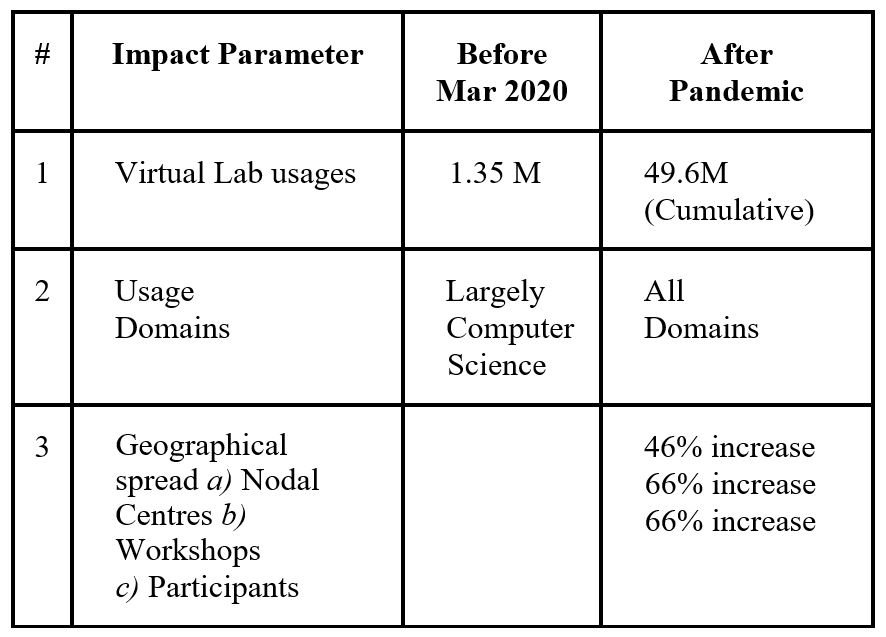
Usage is a significant metric on the impact the portal has on the students and faculty. The following section describes the nature of impact. Table 1 gives the combined Impact details and their causes. The common factors causing contributing to the impact are: the need to complete the curricula, faculty support, the push from the Virtual Labs online webinars and increase in interest among students and faculty.


Usage during the Pandemic

During the pandemic period the schedules were erratic and changed with short notice. High uncertainty cluttered the schedules of classes and exams and made it difficult to do experiments in college labs. For instance, out of a 16 month period from April 2020 to August 2021, only 3 months were available for students to do experiments in Andhra Pradesh. Accordingly, the Virtual Labs option was used and the overall usage grew steadily. Over the period, the overall cumulative page views grew from 1.35M to 49.6M.


Spread of usage across domains

Before the pandemic started, the perception of a large number of faculty and students was that virtual experiments are relevant only to computer science and engineering and not useful to other domains were not useful, as they involved equipment to do experiments. Accordingly, experiments from computer science were the first and the second in the list of top 10 labs used. Due to the pandemic the need to do experiments in non-computer science domains was high and the previously held  This perception changed after students used simulated experiments. Today the top 10 labs are from other domains with “Digital Electronics Lab‟ being the most used lab and computer science labs moving in and out of the top 10 labs. The user community has grown from 0.3M users to 6.9M. Thus, users from all domains have are benefitted from the Virtual Labs.


Geographical Spread of Virtual Lab usage: 

As a result of the increased need and the relevance of Virtual Labs, all the three parameters that increase the spread of usage – number of nodal centers, workshops and participants, increased. Colleges that chose to join the Nodal Center network by choice, committed themselves to use the Virtual Labs. Outreach teams conducted workshops to introduce the students and faculty, resulted in a sustained use of the same. Usages from such workshops and webinars are a small percentage of the usages happening due to interest of the participants. This is an indicator of the extent of sustained self motivated usage of the portal. This is a significant indicator at 8.5%.


TABLE 1 IMPACT OF VIRTUAL LAB DURING PANDEMIC


CONCLUSION AND FURTHER WORK

The Virtual Labs has made a significant impact on the student community by providing the bridge in doing experiments to meet the curricular requirement, otherwise not physically possible due to the pandemic. Virtual Labs has been used by over 7.0M users resulting in over 49M page views. Inclusion in the model curriculum of NEP (?) and the agility of the Virtual Labs infrastructure by scaling multiple times, have enabled this. The increase in usage and users, the spread across more domains and the rapid rise in nodal centers reflect the impact of the Virtual Labs. However, the gaps for further adoption lie in aligning the capability of virtual labs infrastructure to the college processes such as dashboards to record and assess experiment performance by students and buy-in from universities to include Virtual Labs in the curricula. Significant work still remains to be done to sustain the impact of the Virtual Labs in the coming years. Rapidly pushing the crowdsourcing of experiment development using college faculty as subject matter experts are also potential areas of work.


REFERENCES

[1] “National Institutes of Technology”. nitcouncil.org.in. Retrieved 2020-05-16.

[2] AICTE Model Curriculum for Undergraduate Degree Courses in Engineering & Technology , January 2018Vol1, published by All India  Council for Technology Education, ( https://www.aicte-india.org/ ) page 44

[3] AICTE Model Curriculum for Undergraduate degree in Civil Engineering (Engineering & Technology), published by All India Council  for Technical Education, ( https://www.aicte-india.org/ ) pages 47-52

[4] Virtual Labs Portal – https://www.vlab.co.in/

[5] J. R. Brinson, “Learning outcome achievement in non-traditional (virtual and remote) versus traditional (hands-on) laboratories: A  review of the empirical research,” Computers & Education, vol. 87, no. Supplement C, pp. 218 – 237, 2015.  http://www.sciencedirect.com/science/article/pii/S0360131515300087

[6] “NMEICT initiatives of MHRD,” https://nmeict.ac.in/project category/initiatives/, 2020, accessed on 2020-09-29.

[7] R. Bose, “Virtual labs project: A paradigm shift in internet-based remote experimentation,” IEEE access, vol. 1, pp. 718–725, 2013

[8] Virtual Labs Detailed Project Report

[9] Outreach Portal, Virtual Labs, http://outreach.vlabs.ac.in/ )

[10] “Mapping Virtual Lab with AICTE-Model Curriculum‟ Unpublished document

(https://docs.google.com/spreadsheets/d/10LW1hTh07_7kDI80cmp9MNUW4r8tvEY0/edit?usp=sharing&ouid=103977959989942289534 &rtpof=true&sd=true

[11] R. S. Pillutla, V. Choppella, L. Mohan, M. Damaraju, and P. Raman, “Enhancing virtual labs usage in colleges,” in 2019 IEEE Tenth  International Conference on Technology for Education (T4E). IEEE, 2019,pp. 158–161.

[12] “Doing Experiments with Virtual Labs‟, survey feedback from a sample of 200 participants and 5 colleges.  (https://docs.google.com/forms/d/1ot1gzhFlyLPOonEqlKy0yQwjqWZ9T2GJn9virLKWK98/edit#responses )].

[13] Virtual Lab Analytics, https://datastudio.google.com/u/0/reporting/1bVjKkAw-e617LmNE1v_WPdIByVRz2waa/page/5fLPB


Venkatesh Choppella and Ravi Shankar Pillutla are at the Software Engineering Research Center, International Institute of Information Technology, Hyderabad, India. Views expressed are personal and do not necessarily reflect those of Confluence, its editorial board or the Academy.


This article is part of a Confluence series called “Still Online: Higher Education in India”. The remaining articles of the series can be found here.
Pandemic Learning: How do we make it (all) count?

Like many other full-time academics, come May or June every year, I begin frantically looking through all my calendars and diaries, trying to piece together a narrative of productivity for the institution’s annual report. How many invited talks? How many conference papers and panel discussions? How many book chapters and articles in refereed journals? How many online resources developed? How many funded projects?


Does it seem like there is a big hole there, despite the many thousands of words generated and many hours undoubtedly spent in the course of these activities?


I define myself as an academic in many ways; by my research interests and the position I occupy of course, but the unchanging core of that definition—particularly in relation to my status as a university employee–is teaching. But this is the role that is least reflected—directly at least—in this annual stock-taking exercise. Simply listing the number of courses I taught over the year does little to fill out the picture (for a professor in a central university that is usually no more than three, excluding doctoral supervision or directed readings).


Keeping track of what one does in order to fulfill the metrics-hungry system whose appetite for neatly totted up productivity units is stressful at the best of times. During the pandemic-related lockdown, it turned into something of a nightmare.


In the early days following the Covid-19 related lockdown and suspension of face-to-face classes, once the initial shock wore off, it was as if borders had suddenly dissolved. Soon, we were zooming everywhere, attending webinars and dropping into virtual classrooms to listen to lectures happening all over the world. Collaborations that seemed to have been waiting in the wings for years suddenly materialized with the possibility of sustained conversation in these online meeting rooms, and new projects were conceived, discussed, and even approved. I found myself becoming part of many interest groups, from the sub-disciplinary to the trans-disciplinary, even academic-activist networks that seemed to have found a space and a voice in this strange new world. We shared concerns and frustrations, finding resonances across geographies when it came to the occupational crib-sheet. We engaged in exciting and stimulating conversations, partly born out of pure academic interest, and partly to escape from the one uncertainty that loomed large over us, and that we were afraid to confront with any measure of realism.


That uncertainty had to do with the job that we had all been hired to do, in the first place. To teach, to help young people learn and explore their potential, to mentor them as they took their own steps into the world of work, to create a space where they could find their own sweet spot of intellectual excitement. Even as we—to use that tired phrase—pivoted to the virtual classroom and the patchwork strategy of a/synchronous lessons, we were hesitant to look the beast in the eye and acknowledge that we could simply not do our job the way it was meant to be done, and the only ways we knew how were woefully inadequate.


When I wrote about this shift to the online in the early days of the lockdown, the sense was that this was something we had to put up with for a short time, that we would come out soon on the other side with no more than a few months of lost time (Raman, 2020). I bemoaned the lack of effective connection and the disappearance of context, even as I did find some ways to accommodate these aspects in my online classroom. But we soon realized that this was also an opportunity to understand and better exploit the possibilities of both fully online and blended modes of learning, some of which was reflected in the National Education Policy document that was released in early 2020.


As I write this, sixteen months since I last faced students in a room without the intervening screen, I am not sure we did use the time to do that. What we did do was learn how to better use our devices, make slicker presentations, and maybe fumble a bit through collaborative tools such as Padlet and Miro and the Google Meet whiteboard. We learned the power (and nuisance) of turning off microphones and cameras (on both sides of the learner-facilitator equation) and became more efficient at finding and pointing to online resources. We figured out how to manage, make and upload classroom materials in digital folders. By the end of the first year, we had to some extent learned how to handle assessments, with an eye more on control and efficiency than on really measuring learning outcomes with any degree of sensitivity.


We have also understood what the shutdown means in terms of learning loss. One paper estimated that 10 million academic hours would have been lost in the first phase of the lockdown (Dutta, 2020), while another said that close to 32 crore students in India were affected, across education levels (Jena, 2020). The immediate response was to try to mitigate the loss through online lessons, right from elementary to tertiary levels. And that’s when we began to see all the cracks, in the clear light of our locked-down days. The challenges have been well documented, from lack of access to devices and connectivity, to the lack of environments conducive to focusing and doing the tasks required to learn. These challenges were faced by everyone in the system. While students suffered from lack of motivation, the absence of peer-group energy, and uncertainty about their future, teachers suffered from a lack of feedback and reinforcement, discomfort with online modes of delivery and assessment, and a sense that their work had been reduced to the flatness of content input.


The work of a teacher, or an academic mentor, is much more than content delivery—however bulky and complex that task might be. There is work that goes before and after the classroom, and the long tail of emotional labour that is put into nurturing students. And here’s where I’d like to go back to that task of filling out the details for an annual report. The many spreadsheets of data that are harvested by that report say nothing about the hours spent on teaching, re-thinking courses and assessment, and, this pandemic year, offering emotional and psychological support to students. One of my colleagues who teaches video production, usually (pre-pandemic) works with students individually to ensure that they acquire competencies in the art and science of image making. The time table may show four hours in the classroom/studio, but this is just the front-end of a process that might on occasion take up to double that time or more when students are working on an assignment. This is the case for all those who teach skills courses in media studies. The labour that is invested by the teacher of practice—and to some extent, all teachers–beyond the time table has no place in those annual reports. This is labour that is taken for granted, even as it is what sustains the education system.


In the shift to online education, these are the courses that suffered the most. Teachers of practice in my field have never thought about what they offer in a class as “content”. Rather, the focus in such courses is on building capabilities and sensitivities to become media producers—to create, edit, and manage media with a keen sense of context and culture. Not to say that it is impossible in an online mode, but it requires a complete re-thinking of our pedagogies. Even for theory courses in the social sciences and humanities, which thrive on discussion and argument—the application of a dialogic method—the online has been a mixed bag.


I teach a course on digital culture, a broad survey course that offers an introduction to the internet as a communication infrastructure and the various forms of interaction and representation it affords, along with the attendant social, cultural and political dynamics. Perhaps because of the subject matter, the online mode actually threw open many new possibilities. The chat function offered a parallel avenue for discussion for students who either had poor connectivity or who were too shy to speak up. Students shared links and images from time to time in the chat, and in our WhatsApp group, thus opening up many concurrent strands of discussion. Advait Sarkar and Sean Rintel of Microsoft Research (2021), while acknowledging the potential of chat to distract, report that during online office meetings chat has had a net positive effect, particularly in large groups where turn taking might be difficult or intimidating. I certainly found this to be true in my class, and took to saving and sharing the chat from every session, as part of the materials. It made up to a large extent the absence of the affective space that enriches classroom interactions.


However, this was not true of every theory course. One student remarked to me, comparing the digital culture class with a concurrent course on media historiography, that “some classes are not meant for online”. His point was that the other course required one to think deeply before responding, and the silences were just as important as the dialogue—and we are yet to become comfortable with long silences in front of a screen.


Personally, I wouldn’t say the year of teaching online has been a total loss, but I can see it has been pretty much a write off for many students who have found it impossible to engage online, partly because of technological or situational constraints, but also because they have never learned how to learn independently. Their ability to take full advantage of the online system—listening to recorded lectures, participating in a flipped classroom by keeping up with readings, exploring materials beyond the syllabus—is limited simply because they have never been expected to learn on their own. For me, this has meant constantly thinking about and adjusting for several mental models of learning. While one also does this in a physical classroom, the work that is required to make this happen on a screen is, I have found, far more intense. Consequently, the number of hours put into preparation and assessment, and the energy put into delivery, is much higher than in pre-pandemic times. And the lack of feedback turns what might be a closed loop in physical classrooms, into an uncertain spiral. This, combined with the frenzy of collaborative projects that I jumped into in the early months of the lockdown, has been, to put it mildly, exhausting.


There are indications that the lockdown, and the extended isolation and hours spent on screen has led to a variety of stresses among groups beyond the health impacts of the virus. Teachers are among those who have experienced burnout, in some ways because of the anxieties generated by the gap between what was traditionally expected of them and what (and how) they are now doing. Victoria Turk, writing in Wired magazine, observes that “our current burnout moment may pose an opportunity to rethink our roles at work”.


In the past year, these roles have taken on new dimensions, and we have had to learn new tricks for a changing game. We’re not certain about how learning takes place in this new environment, and what the enablers might be, particularly given the diversity of students’ contexts and experiences.


In their preface to a volume of essays about early experiences of online teaching, Babu and Ramaswamy saw the circumstances created by the pandemic as an opportunity to “reimagine higher education in India”, that we could find ways to rebuild our it in a manner that was more equitable, accessible and democratic (Babu & Ramaswamy, 2020; p. 10). While a year may not be long enough to judge whether we have sufficiently acted upon that imagination, it is enough to see whether there is a commitment to a different vision of education.


This imagination—or revisioning—needs to happen beyond the classroom transaction. It needs to reflect in the way we think about issues of context, teaching roles and workload, and how faculty responsibilities can be realistically managed and supported—not just with training and the provision of technologies, but by creating supportive environments.


When I look back on the work year, I want to be able to count everything I do, the visible and the invisible, and feel that all the roles I play have some meaning and some contribution to make to the larger project of education. The pandemic year has allowed to see some of the gaps in how we think about and do our work, and this is perhaps its only positive fallout.


References

Babu, S & Ramaswamy, S (eds), Higher Education in India: The Challenges of Going Online. Bengaluru, Indian Academy of Sciences.

Dutta, A (2020). Impact of social media on Indian higher education: alternative approaches of online learning during Covid-19 pandemic crisis. International Journal of Scientific and Research Publications; 10 (5). http://dx.doi.org/10.29322/IJSRP.10.05.2020.p10169

Jena, P K (2020). Impact of pandemic Covid-19 on education in India. International Journal of Current Research; 12 (7): 12582-86. https://doi.org/10.24941/ijcr.39209.07.2020

Raman, U (2020). After the pandemic: the precarious classroom. Pages 31-36 in Babu, S & Ramaswamy, S (eds), Higher Education in India: The Challenges of Going Online. Bengaluru, Indian Academy of Sciences.

Sarkar, A and Rintel, S (2021). The rise of parallel chat in online meetings: how can we make the most of it?

Turk, V (2021). Our current burnout moment is a good thing.


Usha Raman is a Professor in the Department of Communication at the University of Hyderabad. and the lead editor of teacherplus. Views expressed are personal and do not necessarily reflect those of Confluence, its editorial board or the Academy.


This article is part of a Confluence series called “Still Online: Higher Education in India”. The remaining articles of the series can be found here.

Teaching and Caring

Like most others, I transitioned into online teaching without much problem although in the beginning I felt that this mode went against certain basic tenets of teaching and learning. For me, teaching philosophy is not about the content but about ways and forms of thinking about something. Thus, my teaching tends towards using questioning as a way of learning, of finding ways to let the students discover and articulate on their own through thinking, moving from one level to another. Given this mode of exploration, physical presence seemed essential. So when I had to do philosophy courses online, I did face a profound challenge in finding ways to communicate and practice these forms of thinking without being in the physical presence of the students. However, I soon discovered that teaching online did not bother me as much as I had thought it would. I found a kind of rhythm and a way to use Powerpoint (which I would not normally use in my regular classes) to try and teach philosophy.


But as I did more and more of these classes, and began to get more complacent about this mode of teaching, I also began to realize a major missing element in my experience of teaching. There were many pointers leading me to this realization. First was the simple fact that it was far less tiring to teach online compared to teaching in a class. This did not have to do only with the physical aspect of movement that is part of teaching in a class. It had more to do with a kind of mental engagement which also tires a teacher. Secondly, I was trying to make sense of this ‘dissocialized’ (like disembodied) experience of teaching where it seemed that more often I was teaching and talking to myself than to others. Cognitively, I knew that there were others listening to me but my experience of teaching was as if I was the only person in the room and I could as well have been giving a lecture to myself. Thirdly, the way the students entered into any interaction during the class was again disembodied in that they were reduced to only voices and in some cases, hazy pictures in tiny frames. This reduction of a person into a voice and/or a tiny picture also reduced teaching to a transaction of language. While it is true that much of teaching takes place through the medium of language, being present in a class physically produces other forms of interaction which include all the other senses. Ironically, teaching in the online medium shifted the hegemony of sight that has become so important in our teaching practices to a more balanced hegemony of sight and sound. It thus shifts the way we listen, the way we hear and brings into play new experiences of the aural.


Fourthly, the disembodied action of my teaching also removed the important experience of bodily motility that is essential to teaching. This motility is the way we as teachers orient ourselves in a class when we teach. Our body responds to various stimuli in the class and we use our body and gestures in many different ways to communicate and reach out to the students. In so doing, we create a sense of tactility that brings the teacher and the students together through a different sensory experience. These practices define the very act of teaching as much as verbally teaching content in a class. Finally, a teacher’s act of teaching is moderated by the experience of seeing the class and being-seen by the class. As teachers, we develop a fine-tuned antennae that can sense the mood of the class. We know when the students are getting bored or restless, or when they get a spark thinking through something we have said. We read cues from the way students sit, from their glances or even from the way they stare at you! There is a surplus of information that we get from non-verbal communication in the classroom. These non-verbal cues are not merely indicative of the moods of the students but they are also about the processes of learning – whether they are ‘getting’ what we say, whether they disagree with something or whether they are trying to make sense of a particular idea.


Online teaching completely eradicates all these features – disembodied, dissocialized, bodily motility, non-verbal cues – and becomes a very reductive mode of teaching. What is the consequence of the loss of these elements? One might say that in reality little is lost but this would be true only if teaching is seen as a transmission of some content. The content can anyway be transmitted through slides and powerpoint. But this method of teaching makes the teacher redundant and one could as well have given the students the textbook to read. So even in courses, such as in the sciences, where content has a greater importance, the online mode of teaching misses out on these crucial aspects of being-present as a teacher. In the case of the social sciences and humanities, the loss of these aspects of embodied teaching can have lasting consequences.


Teaching as Caring

The most important element of loss in online teaching – an element that also unifies many of the points I mentioned above – is the element of caring. I would argue that the idea of care and the act of caring are the most important components of teaching. In a rudimentary sense of the word, care is the disposition that characterises the act of teaching and the notion of caring defines the practices related to teaching. As teachers, we care for students in a most general sense of the term. This idea of care includes taking care that the students learn what they are supposed to, that they learn the skills needed for them to do well in their coursework and related issues in learning content. But this notion of care is more than practices related to the caring of the intellectual well-being of the student. The teacher cares for the student in that the teacher cares for the well-being of the student over and beyond the subject matter that is taught by the teacher. Competently teaching the subject matter is necessary since to do that is also to care but only focussing on the subject matter does not fulfil the conditions of caring that is required by the act of teaching.


This focus on caring is not to reproduce the image of teachers as doing the work of parents. The act of caring by the teacher is very different from the act of caring by the parents and family members or even friends. The teacher is not a member of the family but performs an important function of a family. The teacher does not continue to remain in the lifeworld of the student after the student leaves the class but nevertheless brings an element of caring in the short period in which she interacts with the student. The teacher is a disinterested ‘carer’, somebody who cares not because of family connections or for utilitarian purposes. A student once told me that while he appreciated the work we were doing as teachers, he also felt that we were anyway being paid for it. He was right in that there is a transactional element in teaching. But this transactional, utilitarian element of teaching is for the most basic, core expectations of teaching. So we could argue that teachers get paid to teach the student the core content but anything else the teacher does is done out of a commitment to the act of teaching, to the act of caring for the student over and beyond the teaching of the core subject matter.


It is difficult to clearly define what care and caring really means. The growing field of care ethics illustrates the problems in these definitions. However, we have a better grasp of how to approach these themes without sentimentalizing them. An introductory essay on care ethics shows the various difficulties in producing these definitions such as care’s relation to labour, values, responsibility, attentiveness and so on. I am using these various characteristics of care and caring to show its essential relation to teaching and to suggest that the greatest loss in online teaching is this aspect of caring. The loss of the physical presence, the disembodiment of the teacher, the dissocialization of the teacher and other factors discussed above all contribute to the loss of caring that is essential for meaningful education. In the case of education, one could argue that the core purpose of a teacher is to provide an atmosphere of caring in the act of teaching. What the teacher brings to her presence in the class is the possibility of caring. In online education, it is this aspect of caring that is so drastically lost. It is no wonder then that students from poorer communities as well as marginalized students in a class have dropped out or have lost ‘contact’ with the class. Online education for so many of them became a statement of uncaring, of being indifferent to the multiple difficulties they face in these systems. Caring is not guaranteed by the presence of the teacher as many of these students will attest when they go in person to class. However, physical presence becomes a necessary condition that is required for a meaningful sense of caring.


Caring is also what is common to both matters of health and education, and particularly more so in the very ideas of public health and public education. The online system of teaching and medical practice have to find ways to incorporate this most essential aspect of health and education. Public health is as much a statement about the act of caring by an anonymous public (including the State) as it is about health parameters. Similarly, public education is as much a statement that emphasises the act of caring by an anonymous society. When public money is used to give good education to the deprived, then we are actually extending an aspect of care to these children without even knowing who they are as individuals. This is an act of caring that comes not from people around you but from those who are not part of your family – this feature captures an important sense of the meaning of the ‘public’.


What this analogy also reminds us is that teaching is primarily about making students healthy. If we reduce the meaning of health only to certain physical parameters we are forgetting that the essential aspect of health is the health of the cognitive and the emotional, and not just of the cognitive alone. That is the reason why teaching as focussing on content alone has bred a large number of students who cannot be decent, caring citizens in our societies. Teaching as caring is the only way to create healthy students. The recognition that the process of learning is exactly like the process of healing is what should define the act of teaching today.  We all know that in today’s technologicalization of medicine, in which machines and machine-logic do the work of doctors, what is most crucially lost is the aspect of caring. Reducing education to such techno-logics of various kinds also does the same violence to children, once again emphasising the point that public health and public education are conjoined to each other, and harming one does equal harm to the other.


Sundar Sarukkai, founder of the Barefoot Philosophers initiative, is currently a visiting faculty, at the Centre for Society and Policy, Indian Institute of Science, Bangalore. Views expressed are personal and do not necessarily reflect those of Confluence, its editorial board or the Academy.


This article is part of a Confluence series called “Still Online: Higher Education in India”. The remaining articles of the series can be found here.


Update: 21-Nov-2021: The author’s affiliations were wrongly mentioned as Anant National University, which has now been updated.

Response to “The Many Ways of doing a PhD”

There are many forms that the PhD program can take, and though the thesis is the endpoint in all cases, the requirements for getting a PhD vary with regard to the type of problem, the nature of work involved and most importantly, the relative contributions of the PhD student and guide towards completing a PhD.The nature of the relationship between mentor and mentee has been aptly summed up into three broad types in Dr Gadagkar’sarticle. The path to getting a PhD depends heavily on this relationship of mentor with mentee. The nature of the mentor-mentee relationship also impacts the amount of learning both of theory and practice in the area of specialization, as well as acquisition of problem solving skills, of the mentee.As highlighted in Gadagkar’s article, the independent mode of doing a PhD, in which the mentee has more freedom to carve out her area of research and work out how to execute it, has the maximum benefit in terms of the intellectual development of the mentee and learning of research skills. In this mode, the mentee would have acquired problem solving abilities both in working out experimental approaches to a problem and in answering a research question.This mode or relationship requires a culture in which one is prepared to make allowance for a student to learn in her own way (despite the time needed to achieve this). It may well require that the mentor is willing to accommodate changes in the original plan and make course corrections in the process.The second type of mentor-mentee relationship discussed in the above-mentioned piece, is the collaborative mode, in which there is an equal involvement of both mentor and mentee in planning and carrying out the research.This again requires that the mentor places sufficient confidence and faith in the abilities of the mentee to contribute independently to the research problem.The third type of relationship in this category, is one that Dr Gadagkar refers to as the “apprenticeship mode”. This is a path that is least geared towards optimal development of mentee as an independent thinker and researcher. It requires little intellectual input or involvement of the mentee who is assigned to work on a small part of a bigger problem that is already defined by the mentor.This mode quite evidently, leaves the mentee with little freedom in carrying out the research.Both the problem as well as the path involved are spelt out by the mentor.This latter mode is increasingly prevalent in science in recent times, especially in experimental research laboratories. In a scenario of increasing difficulty in obtaining funds for research, and the associated pressure to ‘publish or perish’, productivity is the overwhelming concern of the research mentor and this leads to compromising the quality of mentorship as well as the learning process of the mentee as such. The mentees are essentially pairs of hands that are recruited to carry out the assigned work, and are expected to produce results in the shortest possible time.


Quite apart from the expectations imposed by the mentor in this process, mentees themselves have their own perceptions and motivating factors in doing a PhD. In an ideal situation, students should have enough choice in their educational opportunities and the freedom to recognize their skills and pursue the career that suits them the most. This is a far cry from what one sees in India. Academia unfortunately, is the least preferred career path as compared to the lucrative professions that are associated with either money or social privilege or both. The trend is that if one does not qualify for medicine, engineering, business or accountancy, one gets into a routine Bachelors program which follows into a Masters and then automatically, into a doctorate.The desirability of moving up in the career ladder, with the possibility of better paying jobs, means that one tries for the highest degree possible. This path leads to students with little interest in academia or in research in particular, and who have opted for it by default, or due to pressure from family (usually for perceived prestige and social standing).


In addition, the essence and purpose of PhD is viewed differently from one place to another. It is often viewed as a training program and in this situation, graduate students are required to carry out research using a systematic approach to the research problem. It does not matter much if the work leads to novel findings or not. When viewed as a gateway to a research career, which means competing for the best possible opportunities, whether in postdoctoral positions or other jobs, good quality publications are an essential part of a PhD. For this, one seeks challenging problems that may lead to new and interesting results. Against a backdrop of an oversupply of PhDs versus demand in recent times, even a postdoctoral position becomes competitive and difficult to get. This places a premium on novelty and originality of doctoral research.


Chitra Kannabiran is a scientist at the L.V. Prasad Eye Institute, Hyderabad. Views expressed are personal and do not necessarily reflect those of Confluence, its editorial board or the Academy.


This article is part of a Confluence series called “Mentor-Mentee Relationships in Academia: Nature, Problems and Solutions”

Teaching in Pandemic Times – A Personal Reflection

It is an interesting exercise to be reflecting on the impact  that the  COVID-19 pandemic has had on education more than a year after we were forced to migrate online in order to teach. From being completely at a loss in March 2020 — and wondering about the relevance of my profession — I am now comfortably and confidently preparing to teach a new batch of students via online classes. This journey from uncertainty to a degree of control has been riddled with mishaps and situations where one has either been forced to quickly learn new skills or rummage around for skills one had earlier dismissed as either obsolete or far too irrelevant for one’s context. Before I elaborate on my experience, allow me to provide a little background on my institution and the milieu of teaching there before the pandemic.


Kohima College Kohima

Kohima is the capital of the state of Nagaland. It is located in the district of Kohima. I teach in Kohima College, Kohima, currently the only government arts and commerce college in the entire district. Established in 1967, Kohima College, Kohima is one of the state’s oldest arts colleges. It was absorbed into the Department of Higher Education under Government of Nagaland, in 2006 and moved to its current location in Kruoliezou in 2009. Kohima College has the peculiar situation of sharing its campus with Thinuovicha Memorial High School, a government run school. The college has 18 classrooms for a student strength of 1400. All classrooms are occupied at all times, precluding the possibility of conducting classes outside of the prescribed routine. Being the only arts and commerce government college in the district, the college is mandated to accept any student that has passed out from government schools in the district who meets the cut-off marks criteria set by the college each year. Hence our students are predominantly from low-income, semi rural to rural agrarian backgrounds. While the rural agrarian students belong to the tribes whose lands fall within the district – Angami, Rengma and some Chakhesang, a significant number of this group belong to other tribes from the state whose parents are employed in low level government jobs or hold working class jobs in the private sector. The student body thus boasts a wide representation of Naga tribes from within and even outside the state.


The Department of English, Kohima College, Kohima

The Department of English is one of the oldest departments in the college and boasts of having an all woman faculty since its inception in 1967. Having taught both in annual mode and experienced the transition to semester system, it is my personal opinion that the current syllabus is least suited for this format. The annual syllabus was arbitrarily redistributed to semesters so that some semesters have honours papers covering only fiction and drama while others have only a handful of poems. This imbalance, in terms of scope and bulk has been the subject of many a casual conversation in the staffroom as well as a matter that has been raised (by myself and others) during the curriculum review under taken at the meetings of the Board of Undergraduate Studies (BUGS), Nagaland University, of which I am a member. The current modalities of the semester system as implemented by Nagaland University, to which all higher education institutions are affiliated, also focuses on facilitating administrative convenience at the cost of actual teaching time. Hence we hardly have three months of teaching per semester, whereas on paper, each is roughly five and a half months in duration.


Literature is a discipline that demands protracted discussions, often spilling out of the space and time of the classroom. In my opinion, students benefit best when given research based assignments that can be delivered in the form of presentations, discussions, essays and term papers. All of these allow for students to both develop their critical thinking as well mastery over language and writing. Within the current semester system, time is scarce for both student and teacher and specifically in our college, the dearth of space also does not allow for teachers to conduct more classes though they and their students may so desire. Nevertheless, most continue to take classes beyond the stipulated teaching period to cover up the syllabus as well as to accommodate and encourage the intellectual curiosity of our students. So in one sense, performing one’s duties involves teaching against the current system.


Going Online

I was one of the faculty members tasked to review the National Education Policy in 2019 when our college was asked to send feedback to the Department of Higher Education. Reading through it, I was particularly struck by the focus on digitising pedagogy. While attending an orientation programme that is mandatory for college teachers, I listened to lectures on Massive Online Open Courses (MOOC) and other forms of  digital learning with impatience and a dismissive attitude, wondering how and if at all these would ever be a possibility in Nagaland. At that time, it seemed highly impractical and irrelevant for us in Kohima, the capital of our state and even more so for other government colleges in other districts, most of them semi-rural areas. My previous posting prior to Kohima College, Kohima had been Pfütsero Government College, Phek. Pfütsero, Nagaland’s highest altitude town is a small idyllic town and the college there is housed in a very basic rudimentary structure. The roof of the largest lecture hall was a single sheet of corrugated tin that would make giving lectures during rain a futile exercise. And this is a town that is a few hours ride away from the capital Kohima. Given that more interior parts of Nagaland do not have good roads and suffer poor infrastructure, I considered the idea that going digital would somehow democratise and make accessible education to students (school and college) with a great sense of irony.


Pandemic

That was of course until the pandemic hit and all life, including the school my children attend and college where I teach came to a standstill. As we were forced to go online, Kohima College contracted a software development firm to create an online portal for us to be able to take classes virtually. By June we were informed that Proctur was ready:  Proctur is much like Zoom and Google Meet, a more basic and less stylised version but one that allowed the institution to manage the classes as well as to keep track of classes conducted and student attendance. By the time we began online teaching, most of the faculty including myself, were already familiar with Zoom and Google owing to the fact that we were using both for our meetings, faculty academic programmes and also our own academic work in the form of attending webinars and online conferences. So adding Proctur to our list of online platforms was an easy transition but on the other hand also frustrating because of many initial glitches that one had not experienced in the more sophisticated platforms. For one, a time table had to be followed and once again, even online, it was not possible for multiple classes to be conducted at the same time on this platform. So if one of us overstayed our time slot, it would cause problems for the colleague following us.


Unlike its commercial counterparts, Proctur did not allow for us to see our students via video. The only visual that is available is the video feed of the instructor. It was and continues to be a big challenge to look at one’s own face for the entire duration of one’s lecture. It also limits the nature of interaction we can have with our students. One crucial aspect of this is that one is unable to gauge their level of interest /attention and engagement with our lecture – something I personally felt reduced my lecture to a monotonous monologue – a teacher’s worst nightmare. Though there is a provision to share Power     point files and even pre-record and upload lectures, these features in practice were not so user-friendly and almost always did not work smoothly. Given again the time constraints – both in terms of semester as well as class slots, time could not be wasted on fidgeting with settings to set up Powerpoint etc. Lastly the availability and quality of the internet is not constant and one often loses an entire class due to the lack of a steady internet. Thankfully, the process of using Proctur was iterative and as faculty faced difficulties, those charged with liaising with the developers constantly gave feedback and Proctur continued to be tweaked and enhanced till we arrived at a relatively smooth running by the end of the next semester. Proctur however continued to be a one way video feed and could accommodate only one online class at a time. This is where the availability of other commercial platforms such as Zoom and Google Meet provided much needed virtual space and time that was not available to us even in our actual campus.


Adaptation

Realising that my students and I need not limit ourselves to meeting only on Proctor was a liberating and exciting moment. I must make a disclaimer here that I was charged with teaching Honours in which the total student strength was 30 to 40. Moving out of Proctur was not a luxury available to colleagues teaching general courses or honours in other subjects like Political Science whose enrollments touch 100 and more. Taking advantage of the fact that the number of students I had to teach fell within the limit of Zoom’s free allotment, we took to meeting for extra classes scheduled outside of the stipulated college timing and as per the convenience of students and teacher. Having this option allowed for a much needed leisurely and in-depth teaching of texts. It also provided one the luxury of accommodating intellectual digression – something I had come to miss dearly in the rush of completing courses and paperwork in the offline mode.


A mention must also be made of the culture of pedagogy here in Nagaland. In general, the interactions between teacher and students in a classroom continue to reproduce hierarchies established by  colonial/missionary practices. The teacher is a figure of absolute unquestionable authority and students docile subjects expected to accept and absorb lessons. In fact, critical engagement and original thought is often actively discouraged – a simple example being that answers which deviate in letter and thought from prescribed notes are generally not rewarded with good marks. So when students come to college, we are confronted with docile minds, intimidated by the perceived authority of the teacher. This results in mostly one way lectures where students mutely listen to lectures and refuse to engage in classroom discussions despite many efforts by teachers to elicit responses from them.


A wonderful corollary of going online was to witness these very same ‘docile’ students come out of their shells. In particular, in the space of the chat box – a feature available both on Proctur as well as other platforms like Zoom, they were highly interactive. It was possible to have very stimulating discussions where many raised critical questions and demonstrated mature analytical skills that proved them at par with any of their counterparts across the world. By going online and bypassing the conventional four walls of the classroom, my students were somehow less inhibited and laid bare faculties that must have been there all along (in previous batches too) but had somehow been stifled within real offline structures. As they shed their inhibitions on chat, many slowly began to speak up in virtual classes and by the end of the semester, when they made presentations online, they were more at ease with me as well as with their peers in my presence.


Apart from video classes, WhatsApp has also proved to be remarkably useful for teaching/learning. Teachers from my childrens’ school have taken to creating excellent video content covering their lessons that parents can show their children as part of their home school work. It has also expedited and eased the process of sharing texts, notes and assignments.


Access

Regardless of the surprising positive outcomes of going online, the issue of access was and remains a great challenge. Two aspects bear mentioning – access to devices and access to internet/data services. As we began our classes a few students were conspicuously absent. When I tracked them down and spoke to them personally, they confided their inability to afford smartphones with which  to join classes. This was something many of my colleagues also faced with their students and also among many school students. Collectively, teachers and parents have been compelled to take on informal awareness building to de-stigmatise  non-ownership of smartphones and devices. Localities both in urban and rural areas have mobilised to make sharing devices amongst their members – whether it is in the form of lending devices to those who cannot afford their own, or hosting them in an informal ‘classroom’ setups. In one case, classmates contributed towards buying their lone peer a mobile device. While our traditional sense of community has yielded these heartwarming stories, they still do not account for the many students who were left behind, some who had to drop their studies altogether because they could simply not afford  devices or pay for data services. When we began online classes, most of our students had returned to their villages – some in remote ‘backward’ districts. Though they had smartphones and other devices, many of them either missed a number of classes or were not able to enjoy smooth connection due to poor network. One solution was to switch off the video mode but again, this turned what could have been an interactive class into a one way lecture. Many times, the unstable connection of a student disrupted the entire class time, costing both teacher and other students precious teaching/learning time.


Online and Onward

Come what may, the pandemic has made a compelling case for teaching online. As I stand at the threshold of another new semester, I am excited to hone skills I have learnt as well as to continue experimenting with the possibilities presented by the online medium. Some possibilities I am considering are video assignments – in the cinematic sense. Work that can be shot on our cameras, edited using apps that are free that can then be viewed collectively via screen share. Online teaching also situates the platform on the same device as my digital store house of notes, power points, liked YouTube videos, bookmarked Kindle pages. The past year and a half of teaching as well as pursuing my own academic work in the form of online workshops, webinars and conferences has made me more dexterous in accessing and sharing these resources in real time. If offline lectures are a dramatic performance of sorts, then online teaching also presents possibilities of a different theatrics – one that, provided the obstacles of access are surmounted, promises to bring pleasure back into pedagogy.


Theyiesinuo Keditsu is an Assistant Professor in Department of English at Kohima College, Nagaland. Views expressed are personal and do not necessarily reflect those of Confluence, its editorial board or the Academy.


This article is part of a Confluence series called “Still Online: Higher Education in India”. The remaining articles of the series can be found here.

Mentoring as Radical Practice

Teaching/Mentoring as passionately political work

Learning is a social process. Ostensibly, education is a non-political institution that facilitates this process. Far from that, education is a profoundly political field. As part of the ideological state apparatus (ISA), education system produces and circulates knowledge that in turn supports the dominant socio-political-economic order. As Louis Althusser argues, it is through the educational institutions that the dominant section legitimizes its unfair control over resources, and normalizes various forms of inequality. Nevertheless, if education is associated with reproduction of dominance, it can also play a role in challenging the same (Apple 2019: 18). For the legendary philosopher-activist Paulo Freire, education has to be about changing society. If education is a field invested with political interests, teaching has to be an intense political mission to counter hegemonic interests and foster social change. Krishna Kumar (1989) has also reflected similar sentiments when he argues that schools [or universities] have to be agents of social change and not merely reflect the existing dominant social values. What is important, therefore, is to understand who produces knowledge, whose interest the educational apparatus serves, whose voices are reflected through the curriculum and whose is absent or gets drowned. Answers to this will help to decipher what kind of political strategies are to be initiated to make education a political act to exorcise the ghost of hegemonic dominance of casteism, religious orthodoxy, patriarchy, colourism, and class-biases etc.


For a society that aspires to counter this hegemonic political landscape, the schools/universities need to play a major role in fostering values that nurture egalitarianism and democratic spirit. What we need therefore is to lay bare the relationship between the dominant ideology and the curriculum, and adopt critical pedagogy that engenders democratic values. The teacher-mentor has a tremendous responsibility to initiate and foster critical learning that makes this possible.


For this, we need teachers as mentors who are invested with a sense of justice. Unfortunately, most of the teachers take up teaching without a political sense of justice for all. We can classify two kinds of mentors. One is the by-default mentors who perform teaching or mentoring as part of their profession. They are not passionate about it. I am therefore not interested to consider these teachers as mentors. The others, mostly a minority, are passionate mentors, who love to teach and interact with the students, and actively take interest in their well-being and contribute towards shaping their lives. Such passionate teachers as critical pedagogues prepare the society towards a journey with critical consciousness. Personally, I did not have had a mentor as a student, though I am blessed with relationships with a few people who have inspired me to be in academics. Nevertheless, “not been mentored” is in fact is one of the reasons for which I wanted to be a passionate mentor. I often feel that the students must be looking for or longing for a friend and a guide (as I was doing as a student). How could I not be concerned about them!


The essay here is mostly based on my personal experience as a faculty of Sociology in the Tata Institute of Social Sciences (TISS), in its Tuljapur Campus.


“Critical pedagogy” and “Engaged pedagogy”: Mentoring for democratic and participatory learning

“Critical pedagogy” as championed by Paulo Freire (1921-1997), departs from the “banking system” of learning that emphasizes on memorizing information, and learning certain skills to make a career in response to the demands of the market. Critical pedagogy, on the other hand, wants us to know the relationship between power and knowledge to explain who has control over conditions of learning within the classroom, and its impact outside. By giving agency to the learners- the students- critical pedagogy expects them to question the taken-for-grantedness of the existing system. Far from being passive learners, the students are expected to transform existing knowledge, and create newer forms through self-reflection and through critical dialogue with others.


bell hooks, however, asserts that one needs to go beyond critical pedagogy. What is important is to go one step further for the practice of “engaged pedagogy” that involves “self-actualization”- the act of transforming oneself to attain well-being.  Both the teacher and the student have the moral responsibility of taking care of their moral well-being as well. Taking cue from Vietnam Buddhist monk Thich Nhat Hanh, hooks argues that a teacher has to be a healer. As healer, the teacher should heal themselves first, ‘because if the helper is unhappy, he or she cannot help many people’ (hooks 1994: 15). As the teacher has to practice what they teach, it also helps them to mentor the students holistically by not just supplying information, but by making it meaningful for them in their lives.


Teaching in the classroom is a first step towards mentoring the students. As undergraduate students, it is about initiating them into a distinct domain of knowledge. It is also about initiating them into the perspectives of social sciences that helps them to develop a critique of the social sciences in general, and discipline in particular, as well as to develop critical perspectives offered by the discipline(s) through which they can see the world differently. When I introduce the students to the world of Sociology, the students are given a critical understanding of the emergence of the discipline of sociology, and then various perspectives within Sociology that provides varied vantage points to see the society. As they try to develop a “sociological imagination” through their critical engagement with “common sense” they take their first steps towards unlearning. Unfortunately, the unlearning starts at a very late stage as they enter the university. The schooling of the students does not enable them to develop a critical mind. Most schools prescribe learning based on memorizing information.


The next task is to make the students believe in themselves and participate in a democratic process of learning. Every year, to the new batch of students, I give example of my favourite teacher in JNU who told us the story of his teacher who posed a question to the students in his first class- “I do not necessarily know more than what you know, …  then why am I standing here as a teacher?” As students would struggle for answers, after taking a pause, he would supply the answer- “… because I happen to be born earlier!” At one stroke, this dismisses the divinity of the teacher as “guru”. Within the Indian Brahmanical tradition, the guru is associated with a divine status that is not to be questioned. Sharmila Rege also points out that the critical pedagogy must reject the teacher as “god embodied” (Rege 2010: 94). I tell my students that the first step towards critical learning is “doubt” rather than have unquestioned faith in the teacher or in the (canonical) texts. Using Karl Popper’s theory of falsification, I argue that nothing in this world of knowledge need to be treated as sacred, and as true learners, they need to question everything including the ideas of their teachers.


In the first instance, many students are amazed, and some are also amused as they have been told so far that they are supposed to believe in what they read in the books or what the teacher says. Now, they are told that through their ‘disbelief’ and ‘criticism’ they contribute towards production of knowledge. And believe me, that makes the students excited about their role as active partners in the process of learning which is fluid and dynamic, not fixed forever. I encourage the students to express their opinions and values. I also tell them, however, that not all values are equally valuable. It is important to evaluate the values. How do we do that evaluation? They are explained how the dominant value/idea is a society, as Karl Marx pointed out, is the idea of the ruling class. Therefore, in a democratic society, the preferred values need not be that of the same class. Those dominant values that we generally consider as ‘normal’ or ‘natural’ need to be deconstructed and reconstructed. For example, in Sociology, when they are taught functionalist and conflict perspectives, or feminist and subaltern perspectives, the students see a new world before them hitherto blocked from their vision. They find that these alternative narratives are novel, exciting, and also at times painfully disturbing as it destabilises their own experiences. The marginalized students such as the Muslims, Adivasis, Dalits, girl-students across categories go on to discover new ways of understanding domination and marginality, those from the privileged background also discover their own prejudices and privileges. Intersectional locations (of caste-gender-religion etc.) further complicate their understanding, and that is how they also learn to view the society not through simplistic categories, but as complex realities.


Diversity in classroom makes it an exciting place of learning. In TISS, fortunately we have students from across India, as well as from various socio-economic backgrounds thanks to the reservation policies. That makes the classroom an ideal place to practice critical pedagogy. Sometimes, I also face hostilities from students who are from privileged backgrounds, or who are heavily influenced by religious fundamentalism thanks to their socialization earlier. Some of them change their values and perspectives over a period of time, some do not. But, the purpose of engaged mentoring is not to ‘convert’ people. It is to instill a sense of participation in the classroom deliberation and help them evaluate their own values through the yard-sticks of democratic principle. That is the joy of education as practice of freedom, for it allows students to assume responsibility for their choices. Engaged mentoring is also to help them develop critical consciousness to engage ‘in an active, dialogical, critical and criticism-stimulating method’ (Freire 2013: 42).


Thus, the mentor, though granted extra power in this system, is not to be a dictator. Power, as bell hooks argues, is not necessarily bad. A teacher need not pretend that they do not have power, or that they do not want power. What is more important is how the power is used (hooks 1994: 187). A teacher can (mis)use power to muffle voices in the classroom, and maintain the social hegemony; or they can use it to ensure multiple voices speak and learn together democratically. This can teach us to live together as equal beings and also to work together towards breaking hegemonic and normalized ideas.


Mentoring to Transgress

Mentoring that happens in the classroom is not enough for someone who is a passionate teacher. Teaching does not begin and end at the doorstep of the classroom, though unfortunately that is how many professors complete the task. After taking a class on marriage from the perspectives of feminism, one student, turned up in the office and asked- “Could you please explain why mother did not break her relationship with my abusive father for so many years?” She was one of the many students who would come up with their own questions, often that is about their ‘personal troubles’, to use the concepts of C. Wright Mills, as they struggle to link it with the ‘social issues’ as they attempt to develop their sociological imaginations.


Gender identities and politics plays a significant role in the learning process.  While the gender issues are discussed in the classroom, there lies a wide field outside that domain that shapes the way gender is organised and shapes individual’s behaviour. For boys, it is an opportunity of unlearning and relearning to be a participant in democratic politics in everyday life as they come to terms with their privilege of birth. Of course, many male students resist, inside and/or outside classroom. What is refreshing to see is that some of them do change their ideas about gender and participate in progressive politics. For girls, these are ideas of resurrection. They are very vocal and excited in classroom as well as outside. Teaching-mentoring helps transform the learning outcomes into life out comes. The rebelliousness against patriarchal values and power-structures redefines the way they conduct themselves within the campus and at home. One day, there was a discussion on “benevolent patriarchy” and I illustrated that with the example of people affectionately calling their daughters (beti) as betā which in fact is a term to address the sons. The same day, after the class, one girl protested at home when her father called her betā and explained to him that if he could not call his son as beti with affection, then it is highly patriarchal to call the daughter as betā.


This might be a case where the girl stood her ground, but there are many other cases where the girls are snubbed for being too radical and spoiled due to their education in TISS. They face harassment at home, or are denied further education, or forced to compromise. Parents find it difficult to adjust to the children who now talk feminism, equality, rights and justice etc.; write term papers on communal violence or on experience of (benevolent) sexism in personal life; or write a dissertation of homophobia in their Church. Girls face this kind of discord at home more than the boys. Sometimes girls break up their relationship with their boyfriends as they exercise their agency to counter patriarchy. All these are sad, even though it is a vindication of the outcome of mentoring the students about rights and justice.


It is politically enriching to mentor the students coming from underprivileged background especially the Adivasis of ‘dominant-land’ India, indigenous students from the North-East, the Dalits, the Muslims and the Other Backward Castes. For these students, it is not just their poor material condition, but more than that their social identity poses a serious challenge for them to experience equality. In an institution like TISS, liberatory struggle is well rooted within the student community, but that often needs overt and covert support and guidance of some faculty members. In our campus in Tuljapur, there are only a few who are associated with the resistance politics of the subaltern students. Many other professors would not like themselves to be associated with the resistance politics else they might be “branded” as supporters of the ‘quota-students’. Nevertheless, for me, it is crucial that the students are also mentored for leaning a few steps in developing self-esteem, and fight for diversity and their right within that framework. It is a great pleasure for me to work with young minds to organize Ambedkar Memorial Lectures, celebration of Indigenous day or Savitribai Phule’s birthday as teachers Day (and rejecting Radhakrishnan’s birthday as Teacher’s Day). This helps foster respectable identities for the students and a legitimate sense of place within the space of academia. It also engenders a sense of justice to heal the psychic turmoil that students from the margins experience.


Care, love and support:

“Sir, are you there in November in the Campus? … I am coming for a week or two”- was the message from a (ex-)student who wanted to come to the Campus and spend a week’s time with us as she was too tired of the city (Delhi) life. I was pleasantly surprised that she didn’t even bother to ask me if I would agree to that idea. Of course, not every student that I have mentored may approach like this, but this is what comes as surprise gifts to a teacher who loves students deeply. When the students live with you in the campus, you meet them every day, go for a discussion during morning walks, invite them for a cup of tea/coffee, share lunch/dinner, ask them to come over for cooking during certain special occasions, or store their birthday cakes till midnight- are all part of the relationship that makes them comfortable and share a bond that further helps a teacher to understand them. Then they freely share their problems- separated parents, abusive father, financial stress, career anxieties, or harassments by their hostel mates and other tragedies of life. As young undergraduate students, living away from home, these are the relationships that are very crucial in shaping their lives.


“Come, let us live with our children”this often-quoted motto of Friedrich Froebel (1782-1852) has been part of my consciousness since my early childhood. My father, who was a very popular school teacher, had inscribed this over the door of his office. Subconsciously, I have imbibed his abilities to love and sacrifice for his students. Yet, despite of receiving the students’ hugs and heart-felt appreciations in return, I do feel at times that I could have done better; that I might have left some students behind that could have carried along; that sometimes I have let my students down, that I should have further done away with my biases and prejudices. As a mentor it has been a journey of mixed feelings, unlearning old ideas, and learning a few new things.


The regret is that there are not many professors in the universities who are sensitive to the students’ needs including the learning needs, and that too at the undergraduate level. Most of them are busy with their own research and publication and of course networking with the higher ups for generating more social capital for themselves. In most of the big universities the faculty members concentrate only on the research scholars, and then may be on the MA students to much lesser extent. Developing relations with undergraduate students hardly pays any dividend. University Grants Commission (UGC) also emphasizes on Academic Performance Index (API) scores that has no place for passionate teaching and mentoring of any kind. Then, who would bother to mentor the undergraduate students even as rituals?


References:

Apple, Michael. 2019. Can education change society? New York: Routledge.

Freire, Paulo. 2013 (1974). Education for critical consciousness. London: Bloomsbury.

hooks, bell. 1994. Teaching to transgress: Education as the practice of freedom. Oxon: Routledge.

Kumar, Krishna. 1989. Social character of learning. New Delhi: SAGE.

Rege, Sharmila. 2010. Education as Trutiya Ratna: Towards Phule-Ambedkarite Feminist Practice. Economic and Political Weekly, Vol.45(44): 88-98.


Byasa Moharana is Assistant Professor at the School of Rural Development, Tata Institute of Social Sciences, Tuljapur. Views expressed are personal and do not necessarily reflect those of Confluence, its editorial board or the Academy.


This article is part of a Confluence series called “Mentor-Mentee Relationships in Academia: Nature, Problems and Solutions”

Online teaching during the pandemic: Some personal reflections

This is a reflective piece based upon my personal experience of transitioning and adapting to the online mode to which much of the teaching-learning process had to abruptly shift owing to the pandemic induced lockdown in 2020. The writing has been undertaken in a documentary spirit and may be of some limited use in thinking about the future such possibilities offer in the field of higher education.


When the lockdown began in March 2020, most of us in the Department of Sociology in University of Delhi were halfway with our MA teaching in the Winter Semester. The sudden change of tracks that the new situation required of us was not something anybody was comfortable with. But given the situation, the availability of technology which permitted continuation of teaching via an online platform did seem like a boon. I have often wondered what would have happened if such a situation had arisen 30 years ago. But then perhaps the technology as well as the Covid19 pandemic are two sides of the same coin.


Teachers and students both took to this medium with some resistance. I remember agonizing at length over the modalities of delivering my first online lecture. Trying hard to channelize what I believe to be my better than average IT skills, teaching in the online mode seemed to require much renewed effort. Not surprisingly, at least some of the students proved to be savvier about the technical know-how and, with their help, at the onset, we could quickly put together resources to enable the faculty to continue with the teaching-learning process.


Given that attendance in classes is not compulsory in the MA program of DU, it is not a very reliable parameter to gauge the experience of online teaching. But interestingly, in my class the attendance remained comparable to and even at times better than that in the offline times. This could be owing to the absence of other distractions in the lives of the students due to the lockdown. Sometimes, classes seemed even more enjoyable than they had in the offline mode. This may be due to the renewed effort we as teachers had to put into our teaching.


This should however not detract us from the serious issues which bedevil this mode of imparting learning in general and also the particular conditions which have shaped its experience in this particular context. Poor internet connectivity as well as lack of adequate physical space were very common issues that students and even teachers have had to continuously face. In addition, the artificially imposed isolation has taken an undeniable toll on mental health of many, especially the young on the cusp of their careers. The latter was more than evident during the second wave of the pandemic when it became impossible to even carry on the online classes for at least a brief period. Such factors cannot be ignored in any assessments of the long-term potential of online education. A sense of gloom and impending doom thus formed the backdrop against which carrying on online classes was primarily directed at maintaining a semblance of normalcy (‘new normal’ and ‘social distancing’ being the new catch words) and even business as usual.


While different members of the faculty took their own time to come to terms with the situation, at least at the beginning no one expected that the lockdown would persist for so long. Some of us, including the students, even expected to go back to the former situation of classroom teaching and exams within the same semester. But as the semester inched towards its culmination and there were no signs of returning to the ‘old normal’, examinations were on everyone’s mind. Despite many differences of opinion and considerable doubts about its efficacy, the University of Delhi opted for the so-called Open Book Examination (OBE) or blended mode of examination which is largely a euphemism for a very compromised mechanism of examining students. The main purpose this mode of examination seems to have served is that of a rite of passage which perhaps exams tend to be in some measure in any case. The official ‘success’ of the OBE/Blended mode of conducting this biannual ritual can be gauged from its having been accepted as the only option for the subsequent examination cycles as well as we continue to reel under the consequences of our response to the pandemic. It is not as if our examination system was ever perfect. However, grafting the existing modes of examination onto the online mode is far more complicated than even the issue of imparting classroom teaching via this mode. Any assessment of the potential of the online education mechanism should therefore also not ignore that such measures were at best a short term coping strategy and cannot be seen as desirable in the long term.


The much delayed start to the academic year 2020-21 amidst the continuing pandemic posed a renewed challenge. While the first transition had meant interacting with students with whom a rapport already existed, teaching a fresh batch of MA students meant knowing students only as a small icon on the computer screen. Teaching a whole batch of students with whom one had no previous interaction was thus a new challenge. Although yet again the student and teacher experience was a mixed one, the limitations of teaching a large group of students (we admit more than a 100 students into MA programme) without even the benefit of looking at their faces was alienating. The teacher has no means to ensure and gauge the attentiveness of students whose only sign of presence in the class is a little square on your screen. Like everything else, this is also something one has grown used to but this is hardly the best case scenario. Interacting with tutorial groups and an M.Phil coursework class proved to be somewhat easier on this media owing primarily to their small size.


Somewhere along the way, it also became clear that tech giants like Google and Zoom dictate the terms of interaction in many ways. The interface is after all in the hands of the service providers who can decide what they allow users to do, and how.  Despite some amount of free services which such platforms continue to provide, they are commercial ventures that entail a cost if their full potential is to be utilised. The potential of technical affordances of such media such as recordability and dissemination of the content of classroom interaction, although not entirely missing even in conventional classroom, proved to be a grey area for which normative and even working frameworks remain to be evolved. This is not the place to assess the extent to which the University system had the capacity to step in to act as an enabler in this regard, but it cannot be overstated that Public Universities require more robust IT infrastructure and personnel at every level if it such platforms are expected to play such a significant role in teaching-learning process, which is the primary raison d’etre for the existence of such institutions. The IT potential for which India is justly famous somehow eludes to enhance the capacities of the Indian university system as perhaps of many other public institutions.


While teaching was a priority, it took us a while to realize that other institutional work would also increasingly need to be carried out online. One inadvertent fallout has been that considerable administrative work has fallen on the faculty shoulders.  Not everyone has taken kindly to this. However, the need for more robust institutional system software has never been felt more. One of the unintended effects of the situation has also been that at least some institutional activities which could or should have been conducted online more efficiently even without the intervention of the pandemic were finally able to break through the usual resistance such changes encounter.


The official enthusiasm for the online mode which derives from the obvious possibilities of extensive reach it offers must take into account that online education cannot be simply old wine in a new bottle. The new medium requires new modalities. MOOCs which predate the pandemic by about a decade have been a very enabling online resource available on global platforms like Coursera and Edx. However, they best cater to the process of continuous self-directed learning and are not comparable to the online classes of the kind that took place during the lockdown. The success of our own homegrown attempts at imparting education using mass media channels (such as Swayam) some of which also predate the lockdown is not so well established and are better seen as substitutes/supplements for the old-fashioned distance education or open learning initiatives. A dispassionate assessment of the same may dampen the enthusiasm for the future of online education in India.


Even if such resources are growing and their quality can potentially improve, whether they can stand in place of some of the conventional modes of learning should not be assumed. The self-directed individualized learning that is permitted by such platforms cannot replace the need for teacher-led group learning which has a different potential.  Teaching even a modestly large group online is something which may be desirable when there is no option (as in the case of conditions of extensive lockdown). It should however not be seen as a replacement for conventional classroom teaching.


By now, online teaching has become as normal as classroom teaching was not so long ago. Google Meet and Zoom have become part of our everyday conversations and it appears strange to think that less than two years ago, most of us in academia had no idea about communicative and interactive possibilities offered by such platforms. It even appears likely that the normalization of such possibilities in educational delivery means that things will never go back to what they were in the pre-pandemic times. But we are still living in what seems like a liminal phase. Even as we are trying to make sense of the potential of the means that the global community mustered up at a fairly short notice to deal with the extraordinary confinement to which the pandemic subjected us, the prolonged character of the crisis is contributing to entrenching new practices in a manner which may have been unlikely had this been a short-lived scenario. This is why some of the changes brought about in this period may be here to stay. But as always, it would be prudent not to treat all the changes we have embraced as in themselves desirable or undesirable and look for independent parameters to assess what we want to keep and what we want to forsake.


Despite the widespread and understandable nostalgia for pre-pandemic times, the possibilities offered by internet and communication technologies had already become pervasive in our practices for some time and at one level the changes experienced can be seen as a matter of degree and not kind. After all, email, WhatsApp, Google DriveGoogle Forms and online resources of all sorts have crept into our educational practices gradually and imperceptibly but to an extent that would be hard to imagine even 20 years ago.  What the lockdown has done is to take this dependence to another level. Maybe this should be seen as an opportunity to dispassionately assess what the uses of such technologies are that need to be embraced wholeheartedly and what are the ones which need to be utilized only under conditions of duress such as those imposed by the pandemic.


Anuja Agrawal is Professor at the Department of Sociology, University of Delhi. Views expressed are personal and do not necessarily reflect those of Confluence, its editorial board or the Academy.


This article is part of a Confluence series called “Still Online: Higher Education in India”. The remaining articles of the series can be found here.