So near, yet so far

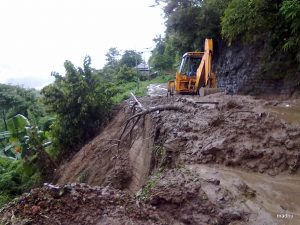
Figure 1. Road leading to MZU after the rains. Landslides like these are very common during the rainy season in Mizoram. This creates issues for transport of both people and goods. Photo credit: Author.

I taught at Mizoram University (MZU) between early 2007 and mid-2012.  Every day of the five and a half years there was a learning experience for me. The first striking feature is the geographical diversity across the North East Region (NER) of India. Technically NER of India consists of the states that exist entirely on the other side of the Siliguri corridor, commonly known as the “chicken-neck” of India. This nearly justifies the use of the term “mainland” by the people of NER for the rest of the country. Mizoram is an almost entirely hilly state, on the geologically young Lushai/Patkai hills, made of soft, muddy hills that are prone to landslides, sometimes bringing down entire hillsides with all the houses on them.  More importantly, landslides can cut off the entire state from the rest of the country since there is only one highway out of the state and air travel, to date, is dicey. This in turn means essential supplies including fuel, milk and groceries can run short. This is in sharp contrast with Guwahati, with much better connectivity or Agartala, which is on plain land, or Imphal in the middle of a valley or Shillong, which was patronized by the British for its cool climate and hence has better infrastructure.


Teachers in general are given enormous respect in the state. I have not seen any other state capital with “Happy Teachers Day” banners all over on September 5th, every year. This is probably due to the fact that for the most part, education in the state referred to School education. Mizoram University, formally established in 2001, was the first University in the state, prior to which it was a campus of the North-Eastern Hill University (NEHU). The first thing that I noticed with the students was that the discipline levels were high. Also, there was a complete absence of questioning; something that felt ingrained in them.  Added to this was the common insecurity of students of being looked down upon by peers if their question was “stupid”. It took great efforts to make them ask questions.


Formal education in Mizoram was started by the British Christian Missionaries in 1894. The first government school was established in 1897 and the first higher education institute, Pachhunga University College (then called Aijal college, now a constituent college of MZU) started as late as 1958. A large percentage of my students at MZU were from the state and many of them were first generation graduates. This was in contrast to the situation across the state border in Assam at Silchar. For example, Gurucharan College (popularly called the GC College) there was established in 1935, and thus the students from there are usually third generation graduates.


In Mizoram, I realized that the Tibeto-Burmese languages were nothing like the Sanskrit based (Indo-European) or the Dravidian languages that I was familiar with.  I had to quickly adopt a clipped accent and speak in shorter sentences to be understood. On the other hand, in almost all the hill states, languages are often not understood even across districts. This reality meant that the students adapted themselves to new languages quickly.  Further, Mizo language, like other languages of the hills, is written in the Roman script, while the languages spoken in the valleys have recorded history of at least a thousand years. These differences gain importance when you notice that certain parts of NER have a history of books being written and read and the others relied on oral transmission of knowledge even hundred years ago or less. Although the infrastructure is markedly improved now, in those days, there were no book shops in the state of Mizoram, other than those catering to regular school books. Internet was running at kbps  speeds at best which meant we had to source all our books for professional and personal reading on trips to the mainland.


Teachers in schools and colleges were mostly those who were educated within the state. First generation students becoming teachers in a short span of about 5 years meant that many of my students were not exposed to simple pedagogical tools such as solving a problem sheet. Introducing such ideas was no simple task either, since the cultural and religious requirement of social work meant there was very little time for the students to invest on their own education. This was felt very acutely in the initial days and got better with time when the value of higher education and the need for many more hours of work for laboratory-based sciences was understood by and large.


The emphasis on social work by the youth of the state was reflected in classrooms and in research, albeit in unexpected ways. There was a certain underlying trust and ease with which Mizos interact and work. This is usually attributed this to their traditional code of conduct called Tlawmngaihna which expects them to be kind, hospitable and most importantly, helpful to each other. Among the students, this was reflected as strong cooperation among themselves.


There was this instance when the students refused to submit an assignment on time since one of them, who would not be named, did not finish it. When I sat down with some of them over a cup of tea in the canteen and asked them what was happening, they said that it was their culture not to rat out anyone and to bear the consequences of such actions collectively! That day was a day of introspection. In my previous experiences, evaluation of students was always based on the assumption of competitiveness among the students, which was not the case here. I asked myself if I was right in imposing competitiveness to a group that was so cohesive, if marks and grades were really to be valued above human relationships and if I was teaching them rivalry instead of learning cooperation from them.


Emphasis on social work translated to the students preferring theoretical or computational Physics to experimental Physics, since experiments needed longer hours in the laboratories. However, as an experimental Physicist, this was the smallest of my problems there.

The author’s lab in the early days of its set-up in 2007. Photo credit: Author.

Initially, the lab space allotted to me was 1.2 km away on the hills, with no local transport. The University buses would bring us in by 9:00 a.m. and leave by 5:30 p.m. In the meantime, I would take classes, attend meetings and walk to the lab for the research work. Almost towards the end of my stay there, we had residential housing and permanent department buildings with the labs in it. However, the research labs also came with pre-constructed cement slabs, like what you may need in a teaching lab.


In the initial stages, getting experimental equipment delivered to my lab was a problem in itself. Like most other smaller institutes, there was no seed grant to start research. It was slightly easy to get research grants under the NE schemes, but difficult to impress upon the panel of evaluators that all things cost twice as much as in mainland due to poor roadways. The number of permits to be obtained, hopefully without the addresses being confused, was large. The cheque for the first-year instalment of a major research grant of mine from a defence research organization was marked to MZU, Kohima; Kohima is the capital of Nagaland, a second nearest neighbour state to Mizoram. One can image the time and effort it takes to get a cheque reissued from a funding agency.


Once the money was in and orders placed for the equipment, one could only wish, hope and pray that the fragile parts did not get damaged on their journey through the hilly tracks. A single replacement would set us back easily by a few months. The ease with which one could get the administrative approvals for most part was what encouraged experimental work. I had two major research grants, and as the Principle Investigator, I was the financial sanctioning authority. The files would go to the finance section only for financial concurrence. There was an implicit trust that a faculty member with a PhD and who has been sanctioned a grant can handle the basic finances of their projects. This went a long way in reducing the time for files to go around and sanctions be approved. I truly wish all other Universities of this country would follow this good practice.


Figure 3. Road transport has always been a problem in the NE. Ensuring that fragile goods survived the journey was a nightmare. As with other infrastructure, roads are much better now, but the issue with landslides remains. Photo Credit: Author

Temperatures in winter could drop to 5°C. This may not seem very low, but when you take into account that most houses are not thermally insulated, room heating is by small heaters and the hilly winds add to the chill factor, it does become difficult even for those who are acclimatized. Maximum temperatures in summer were around 30°C (although they are seen to be raising over the last few years). This meant there were no shops selling air conditioners. Combining this with the high humidity characteristic of the region meant doing controlled experiments was a huge task. Very often, my research scholar slept in the lab to wake up at 2 AM to do the experiments since he found that that was the time when the temperature and humidity was near constant in one given period.  Moreover, there were no shops selling research grade chemicals for experiments. One had to wait for very long periods to procure them from outside the state.

In short, it took triple the time, money and effort to get a single research publication, especially in fields such as what I work in, namely soft condensed matter physics (SCMP). Unlike some fields like the study of radioactivity associated with earthquakes or studies related to bio-diversity, which the region was conducive to, SCMP did not lend itself to the place. There were no centralized facilities such as Search Results Web results  Sophisticated Analytical Instrument Facility (SAIF) centres, and my laboratory had only some small equipment purchased through research grants. Collaborations were imperative, but travel was difficult. Flights out of Aizawl were to Kolkata and Guwahati and were prone to cancellations at short notices. Road journeys were arduous, a trip to Silchar, some 150 km away, was a back breaking 8-hour journey.


One had to tailor the research topics such that the samples could be preserved for long enough to the transported to the laboratories of collaborators and the experiments done. Given all these constraints, I sometimes feel surprised that I was able to supervise two PhDs and 9 Masters project dissertations, all but two of the masters projects, in experimental physics. Of all these students that I supervised, only one was a woman. Mizoram is the second most literate state in the country, next to Kerala. All across the state, women are seen in large numbers in public spaces.  It was common to see shops selling household gadgets to be run fully by women, from sales to billing to loading. They are often seen with one of the many local newspapers in hand.  The society, like in most of NER, was fairly egalitarian with no hierarchies but with deep seated patriarchy. It was obvious to the casual eye that women were employed either in work needing physical labour or were mostly in the lower rungs of the jobs. Even in a state like Meghalaya that follows a matrilineal structure, men dominate the local governing bodies, which places them in decision making seats. Married women of Mizoram have got a right to their former husband’s property in the case of a divorce as late as 2014.


The situation was better in academia, but even here social mores such as women playing the role of hostess at formal meetings were expected to be maintained. Although a few women academics from the region have made a name for themselves, but the number is still very low. There is an urgent need for many more female academic role models from the NER to motivate younger women to take up serious research, particularly in sciences.


When I joined MZU, there were two women faculty members in the department, including me! The other person left in a few months and thereafter, I was the only woman across all sciences for a few years. Some of the women academicians I interact with from this region feel that they are much better off in State University systems compared to Central Universities, because the presence of men from outside the region in the latter actually brings in social restrictions that are unknown to them. In my personal experience, I tend to agree. I found that being a single woman, with or without a child, did not carry any stigma in the society and the only comments I heard about the same were made by the non-locals.


Another undeniable fact was the blatant racism that was heard in the comments of people from outside NER about the locals, very often within the earshot of the latter. It was easier to blame racially weak learning genes than put in extra efforts to teach first generation students, I guess. If this were the case with people who choose to make NER their home, I can only imagine the extent of racism faced by the people of the region when they come to study or work in the mainland. Integration of marginalized people can happen only through sensitization of people on both sides. Racism faced by them, coupled with incentives such as income-tax exemption if they worked in their home state, meant that the students were very reluctant to leave the state for either higher education or for work. Even if someone was willing to travel, it took nearly 20 hours by road to Guwahati. It was nearly impossible to motivate my students and research scholars to attend conferences and workshops elsewhere.


It took me a few years to understand these dynamics and the realization led me to organize a workshop on Computational Physics, co-hosted with University of Hyderabad, with speakers coming from very prestigious institutes across the country.  If our students could not go out, we could bring in the experts.  Inviting visitors not from the NER meant one had to carefully evaluate if the visitor would be tolerant to minimal lodging facilities in the town, to basic and local food, to the fact that the state was one with total prohibition, to accept a sudden change of travel plans due to inclement weather etc., etc. I was fortunate that all the people I had invited were very cooperative. I cannot imagine having to cater to a demanding person in that place, such as faced by some of my colleagues. Two experts had to be brought through a dangerous mud path since the main road was closed due to landslides. Accommodation was a problem. The University did not have a guest house yet, and the city hotels with limited accommodation on a normal day was stretched to limits due to a political event occurring at that time. The participants were placed some 7 km away, and hence there could be no interactive sessions beyond 5 pm. On the final day when I went to see off the last set of speakers/participants at the airport, I remember carrying two lakh rupees of personal cash to be able to purchase on-the-spot tickets with an alternative airline, just in case the government carrier cancelled its flight. This felt very normal then!


A lot has changed in Aizawl since I left the place. It is heart-warming to hear of much better infrastructure like hotels and restaurants, indoor swimming pools and basketball courts – things that we only dreamt of. MZU has also made a lot of progress. Over the lockdown period, I have been getting numerous invites to webinars being conducted by many departments with speakers from all over the world.


However, connectivity, medical facilities and school education continue to be core issues for the region. These reasons, combined with the inability of outsiders to buy property and grow roots, are the major deterrents for people from outside to work there.  Racism is probably the single major cause for the people from there not moving out. Investment in grassroots level infrastructure across the region is a must. Creature comforts are minimal and the efforts needed for every day survival are huge, especially for those who are accustomed to them. Investment into a good school education that does not rely on rote memory is crucial. While this may sound like an issue common across the country, the limited access to competitive events for school children such as olympiads, quality quizzes etc., makes it even more significant since the students do not have benchmarks to evaluate themselves and there can be no good higher education in the absence of good school education.


Special measures are necessary to promote higher education especially in states where education has historically had a late beginning. More experts are needed to mentor the programs, but the mentors must be willing to spend a considerable time in the region to understand ground realities. A few hours or days is not sufficient. For example, curriculum revision should take into account job prospects for students who in all probability will not leave the state, and the state does not have industries. One needs to have long interactions with the students to understand their learning difficulties and develop tailor-made pedagogical solutions.


Faculty members need incentives such as more opportunities for travel outside the region to network and collaborate with possible official frameworks for creation of national and international academic networks for them. This would go a long way in improving the quality of research in the region.  Further, evolving a metric that recognizes the amount of work that goes into teaching and research there will not only motivate the faculty but also help them in career progression. Students need travel grants. Students at all levels need to be provided with air travel grants to encourage them to step out and interact.  While students are allowed to avail air-travel, not all organizers of workshops and seminars have money to support the same. Books must be made available! All kinds of books. Not just in the University library but across all educational institutes including schools and also in the public domain. Presence of more women, that too in higher academic positions and positions of power will not only ensure that the existing rules go beyond the rule books and are implemented, but will also provide enough role-models for younger women to take up higher education.


Deliberate equity measures, sensitization programs and presence of more women in academia will be a good starting point to bridge the gap that exists between academic worlds in the mainland and those in the NER.


V Madhurima is a Professor of Physics at Central University of Tamil Nadu, Thiruvarur. Views expressed are personal.


This article is part of a Confluence Series called “Under-represented groups in academia: issues and way forward”. The remaining articles can be found here

Article series: Under-represented groups in academia: issues and way forward

Confluence has invited a number of articles that discuss the various issues pertaining to under-represented groups in academia. The articles deal with varied themes ranging over working in the north east region of India, issues faced in academia by people with disabilities, gender questions, questions on caste and much more. While some of these have been addressed on various fora, silence largely prevails in other areas. The articles discuss aspects of what were the issues, steps taken to alleviate them and give suggestions on what is to be done. We will try to include as many voices as possible to produce a harmonious and complementary spectrum of views.

Here are the articles in the series:

  1. So near, yet so far by V Madhurima
  2. Invisibility of disability in academia by Zarana Maheshwari
  3. The many kinds of underprivileging: women’s lives matter, from root to STEM by Vineeta Bal
  4. Sexual harassment at higher education institutes: what needs to be done? by Preeti Karmarkar
  5. Gender diversity in science education and research: student aspirations by Megha

Can the pandemic catalyse efficient distant and distributed education in India?

Following the concerns expressed on future Higher Education India in the aftermath of the pandemic, both on the Confluence Discussion pages as well as elsewhere by teachers and students from a variety of institutions and disciplines, I received the following comments from a friend who prefers to remain anonymous. He is well-versed with the Indian educational system, having studied at Calcutta University for his undergraduate degree and at IIT Kanpur for his Masters. He is also knowledgeable about the US system, having undertaken graduate studies at Harvard University.


The views below differ somewhat from those expressed in the essays published so far in the series, and since a multiplicity of viewpoints are of value in a general discussion, I am presenting them here.


The manner in which the COVID-19 lockdown has under-utilised academic spaces is starkly brought home by images like this one, of the nearly empty central plaza of Columbia University in New York City.

Education is the transfer of understanding and knowledge from one generation to the next:  it allows the selection of younger people for intergenerational societal progress. Education is an enabler: it teaches us what to target, how to attain and how to judge our progress. It manifests in high school, college, and university or work environment. Every research and development organisation, every technology company, every technical meeting and convention, every think tank — every professional school where knowledge flows from the older preceptor to the younger trainee — serves to educate. Education requires two parties in the exchange: typically an older preceptor and a younger trainee.  The asymmetrical severity of COVID-19 across age groups makes this model untenable since the disease has the potential to selectively incapacitate the fewer older preceptors who are in contact with the more numerous but still capable trainees.


Education has a single persistent model that relies on personal contact and that is very resource intensive:  Select with care, Teach to learn, Measure learning, and Rank for progress.  The four components can be identified as (i) admit, (ii) teach, (iii) test and (iv) graduate.  The core activity of education — teach to learn — is expensive irrespective of who pays for it. Even in the USA the vast personal expense of achieving a high quality four year undergraduate education is strongly subsidised by university funds. The expense arises from facilities (universities, research hospitals, think tanks, and industrial laboratories), the people (teacher, professor, senior scientist) and operating expenses (research grant, meetings, wages for trainees). Teach to learn is also very contact intensive. Teaching is done at a variety of scales – the big class, the medium sized tutorial sections and then one-on-one coaching to ensure learning. All of this takes a variety of preceptors in long-term contact with the student. The model rests on a perception that there is no other path to the two way communication that is the essence of teach to learn.  A book or any printed material is one way: the preceptor never gets any confirmation on the extent of learning.


A concomitant part of the education via contact model is that it more efficient to bring the students to the teachers rather than the other way around, of bringing the educator to the student. This allows multiple students to be taught simultaneously. It also allows for the multiplication of the scarce resource (namely the preceptor) for the benefit of the more numerous students. Colleges which are the epitome of this model worldwide devote resources to housing and feeding their students in addition to their cultural growth and the actual educational expenses of facilities and faculty.


Society perpetuates this model by funnelling resources into education. They reap delayed but significant benefits in societal progress – as can be seen, notably in Europe, the USA, and lately in China.  Resource allocation is typically very long term, spanning decades if not centuries. The picture above, of Columbia University’s empty central plaza illustrates the point: a fortune committed in perpetuity to building, facilities, land and grants for education at one college.  Similar statistics of cost can be derived for large meeting venues such as convention  centres across the world.  Very few societies have ever been able to perpetuate this level of financial commitment through history. Educational organisations cope with reduced resources by making the selection process even more selective and admitting fewer students, hence the extremely competitive college entrance examinations in Asian developing countries.  It is paradoxical that these countries in the throes of development — which would benefit the most from educated students to accelerate their societal progress — are the ones that are least able to afford the resource allocation or show long-term sustainability in commitment.


COVID -19 makes this inefficient model untenable because it selectively incapacitates the few preceptors who are the critical to the process. If you lose the teachers, how do you teach? Or measure learning?  The residential and the favoured model of selective high quality education (such as the IITs or the IIMs for example) is even less favourable because it brings teachers and students in close proximity, thereby increasing the transmission of any contagious infection. The fear of infection may be more dramatic than the reality but again the picture of Columbia University illustrates the point – the committed fortunes are not productive. In developing countries with less efficient health care and fewer colleges (per capita) this cessation of teaching is more dramatic and more damaging to societal progress.  The model for education fails because the central tenet of education that

  • the preceptor contacts in person many students to teach and measure learning,
  • the students come from around the world and
  • the prolonged contact in residential colleges – the preferred model

all facilitate the spread of contagion from the students to the teacher.


In this essay, my thesis is twofold. Firstly, a viable mode for education in the presence of infectious contagions can be provided through bidirectional communication. This can be provided for both audio and video by information technology (commonly meeting software) from the preceptor to the student and vice versa. This removes the distinguishing features of current education – prolonged, localised contact with many global students – which endanger the experienced preceptor. Already this is being done with varying degrees of enthusiasm around the world. Secondly, I believe that this model of remote, bidirectional audio visual education is particularly suited to developing countries whose goal is to produce the greatest number of high quality educated students, in the shortest possible time with the least commitment of scarce financial and organisational resources. If true and enabled, this changes the essential model of education which we have outlined. The latter part of this essay is devoted to the development of this feature using tools developed to implement the first.


Remote bidirectional audio visual education removes at its conception the fundamental expense of the traditional education which is assembling the students in proximity to the teacher. Both the students and the teachers are distributed geographically with neither the faculty nor the students physically located together or even in proximity to each other or even on the same continent. This distribution makes college buildings, meeting halls, convention centres, real estate property, residential facilities for students and teachers and the hundred other items of education experience essentially redundant or more likely, significantly reduced in utility. Additionally, the process allows for a facile movement of the student form one teacher to another, even though they may be quite distant from each other. Thus it is easily understood that learning from two or more teachers, teaching complementary or disparate subjects, is quite feasible without having the student to be physically present at any of the teacher’s locations.


There are four additional advantages, subtle but important, in trying to multiply the educational impact of the preceptor. First, the delivery of education through technology is reliable, unlike the delivery in person, because independent of the class size every student is exposed to exactly the same thought and deduction process. Second, delivery through technology is increasingly efficient with class size – that is the cost of education for the thousandth student is small fraction of the cost of educating the first – since the capital cost of the infrastructure scales downwards. Contrast this with current models where there are limits on in-person class size and the expense of the thousandth student is typically no less than the first. Third, the curriculum for each student is instantly and easily customisable – you learn what you need to.  Fourth, delivery through technology scales in quality with utilisation. The education of the thousandth students will be smoother than the first because the inconsistencies are weaned out with experience. Contrast that in person delivery where human nature ensures that the quality of the instructions rapidly degrades with the number of in-person interactions.


I envisage a distant, distributed mode of education which is efficient at teaching and measuring learning. It is of great advantage when applied to cases and countries where there is demand for highly quality educated people – in short, a society striving for more education with only minimal capital and financial resources to deliver them. The qualification striving is important and critical. The benefits to both the poor and paradoxically, the prosperous societies are less clear. The developing nations of Asia, India included, fall clearly in the group who would benefit. The progress of society which depends on the number of people who can make this progress happen and measure it (the educated) is frequently the determining factor in how fast the society transforms itself.


However this is not the ultimate panacea to all educational needs for all of these countries and societies. There are other education models largely centred around learning by doing, practical education as practiced in the sciences in PhD. research projects, by physicians working their way through post M.D. residency, by lawyers working their way clerkships and trainees around the world that this model of distributed and distant learning has at best, a peripheral effect. But for the bulk of classroom education in high school, undergraduate college and graduate university, in every convention and meeting, in every training class where the current practice is a preceptor teaching to an assembled group of students this common model would work. Undoubtedly the technology will improve and become more capable, more immersive and, ultimately, deliver an experience which cannot be matched by the traditional classroom.


But will it be implemented? In my view, this depends on the extent to which the society is striving. In prosperous societies where education is easy and accessible to the vast majority of those who choose to pursue it and who have a reliable working model of in-person face-to-face education that has been honed and financed through centuries, this change is a risk and a disruption. Adoption of distant learning effectively devalues decades of investment and will therefore be discouraged. Meetings and conventions which do not have this inherent investment but are nevertheless extremely time and resource inefficient will be the first to adapt. In developing nations that have a much more overwhelming need but fewer resources for enablement of education, this could provide the answer. Society can have an adequate number of educated citizens without having to wait for centuries of growth and investment. Thus these theses apply more to developing rather than developed nations.


It is pertinent to comment that distant and distributed teaching is not new and has, in the past, had indifferent success: it is the equivalent of observing that books do not teach. The critical difference for this proposal is that the attainment and testing of learning, though long term and multi-scale (namely classes, sections, tutoring) distant engagement of the student is the quantifiable goal. That is possible only though the most important part of the technology of bidirectional engagement – from the student to the preceptor.


It is fair to be critical of this proposal in the sense that education is not just learning but also the social growth and mental enlightenment in the interaction with peers, and this model in the most distilled form does not cater to that. However there is a middle ground which retains the essence of distant and distributed learning but also provides an opportunity for peer-to-peer and peer-to-faculty interaction in a limited use of the existing educational and meeting facilities. I believe that for the scarce high quality educational institutes and universities in India we consider the prospect of having, as an illustration, three independent but parallel batches of students every year. Each batch spends four months in residence and eight months in distant and distributed learning. That time in residence should be adequate to attain some of the peer-to-peer contacts and the ability to work to common goals that mark education. This model ensures that the intake and the output of educated students in countries with limited facilities but a great inherent demand can be rapidly met without either needing new preceptors (a rare and very precious resource) or the hardware and the commitment of financial resources of educational organisations. The IITs and other premier educational institutions could easily triple their output of graduates with minimal increase in resourcing. Maybe we indeed can!


I will close with a trite example that illustrates my point. The visualisation of stories as entertainment can be done in live theatre or in distributed, mass produced movies. Undoubtedly the latter was propagated to expand the reach of the former to audiences that were initially at least quite unknown and distant. The first movies were pictures of the theatres – the movie set. But the scope of this latter art was much larger: depictions of distant scenes, real or imaginary, which could not be on the stage found a niche in movies.  Distributed and distant education will be able to implement and adapt to these extensions of the educational experience. Will the student be educated? Yes, maybe differently, in the same way that both movie audiences and theatre goers are visually entertained, but differently.


But there is one more point.  What does this proposal of changing a five thousand year model of education have to do with COVID? Actually COVID is merely the catalyst. It has made our current models of education inadequate and untenable, requiring us to develop new solutions, and to learn to adapt tools that already exist to aid in the process. Like all pandemics in human history, COVID-19 will be eventually be managed. The success of new educational systems that are necessary for the social growth of the country will depend, in the final analysis, on whether it is cheaper, faster and more effective to teach large numbers of students this way. I believe that this will be borne out.


This article is part of a series called New Directions in Higher Education in India after COVID-19. The remaining articles of the series can be found here.

Homeopathy: Scien-sy Sounding Things and Illusions of Immunity

A shorter version of this article was originally published on The Wire and this version is published here with permission


Homeopathic medicine

Arsenicum album 30C (Aa30C) is a homoeopathic medicine and has been prescribed by the AYUSH ministry in India, through its advisory in the context of the Covid-19 pandemic. In section “i. Preventive and prophylactic” and sub-section “Homoeopathy”, it is advised that the recommended dose is, “Arsenicum album 30, daily once in empty stomach for three days”. And that, “The dose should be repeated after one month by following the same schedule till Corona virus infections prevalent in the community”.


Making the medicine

Let us examine for a moment what this homeopathic medicine is. A “mother tincture” of the medicine is made by dissolving by Arsenic Trioxide powder in a mixture of glycerine, alcohol, and water. Alternative methods, such as “heating Arsenic with water” also exist. 1 ml of this tincture is diluted with 99 ml of water plus ethyl alcohol, and given 10 machine-operated, “moderate, equal and successive jerks” (called  “succussions”) . This causes a 100-fold dilution. 1 ml of this resultant solution is further diluted 100-fold (with “succussion”), and when this process is repeated 30 times it produces the final medicine (30C potency). A few drops of this, loaded on sugar pills, is administered to an individual. According to homeopathic principles each dilution actually makes the medicine more potent and the dilution process is often referred to as “potentization”.  Does this make you wonder how much “active material” (Arsenic Trioxide) is available in the final medicine solution?


Medicine concentrations

Let us do a simple calculation. Assume that we added 200 grams of the compound to 1 liter of liquid to make the mother tincture. This gives a concentration of 1 mole/liter (the molecular weight of Arsenic Trioxide is 198; let us round it off to 200). If we do 100-fold dilution once the concentration will become 0.01 mole/liter. If we do this 30 times, the concentration will become 0.01 x 0.01 x 0.01 … i.e. 0.01 written 30 times and this is 1/10^60 mole/liter. Stated in an alternative manner: this 1 mole is now present in 10^60 liters. The volume of the sun is approximately 10^30 liters, so the 200g of the Arsenic Trioxide is now dispersed in a volume equal to that of 1,000,000,000,000,000,000,000,000,000,000 (1 followed by 30 zeros) suns! Alternatively, this is equivalent to 1 molecule of the active material present in a volume equal to that of 1 million suns. Thus, what is being given to an individual contains nothing in terms of the active material.


However, this should not surprise us. Homeopathy was first proposed as an alternate medicinal strategy more than 200 years ago. This was a time when chemistry was not well developed, and the concept of mole (used in above calculations, and what is now in every high school textbook) was not yet discovered. Homeopathy was founded in Germany by Samuel Hahnemann (1755-1843) in an era where orthodox medicine was crude, often involving profuse blood-letting, and medical interventions were surrounded by obtuse debates – incomprehensible to laypersons. Hahnemann explained that homeopathy worked through a “dematerialized spiritual force”. Compared to orthodox practices, it seemed safe, comprehensible, and focused on patients rather than the sickness. Homeopathy practitioners often spent hours talking to their patients about their problems, likes and dislikes, and then choosing the appropriate “medicine” which was supposed to be highly individualized. Indeed, it grew in popularity. Some people have also suggested that there were in-built elements of counselling and therapy in the interaction between the patients and the doctors.


It is hugely ironic that in the contemporary world, where physics, chemistry, physiology and immunology have made numerous strides since Hahnemann’s time, homeopathic principles still evade the rigors of scientific questioning.


From nothingness to water memory

To escape from this fact, homeopathy takes recourse in the notion that water that comes in contact with the active material develops some kind of “molecular memory”. The water that comes in contact with this memory-laden water itself possibly acquires that memory. It is also suggested that “succussion” helps the newly added water, at each dilution, to acquire the “memory”. Therefore, however diluted the “medicine” may be, the water always carries the memory of the original active material. And it is this “memory-laden” water that triggers an “immune” response in the human body. Homoeopathic treatment philosophy is based on the principle of “like cures like” i.e. a substance that induces the symptoms of a disease is what will cure it (“law of similars”). Hence, the substance will also invoke the same “immune” response as the disease does. In fact even the substance is not needed to be present; its “memory” alone, as “implanted” on the water is sufficient. Homeopathic practice also suggests that more “potentization” is because of “succussion”  – the shaking somehow imparts some “structure” to the water. So, as the solutions are diluted further, accompanied by “succussion”, the formulation becomes more “potent”. This is captured in the homoeopathic “principle” “less is more”.


Unfortunately, there is no evidence of any kind of water having any kind of memory. Even the journal “Nature” was touched by this controversy and this should have put an end to these fantastical hypotheses. Any scientific response to such lack of evidence should be rigorous experimentation to demonstrate effects or lack of. However, the actual response to critique of homeopathy often is that “science does not know everything” or “does not know yet”.


It should strike us that if water “remembered” what it touched it should have lots of memories – of all substances it may have encountered in its “life” – from metals, food, biological slime, and a million more. Tim Minchin, the famous Australian comedian, sang, “Water has memory! And while it’s memory of a long lost drop of onion juice seems Infinite; It somehow forgets all the poo it’s had in it!”


Homeopathy is nanomedicine

The quest to explain how homeopathy works has also led to hypotheses which suggest that active material somehow survives in even the most dilute homeopathic medicines. It is proposed that the original active material is present in the form of nanoparticles which cling to tiny bubbles. These bubbles always rise to the top (in between “succussions”). Because the “1 ml”- for dilution – is taken from the top layer, the active material finds its way into even the most ultradilute potency. Several issues remain though. The methodology is not standard for homeopathy “potentization” (top layer use), the physics of bubbles catching the active material is unclear, and there is no information available about control experiments (measuring contaminants in the water and alcohol used).


More importantly, going beyond this hypothesis, even if traces of active material are present, how do they trigger physiology to act against an external agent (like, Sars-CoV-2), remains unknown. It takes years of experimentation for a chemical to be accepted as a medicine. It involves laboratory experiments, animal trials, and human trials over multiple phases – some involving comparisons with control groups, and double-blind studies (in which neither the participants nor the experimenters know who is receiving a particular treatment).  Proponents of homeopathy claim that it cannot be subjected to such trials because the foundation of homeopathy is in providing “highly individualized” dosage. However, the mass spread of Aa30C is anything but individualized.


So what? It just works

Ultimately, a clinician would say, it is Ok if it just works! Most of the popular narrative on homeopathy consists of anecdotal stories and scientific sounding terms like “vital force”, or more contemporary “evoke biphasic actions on living systems via organism-dependent adaptive and endogenously amplified effects”. A layperson often finds “trials” of this type convincing: “1000 people were given medicine XYZ and then 95% did not get the disease, so it works”. They may not have got the infection anyway. So statements like these are worthless unless compared with 1000 people who are given placebos i.e. blank doses. The fact that homeopathy thrives is not proof of efficacy. Just like the existence of tarot readers and astrologers does not prove that these practices have any scientific basis.


An aura of respectability is provided to homeopathy because there are journals, from major journal publishers, that cater to it. Also, portals of the National Institutes of Health (US) and the National Health Services (UK) have some space devoted to “alternative” or “integrative” medicine articles.


No, it does not!

Many reputed institutions have looked at the available literature and their conclusions are unequivocal. Here is what they say:

  • National Institutes of Health (NIH, USA): “There’s little evidence to support homeopathy as an effective treatment for any specific health condition.”
  • National Health Services (NHS, UK): “There’s been extensive investigation of the effectiveness of homeopathy. There’s no good-quality evidence that homeopathy is effective as a treatment for any health condition.” A report prepared by a committee appointed by the UK parliament called the (UK) government’s position on homeopathy confused. It said that whereas the government accepts that homeopathy is a placebo treatment, it continues to fund homeopathy on the NHS without taking a view on the ethics of providing placebo treatments. The report argued that this undermines the relationship between NHS doctors and their patients, reduces real patient choice and puts patients’ health at risk. It recommended that the government should stop allowing the funding of homeopathy on the NHS. Since 2017 the NHS has severely restricted access to homeopathy, with recent calls to generally blacklist it.
  • National Health and Medical Research Council (NHMRC, Australia): After an extensive survey of the literature, in March 2015, the NHMRC concluded, “There was no reliable evidence from research in humansthat homeopathy was effective for treating the range of health conditions considered: no good-quality, well-designed studies with enough participants for a meaningful result reported either that homeopathy caused greater health improvements than placebo, or caused health improvements equal to those of another treatment.”


A report in the Indian Express cites the director of the Indian Council of Medical Research (ICMR) director saying, “We have issued no guidelines regarding the medicine.” And the WHO chief scientist comments, “No evidence that it works”.


The WHO (Ebola) advisory

The much quoted statement from the World Health Organization (WHO), sometimes in distorted or incomplete form, in the context of the Ebola outbreak in 2014, said, “In the particular context of the current Ebola outbreak in West Africa, it is ethically acceptable to offer unproven interventions that have shown promising results in the laboratory and in animal models but have not yet been evaluated for safety and efficacy in humans as potential treatment or prevention.” The words in bold, above, are often omitted in public statements, including in the AYUSH ministry advisory.


It was also stated in the same WHO report that, “there is a moral duty to also evaluate these interventions (for treatment or prevention) in the best possible clinical trials under the circumstances in order to definitively prove their safety and efficacy or provide evidence to stop their utilization.” Where are the trials or even tracking of large scale usage of Aa30C? What we have are random, untracked distributions of the “medicine” in various states by NGOs and state agencies.


Dangers of pseudoscience

The problems in pushing such unproven medicines for something as infectious as Covid-19 are many. All the hype and publicity surrounding Aa30C, often emanating from official state agencies themselves, have set the stage for people to desperately chase what they think is a wonder drug. “Clarifications” of the type issued by the AYUSH ministry stating that their recommendation is only “in the general context” or that it is only for “add-on preventive care” is like water off a duck’s back once the hype has been generated. Even the Press Council of India (PCI) sent out a warning asking the media not to publish AYUSH related advertisements to prevent “dissemination of misinformation”. Panic buying of  Aa30C had been reported. News of distributions by various agencies and buyers flocking to pharmacies to buy the “medicine” at inflated prices, continue to pour in.


Because this homeopathic “medicine” is essentially just water plus alcohol, a few drops will do no physical harm. The problem arises because people are likely to believe that by imbibing this “medicine” they have just acquired a shield against the Covid-19 disease. A Mumbai corporator mentions that some people when questioned about their being out during a lockdown said that they had taken Arsenicum album. They believed that they would now be immune to the disease.


Anurag Mehra, Supreet Saini, and Mahesh Tirumkudulu are faculty in the department of Chemical Engineering, IIT Bombay. Views expressed are personal.


Press Release Regarding Clinical Trials of a Vaccine Against SARS-Cov-2

The Indian Academy of Sciences (IASc) has noted that a letter reportedly issued by the Indian Council of Medical Research (ICMR) is circulating in the news and other media.  It is mentioned in this letter that ICMR and Bharat Biotech India Limited, a private pharmaceutical company, are jointly developing a vaccine against the novel coronavirus, SARS-CoV-2.  The letter also states that “It is envisaged to launch the vaccine for public health use latest by 15th August 2020 after completion of all clinical trials.”


IASc welcomes the exciting development of a candidate vaccine and wishes that the vaccine is quickly made available for public use. However, as a body of scientists – including many who are engaged in vaccine development – IASc strongly believes that the announced timeline is unfeasible.  This timeline has raised unrealistic hope and expectations in the minds of our citizens.


While there is an unquestioned urgent need, vaccine development for use in humans requires scientifically executed clinical trials in a phased manner.  These trials involve evaluation of safety (Phase 1 trial), efficacy and side effects at different dose levels (Phase 2 trial) and confirmation of safety and efficacy in thousands of healthy people (Phase 3 trial) before its release for public use.  Clinical trials for a candidate vaccine require participation of healthy human volunteers.  Therefore, many ethical and regulatory approvals need to be obtained prior to the initiation of the trials.  While administrative approvals can be expedited, the scientific processes of experimentation and data collection have a natural time span that cannot be hastened without compromising standards of scientific rigour.  For example, immune responses usually take several weeks to develop and relevant data should not be collected earlier.  Moreover, data collected in one phase must be adequately analysed before the next phase can be initiated.  If the data of any phase are unacceptable then the clinical trial is required to be immediately aborted. For example, if the data collected from Phase 1 of the clinical trial show that the vaccine is not adequately safe, then Phase 2 cannot be initiated and the candidate vaccine must be discarded.


For these reasons, the Indian Academy of Sciences believes that the announced timeline is unreasonable and without precedent, and is therefore issuing this statement in the public interest.  The Academy strongly believes that any hasty solution that may compromise rigorous scientific processes and standards will likely have long-term adverse impacts of unforeseen magnitude on citizens of India.


On behalf of the Council and the Fellowship of the Indian Academy of Sciences,

Partha P. Majumder

President, Indian Academy of Sciences, Bengaluru

Education made Remote: Concerns on Digitally Mediated Education in Pandemic times

Introduction

Digital media offers a world of possibilities. It collapses space and time, allows for more social connectivity, and facilitates greater interaction among people. Cultures of relatedness are increasingly shaped by digital media with people using internet applications to stay in touch with family and friends. Some of the greatest protest movements of the twenty first century have been shaped by digital media[1]. Digital and social media often become the site for counter-narratives, emerging as alternative spaces where the boundaries between readers and writers, journalists and citizens, are continuously challenged. Examples could range from blogging to tweets and memes surfacing online. As Walter Benjamin (1969) had argued, referring to the extension of the printing press at the end of the nineteenth century, the distinction between author and public would lose its basic character and become merely functional. If the reference here was to a special case of mechanical reproduction, introducing the era of mass communication and unrestricted circulation of information and ideas, these possibilities increase exponentially in the era of digital media. However, if digital technologies promise a more open and democratic world, they also in many instances facilitate social reproduction. The ambiguous role of the internet is such that while it may emerge as a site to counter and critique state practices, it may also work as a very effective means of state control and surveillance. Similarly, as Coleman (2010) argues, ‘if some technologists can make and use digital media to fight the injustices of capitalism, others are enmeshed in flexible post-Fordist capitalism’ (2010: 493). If digital media is a ‘double-edged sword’, it’s a call for us to engage with its promises, plenty and hopeful as they are, but it’s also a call for us to engage with its politics, to better understand how it mediates, challenges, or reinforces social inequality.


In the wake of the pandemic Covid-19, when interactions, exchanges, paid work, education, have increasingly been mediated by digital technology, whether successfully or not, popular discourse has come to revolve around the indispensability of digital media in our lives. While it is important to engage with how this will re-shape our lives, and reconstitute us as humans, it is also critical to check a technological determinism as the latter may paper over structural inequalities and differential access to resources and power. These are important questions, not to bring down the euphoria around the digital era, but to plan for more thoughtful interventions that do not go on to harden the already existing digital and social inequalities. This paper uses this larger context to engage with a question closer home – how are universities working with and thinking of digitally mediated education at the time of the pandemic, and what problems need to be acknowledged and addressed if we are to plan a more reflexive engagement with our students.


Connection Lost: Some Questions on Infrastructure and Access

With Covid positive cases rising in India and serial lockdowns announced since the third week of March 2020, universities and departments across the country have been devising methods to continue the teaching-learning process in the absence of regular physical classes. Across the world, online platforms like Zoom, Google Meet, Hangout, Skype, Webex have become preferred options to conduct classes, and to give them their due credit, on days internet connection works well for most participants, they do allow some simulation of a classroom experience. However, as we plan our ongoing and future exchanges on online platforms, it is critical that we engage with some concerns with online education – particularly regarding availability of resources, contested claims to shared gadgets, and lack of conducive environment to participate in learning. These concerns become more urgent in the light of universities contemplating remote examinations for graduating students. A blanket assumption seems to operate that all students will be able to take exams remotely, just as they would have managed to log into their online classes.


However, it needs pointing out that many students have not been able to access their online classes and this is not an ‘exception’ that can be ignored in an assumed ‘larger interest’. Lack of availability of required gadgets, such as a computer or laptop, or availability of gadgets on a shared basis, can severely impact one’s chances of attending online classes. A glimmer of hope here is the mobile phone, a gadget that has definitely had deep penetration in India, with the effect that even in the absence of a laptop most online activity, such as emailing, coordination on WhatsApp groups, downloading e-material, logging into online classes, could be facilitated by the mobile phone. However, unlike telephoning and sending messages, these activities depend on a suitable phone model to support advanced operating systems and an internet connection with stable speed that is still not as widely available.


This suggests that even when certain gadgets are available, the online transaction may not be as seamless; rather it may be experienced as fragmented and discontinuous. This particularly comes to the fore in reports documenting how students, as well as teachers, in Kashmir and North East have been struggling with poor network and connectivity (Ahmad 2020; Karmakar 2020). Yes, new media promises transformative possibilities, but, as Brian Larkin (2004) argues, ‘much of the work on the transformative effects of media…takes for granted a media system that is smoothly efficient rather than the reality of infrastructural connections that are frequently messy, discontinuous, and poor’ (2004: 292).


Larkin observes that studies on technology often discuss the effects of technology as if it is working at its optimum, but what is less discussed is how technology influences through its failure as much as through its successes (2004: 291). This also informs his unease with theorizing ‘digital divide’ in terms of the assumption that ‘economic and cultural effects of new technologies are absent from “disconnected” societies’ (2004: 305). For Larkin, this logic fails to examine ‘the structuring effects that technologies and their failures—however dysfunctional—have in everyday life’ (ibid.). Examining the infrastructure of piracy in Nigeria, that generates new economic networks and makes available to Nigerians a vast range of world media at an unimaginable speed, Larkin also draws attention to the material qualities of piracy that generate a particular sensorial experience of media marked by constant breakdown and poor transmission (2004: 290-91). Blurred images, distorted sound, muddy dialogues, loss of detail, broken screen colors, faded figures, are distortions that filter audiences’ engagement with media technologies as well as their experience of time, speed, space, and contemporaneity (2004: 307, 291). As Larkin argues, ‘while media infrastructure creates the reality of being ever more connected to a globalized world, it does so by emphasizing Nigerians’ marginalization at the same time’ (2004: 308).


Drawing from the discussion above, one can argue that while the unavailability of certain gadgets hinders access to digital media, digital inequality may also be at work when some of the basic requirements are made available. Thus, in the context of online education, being connected to new technologies may not automatically guarantee a seamless and liberating digital experience to many students trying to access their classes or exam material online. Rather, slow and fragmentary internet connection – manifesting in frequent disconnections, audio-video hang-ups, difficulty in downloading heavy files and reading material – may intensify the experience of class, or regional, or technological marginalization. As Larkin argues in the context of his work, breakdown and slowness of internet connection may create a temporal experience that has less to do with ‘dizzying, real-time global integration’, but a ‘frustrating experience of duration brought about by the technology of speed itself’ (Larkin 2004: 306).


The discussion so far has attempted to critically engage with an assumption, regarding online education, that may take for granted a certain quality of infrastructural access[2] across regions and student demographics. I now move on to questioning another critical assumption underlying remote education that fails to acknowledge the dynamics of the domestic space from where most students would be accessing their online classes.


Re-thinking Home: Viewing the Pandemic through Gender Lens

When online classes are seen as the future, and demands for remote examinations are made, one not only takes for granted a computer or stable internet connection being available at every student’s place, one also assumes a certain domestic space where there would be enough room to work on online assignments, or log into multiple classes on a regular basis, or successfully take examinations. But what if the domestic arrangement, especially during lockdown with most family members home, does not permit this space? If in normal times one could have used the classroom or library space for personal study, amidst the pandemic there are less chances of escaping home. What this observation is aiming to challenge is not so much the potential of technology, but the assumption that with advanced technology ‘place’ ceases to matter. Yes, the only place the laptop literally needs is the lap, the wireless internet literally allows connection without plugging the gadget into a wire socket; but just as there is a huge material infrastructure of wire and pipes, very much tied to physical locales, that creates the experience of wireless for the end-user, the space one inhabits may also shape this ‘wireless’ experience and the very chance of experiencing it in the first place. By space, I mean not just the physical layout of the home or neighbourhood, but home as a space that is relational. This allows us to also consider that home may not always be the site of love and conviviality as often gets projected in popular descriptions. At a time when online classes have to be accessed from one’s home, this could severely impact one’s chances of access, even if the requisite gadgets and connection are made available.


Sociological studies on gender and family have long drawn attention to the dynamics of gender based division of labour at home. Christine Delphy and Diana Leonard (1992) adopt a materialist approach and study the family as an economic system where women’s labour often gets appropriated by the male head of the household. For Delphy and Leonard, an understanding of the unpaid work women do in the family, and the relations within which they do it, are key elements in understanding male domination (1992: 20).


They argue that the unpaidness, the specific character of housework, doesn’t depend on the special nature of the tasks, since all the goods and services produced at home can also be bought on the market. It depends rather on the fact that the tasks which comprise it are performed within particular relations of production where the ‘people who usually do the work do not own the products of their practical, emotional, sexual and reproductive labour’ (1992: 84). Moreover, these relations of production characteristic of housework (that is unpaid work, done in the home, by women) are not just restricted to the common housework tasks such as cooking and cleaning. Thus, in addition to housework and household work, Delphy and Leonard separate out and distinguish as ‘family work’ all the unpaid work done by dependents for the household head, noting most of the dependents are women as wives or cohabitees (1992: 79).


This allows a focus on the variety of work women do within the family-based household (see Delphy & Leonard 1992: 226-253). As the authors discuss, this could range from their direct contribution to family members’ occupational work, often filling in as unpaid assistants, to ‘emotional work’ – work which establishes relations of solidarity, maintains bonds of affection, provides moral support, friendship and love (1992: 21). In addition, and often overlapping with emotional work, care-giving to elderly family members and children is again work largely done by women. In the context of the pandemic which has led to massive uncertainty among people regarding jobs, livelihoods, healthcare – the demands of emotional work and care-giving would have become more pressing. Even maintaining kin contacts between households and checking up on relatives becomes a task expected of women. Delphy and Leonard argue that even when men contribute to domestic work, the chances are that the overall responsibility of housework would still lie with the woman. Even when women are employed outside, they would generally end up working very long days and at the least favoured aspects of household work (1992: 240).


This discussion highlights the diverse tasks that constitute important components of women’s domestic work – which rarely gets visibilized or addressed as ‘work’. It also suggests that in critical times such as the pandemic, the quantity or intensity of women’s unpaid work may go on to increase exponentially. For instance, with the lockdown entailing that most members stay put at home, there is more food to be cooked, more dishes to be done, more clothes to be washed. This increase may still not de-invisibilize housework. In fact, it’s interesting to note how the jargon of ‘work from home’ may further invisibilize house-work. The expression refers to office-work that is paid and can be done from home. It not only allows a legitimate insulation from housework but also rests on someone doing the larger part of the unpaid work. As Janet Finch (1983) observes, ‘women’s coverage of domestic work enables men to work at home while being assured of protection from disturbance’ (Finch 1983; cited in Delphy & Leonard 1992: 235). What’s particularly relevant for the present discussion is Delphy and Leonard’s observation that there are repercussions for wives and children when men work at home. As they argue, ‘household space and routines have to be organized around the husband’s needs to allow him to carry out the breadwinning activities’ (1992: 243). They add, ‘the house becomes ‘reconstituted as a semi-public place’ (Finch 1983: 55), and the wife loses her privacy and must organize herself even more around her husband’s timetable’ (Delphy & Leonard 1992: 243).


This analysis acquires a tinge of prophesy in the present times. For women, not only has their share of unpaid work increased, but the freedom and time that was guaranteed by either their stepping out for work or their husband’s stepping out for work has also gotten curtailed. For women in abusive relationships, a daily spatial-temporal separation from family members was paramount for escaping control and developing coping strategies. In lockdown-like situations, the chances of escape become more difficult to negotiate, as also suggested by reports of rising domestic violence during the lockdown period (see Mlambo-Ngcuka 2020).


Why is this relevant to a discussion on pandemic and university education? The gendered nature of domestic work, most of which falls on women and girls at home, may affect the chances of women students to access their online classes and prepare for assessments and examinations. They may also be negotiating with other family members to access shared gadgets and internet connection and would be affected in case there is selective preference for their elder siblings or male members of the family. Further, going to college allowed women students to escape familial authority and surveillance and discover themselves anew in terms of their choices, whether of dress, friends, courses, politics, sexualities, which may have not found acceptance at home. Now at home, many would have to carefully guard their identities as the cost of breach could make staying at home more stressful. As we deliberate on the future of university education in the time of pandemic, I argue that it is important we take into account that many of our students may be navigating through lack of gadgets, poor internet connection, house-work, care-giving, family conflicts, loss of parents’ livelihoods, just as they may be navigating their online classes. These are concerns that must be accounted for if we are to plan more sensitive and thoughtful engagements for the next semester.


Conclusion

It is difficult to imagine university education today without some reliance on digital resources which has made some of the best scholastic literature widely available online. But if new media promises spaces of democratic possibilities, conversely, it may also reinforce existing structures of power and inequality. These questions are pertinent to a discussion on the future of university education, especially public educational institutions. Our classroom spaces are not free of economic, cultural, and social disparity, but if a commitment to public education compels us to constantly evaluate our universities and fight for non-discriminatory and affirmative policies, it is just as important for us to take cognizance of the ways online education may amplify existing inequalities and plan for interventions that prioritize greater inclusivity. It is important that universities and colleges take students’ experience of online classes seriously, take into account their constraints and design modules in a way that students without facilities for online sessions are not disadvantaged. This is also a time for us to question if we can think of education in a way that does not necessarily culminate in an end semester examination. Remotely offered education in exceptional times shouldn’t make education ‘remote’ in terms of being inaccessible to students.


NOTES

[1]The ‘Arab Spring’ is often invoked as a textbook case for studying the role of internet and networked social media as being at the centre of civil resistance and political uprisings that engulfed North Africa in 2011 (see Eko 2012).

[2]I must add that though one is raising the infrastructural question in terms of online classes, it’s a pertinent question even for physical classes. Are our university spaces and classrooms designed in ways that allow differently-abled students to access college facilities easily? This concern also raises important questions vis-à-vis online teaching – how do differently abled students manage online classes; are their needs taken into account when universities plan online examinations?


REFERENCES

Ahmad, Mudasir. 2020, April 22. Students, Teachers in Kashmir Struggle with 2G Connectivity as Classes Move Online. The Wire. https://thewire.in/education/kashmir-2g-online-classes

Benjamin, Walter. 1969 (1936). ‘The Work of Art in the Age of Mechanical Reproduction’ In Illuminations, edited by Hannah Arendt, translated by Harry Zohn, pp. 217-252. New York: Schocken Books.

Coleman, E. Gabriella. 2010. ‘Ethnographic Approaches to Digital Media’. In Annual Review of Anthropology. 39: 487–505. Doi :10.1146/annurev.anthro.012809.104945

Delphy, Christine, & Leonard, Diana. 1992. Familiar Exploitation: A New Analysis of Marriage in Contemporary Western Societies. Cambridge: Polity Press.

Eko, Lyombe S. 2012. ‘New Media, Old Authoritarian Regimes: Instrumentalization of the Internet and Networked Social Media in the Arab Spring of 2011 in North Africa’ in New Media, Old Regimes: Case Studies in Comparative Communication Law & Policy.

Finch, Janet. 1983. Married to the Job: Wives’s Incorporation in Men’s Work. London: George Allen and Unwin (Publishers) Limited

Karmakar, Rahul. 2020, June 13. In the Time of Online Classes, Northeast Waits for a Faint Signal from a Distant Tower. The Hindu. https://www.thehindu.com/news/national/other-states/ground-zero-in-the-time-of-online-classes-northeast-waits-for-a-faint-signal-from-a-distant-tower/article31815979.ece

Larkin, Brian. 2004. ‘Degraded Images, Distorted Sounds: Nigerian Video and the Infrastructure of Piracy’. In Public Culture, Volume 16, Number 2, Spring 2004, pp. 289-314. Duke University Press

Mlambo-Ngcuka, Phumzile. 2020, April 6. Violence against Women and Girls: The Shadow Pandemic. UN Women https://www.unwomen.org/en/news/stories/2020/4/statement-ed-phumzile-violence-against-women-during-pandemic


Aarushie Sharma teaches Sociology at Hindu College, University of Delhi. Views expressed are personal.


This article is part of a series called New Directions in Higher Education in India after COVID-19. The remaining articles of the series can be found here.
Post-Corona Turmoil in Theological Education

Education in theological studies involves several interrelated components that are necessary to train men and women to know and serve their respective religion. It has the potential to be the seedbed for the renewal of religious places, serving ministries, community enriching missions, commitment towards global unity in the changing world. This education puts morality first and teaches the claims of divinity leading towards ethical living and global welfare. Investment in theological education is an investment of hope in the future and mission of renewal of the world.


Three months have passed since the pandemic was declared, but the crisis is still wreaking havoc and is growing at a rapid rate. One can expect that COVID-19 virus will be around in some form for the next few years, impacting human lives in different ways. One can also be sure that there will come a time when life will return to mostly (pre-COVID) normal, but it would never be the same for the theological Higher Education sector.


Theological education is a training ground to prepare frontline spiritual responders. It prepares leaders, who are supposed to go out and provide hope and help to people. But the subject faces a double battle since it is not clear how theological education will survive and evolve in the future. All subjects are seeing dropping enrollment, students being stressed about courses, administrators tightening budgets and wondering how to adapt to this new paradigm. There have been many predictions that have gone wrong, but it seems that this time,  society is going to change in a very drastic way. Theological education will have to respond to these changes and also will have to prepare the students by enabling society to face this threat. Society is likely to face a gradual change of mood although it is difficult to estimate precisely how this is going to be. However, one can surely expect that more ‘hope-givers’ will be required in the coming days.


The pandemic precaution of social distancing has shown how necessary it is to keep in touch and teach via the internet. There are effective programs such as Skype/Zoom/Team, and most universities, colleges and seminaries are already running a Virtual Learning Environment. For some years now, theological education has been working more online compared with much of the Higher Education sector because of financial and contextual pressures already in the system.


The world-wide recession that is gradually creeping in will lead to less spending money for ordinary citizens. Colleges for religion studies were already suffering financially before the corona virus, so the financial pressure will surely increase. Since these institutions depend on donations, it may be difficult for them to survive.


There is a growing divide between the developed world and the developing world that may lead to an increase in the gap in theological education, based on the source of funding, where the power is, and where the students come from.  Theological education has found it hard to adapt with the rising network culture and is sure to face monetary problems in the future. Colleges for religion studies, already in crisis now, will face even more threat in the next year or two since the education sector itself will probably go through one of its periodic lean times.  Under these circumstances it will be very difficult for the theological sector to maintain its mission statement and full set of objectives, to serve the respective faiths, culture, and the world in general, by developing students intellectually, morally, spiritually,  with the ability to serve humanity at this time of moral and psychological crisis.


The Indian Higher Education system has coped adequately so far, successfully conducting online exams in most universities. Given the nature of the subject, the effectiveness of the online education in colleges for religion studies is still questionable, but one can hope that new methodologies of practical teaching online are developed as a positive response towards the current crisis.


If the present isolation has taught us anything it is that human beings need to be together, both literally and physically. And for learning, there is a need to embrace new dimensions of getting together by going online.


There is a need to broaden the vision – for a theological education without borders – keeping and developing the interconnectedness between nations and cultures. This may point towards finding new ways to merge various world-views, new ways to serve, especially those in needy situations, new ways to even up an increasingly unequal and uneven world. The higher education system for religion studies will have to be more tolerant and inclusive, and this may mean rewriting staunch doctrines.


As always, different socio-religious philosophies across India pursue their own ideological benefits, but in these unusual times there is a need to raise more inter-religious dialogues. Theological education colleges should not view themselves as institutions separated from the world of technological advances and sciences but must recognize their role as intermediaries. Future students of such institutions will need to genuinely relate to the changing world mood and render possible help to those in need of moral and spiritual guidance.


Nitin S. Cherian is a Bachelors of Divinity (B. Div.) student at Mar Thoma Theological Seminary which is affiliated to the Senate of Serampore College (University). Views expressed are personal.


This article is part of a series called New Directions in Higher Education in India after COVID-19. The remaining articles of the series can be found here.

Education in the time of Corona: Will the system withstand the chaos?

We are going through an unusual situation caused by the deadly virus SARS-CoV-2. The pandemic has already changed the existing world order, leaving humanity in a state of uncertainty. All sections of society have started to adapt to this new world order through different modes and mechanisms, and terms such as social distancing have become part of life. Needless to say, the pandemic has had its impact on the education sector too.


Teachers and educationists of the country have responded quickly to the chaos caused by the pandemic and introduced virtual classrooms at all levels of teaching. Instead of rethinking the purpose and meaning of education, authorities responsible for education in India have viewed the situation through a techno-managerial lens. They are concerned only about the technical side of teaching and learning; how existing technology and apps can be effectively used for online teaching. The system has failed to go beyond the technical aspects of teaching, trying to inject a ‘normalcy’, pretending that nothing has changed, going ahead with the existing syllabus and the same old bookish knowledge.


The lockdown period can offer an opportunity to evaluate the existing education system. Beyond merely finding a technical solution, perhaps we need to unlearn the old system. Using mass communication to reach out to the wider population is not a new phenomenon in the west, but for India, this kind of shift en masse from classroom teaching to online learning is new and comes with many fundamental challenges that are deep-rooted in our culture and society.


The alarming digital divide that exists in India is a fundamental problem.  Delivering technology-based resources to economically backward communities and remote rural populations is a big challenge. When half of the Indian population still suffers from extreme poverty and is most vulnerable to the pandemic, how can we expect these parents to facilitate ‘online learning’ for their children? Online teaching would further widen the gap between the haves and have nots. Besides, there are many backward districts and many villages that are not yet electrified. There are also many areas where scheduled caste and scheduled tribes live as a cohort, and these areas are often the least developed.


The pandemic has made different levels of beneficiaries of education. The urban rich get all the benefits of online education, the middle class partially enjoy the benefits, while the rural poor have to deal with connectivity issues (both electricity and the internet),  and the most affected backward communities like STs/SCs are not even aware of the technological advancement and the possibility of online learning. Sensitivity is needed to address the gaps that will surely widen.


I would like to make some comments on how the pandemic has left the research community in chaos. As a researcher, I realize the opportunities that the online world offers in terms of open knowledge and access. Through webinars and other online forums, we can collect a wealth of information in our areas of research from anywhere in the world. It also helps in communicating with fellow researchers. However, all these types of online facilities were already available for the research community, and not much has changed.


COVID-19 has left the research community on a knife-edge for the entire academic year. As a result of the sudden closure of universities, research scholars have had to go back to their homes where they do not have access to data, scholarly articles, or other basic facilities. The pandemic has hit the cohort of social scientists who are working on primary data since it is difficult to conduct any kind of field studies at this point in time. Researchers in different areas of science who are working experimentally in laboratories are also in a state of uncertainty and confusion due to travel restrictions.


Even though students and teachers have adapted to the online platform, many universities are still hesitant to convert to this new model. Researchers who have submitted their theses are able to appear for viva voce as most of the universities are conducting the exam online, but scholars in the third or fourth year of research are in a dilemma, since there is no provision to submit the synopsis or thesis online. Many universities still insist that students should submit the synopsis or thesis in person. This is exactly the difficult situation I am in now and, as I cannot travel to Chennai (where I am enrolled for PhD) to submit my synopsis. I strongly feel that it is not only the student or the teachers adapt to the changing situation, but the university administration should also come out from the traditional system.


Hitherto, we discussed the confusions and worries about online teaching and learning process, it is essential that the technology must incorporate with education in this modern world even if there is no pandemics like COVID-19. The way in which the banking sector adopted technology into its various functions in a step-wise manner is a good example in front of us. While we quickly adapt to the new world order driven by the pandemic, one should understand that the online teaching platform will never be a replacement for the classroom. As in banking, a gradual adaptation of technology into teaching is what the system requires at this point in time. However, assessment issues need to be addressed and we need to worry about connectivity, access, and economic barriers.


Education is not merely about completing the syllabus in time, or about lecturing on a topic for hours to convey profound bookish knowledge. Gaining experience for life through social interaction and communication is a major component, and this nuanced art of living can only be achieved through classroom learning. We should understand the limitations of technology and the right proportion of online and offline teaching should be the mantra.


Ann Mary Jose is a PhD scholar at the Institute for Financial Management and Research (IFMR), Chennai. Views expressed are personal.


This article is part of a series called New Directions in Higher Education in India after COVID-19. The remaining articles of the series can be found here.

'New’ Directions in Higher Education in India after COVID-19?

Higher education in India has indeed been in dire need of new directions, Covid or no Covid. But the arrival and continued presence of Covid-19 has added to these and also given new direction to the challenges themselves. Technology has emerged as a major aid and suddenly technology aided classes have become the norm not only in universities and colleges but also schools and even pre-schools in certain cases.


Although it was in the air, the lockdown was formally declared with no notice (four hours cannot be counted as a notice period – it only caused panic and chaos), and like most others, educational institutions were caught unprepared. And the Indian education system coped with it like many other sectors did: introducing measures without much thought to the needs of the poor and marginalized sections. In that sense, this was not very different from what happened to migrant workers – their existence was invisible and cramped living conditions unknown to those who planned sudden lockdown with insistence on adequate physical and social distancing.


In addition, education sector responses largely did not pay much heed to the principles of ‘good’ teaching and learning at respective stages of schooling either. Online classes became the main mode of delivery not only in private but also in public institutions, largely driven by the pressure of ‘completing the syllabus’ and in the private profit-making sector, also by the need of ensuring the ‘value for money’ to its students (read customers). Most higher education institutions were no exception. Nevertheless, we need to acknowledge the efforts that teachers took in easily molding themselves to this mode, which they had hardly used earlier and also that it worked for some with access to computers, laptops or smartphones with ready internet connectivity.


However, the very fact that educational institutions either conveniently forgot or were indifferent to the diverse socio-economic-linguistic background of students shows that there is something deeply wrong with the system. Also, it is not only about access to technology but also about reconceptualizing education if it has to be delivered differently.


Two facts are worrying in this context, I will discuss those one by one. The first is that the knowledge on access to technology being a major barrier already exists and is not a new phenomenon. The research on open and distance learning (ODL) systems in India shows that it has rarely been designed by taking the structural bottlenecks marked by issues of gender, caste, location, illiteracy, linguistic-diversity, income-levels and the consequent powerlessness into account.


This can be elaborated by taking examples of our national ODL institutions at both school and university level: National Institute of schooling (NIOS) and Indira Gandhi National Open University (IGNOU), which are heavily technology dependent for all their processes: admissions, teaching support and examinations. These rarely pay any attention to the fact that this becomes exclusionary for many sections of the society. Girls, for example, are denied access even when the household may have smartphones. It has also led to the emergence of unscrupulous middlemen who thrive on exploitation of aspiring students and parents who themselves cannot access or maneuver technology (Jha et al, 2020).


The second worrying development is that it is not seen as a stop-gap arrangement during or post-pandemic response. The Indian higher education system seems to be moving towards embracing this mode as an important means of delivery. That is how it looks like if one glances through the latest version of the New Education Policy, which lays disproportionate emphasis on the use of online for various purposes including vocational education with reference to an imaginary ‘global quality and standards’ without defining what it means, and also without reference to relevant research. That literature is full of evidence about thresholds of illiteracy, poverty, social position and powerlessness play an important role in success or failure of online education but that concern does not find any mention in the document.


In addition to the access, pedagogy and learning resources are equally important and as complex issues in the context of ODL based teaching and learning. Most modern learning theories identify the role of socio-cultural environment and dialogue as critical and intrinsic to learning at all levels. The ODL literature identifies transactional distance as a major pedagogical constraint for the system. In the Indian context, with deep-rooted hierarchies in place, transactional distance plays a negative role even in face to face classrooms, which gets magnified in online classes where opportunities for expressions and dialogue are fewer and far more rigid. At times also completely absent. Lack of peer interaction opportunities makes it worse. It is also much more difficult for teachers to intervene in such situations even if they want to as compared to face to face classes.


For science education and research, where laboratories and close interactions play an important role, it is obvious that online teaching is hardly an option. However, irrespective of disciplines, subject areas or streams, education is a process of co-creating values, skills and knowledge – and online education is limited in its potential for facilitating this co-creation, especially in countries like India characterized by high levels of social, economic and gender inequalities.


The success of the technology enabled education systems is also linked to autonomy and motivation of the learner. Therefore, it has worked well in the context of those where the learner is highly motivated with access to diverse learning resources: books as well other forms of learning tools. The ability to access and negotiate diverse resources and contexts play a critical role in its success. That is why such means and mediums are successful in helping those who want to upgrade their knowledge or skills as a supplementary or complementary mode as an autonomous learner in contexts where otherwise the access to school education and technology is fairly universal. It has been successful for that segment of Indian society as well. But it is severely limited in its potential to work as a primary mode for higher education in the Indian context where less than one fourth of the relevant age group attends higher education institutions.


Higher education is important for an individual in our context not only for seeking and expanding one’s knowledge, skills and information, and attaining degrees that are expected to be valued in the labour market or for further studies but also for its socialization effect. The need for such socialization is greater for lower income groups or girls but to a lesser extent applicable to all. Technology enabled education systems fares poorly on these counts.


For example, for a large number of young people in India, especially women and those coming from poorer families or rural / small town locations, education institutions are also the only places where they meet others, make friends and form alternative micro social systems of their own, which is otherwise not accessible for them. Teacher-student and peer relationships often go (or at least it is supposed to go) beyond classroom teaching and open new paths and newer ways of looking at the world. In other words, sheer participation in higher education institutions has a potential for widening the freedoms in a manner that technology enabled education systems can rarely do.


So, ultimately, it is important to realize that education at all stages is inherently a political process but much more so at higher education stage, where values and ideas are discussed and debated, and the very choice of a course, a research problem or how these are chosen, framed and delivered, is reflective of these ideas and values. Online education, even when delivered effectively and with rigour, is limited in its potential for fulfilling all these objectives of education. Important to acknowledge that most higher education institutions are not necessarily centres for enabling new ideas and creativity but greater dependence on online or technology-based education is definitely going to make education merely a technical exercise rather than a transformative process of co-creation of knowledge and widening of freedoms.


It is also important to point out that even in situations like the present ones, where distance education becomes the only choice, it needs to be reconceptualized taking the alternative mode of delivery and unavoidable distance into consideration rather than using the same face-to-face pedagogy and teaching-learning materials. For instance, many students, especially girls, may not have the same freedom at home to be present in an online class at designated time, they may not have access to libraries or even internet to enable searches, they may have various other pressures to deal with if living with families, and therefore, it may be misplaced to have ‘regular’ online classes.


The very nature of distance education needs reconceptualization in terms of how to engage students and engage with students while allowing flexibility in terms of time and openness in choosing the pace. Even in the short run, online or distance education cannot be delivered effectively using a rigid frame, and it is indeed not a replacement for face-to-face higher education. It can provide a flexible alternative, as mentioned earlier, for supplementary or complementary education but that too needs to be designed with adequate attention to both access and suitable-pedagogical issues to be effective. New does not necessarily mean novel, and novel is not always noble.


References

Jha, Jyotsna, et al. (2020); Open and Distance Learning in Secondary School Education in India, Routledge, London.


Jyotsna Jha works as the Director of the Bangalore based think tank, Centre for Budget and Policy Studies. Views expressed are personal.


This article is part of a series called New Directions in Higher Education in India after COVID-19. The remaining articles of the series can be found here.

Covid-19: Disparities in Social Distancing Rules

In the absence of a vaccine and effective medications to treat SARS-CoV2, the options currently recommended to prevent its spread are social distancing, wearing masks, and social behavior such as frequent hand washing and following a strict cough and sneeze protocol. Social distancing is viewed as the most effective approach in preventing the spread of the novel coronavirus. However, in different countries, there are different rules for social distancing. It is important to look at the variations in social distancing rules in different countries and examine the scientific basis for social distancing in this case.


Let us first start with the World Health Organization (WHO)’s guidelines. The WHO recommends at least 1metre (3 feet) of social distancing. Most countries around the world follow the WHO guidelines. For instance, India currently recommends 1 meter. By contrast, Australia suggests keeping 1.5 meters away from others wherever possible. The United States and Japan have adopted a 1.8 meters rule. The Center for Disease Control (CDC) in the U.S. recommends staying at least 6 feet (about 2 arm’s length or 1.8 meters) from other people. Canada follows the same rule of 2 arm’s lengths. However, it says 2 arm’s length is approximately 2 meters, rather than exactly 1.8 meters. The United Kingdom and New Zealand‘s governments advised their citizens to maintain a distance of 2 meters from others.


The existence of different rules for social distancing across countries for the same disease may raise questions in the public about the validity of expert knowledge and whether there is clear scientific evidence in support of public health measures. It is likely that questions may naturally arise about the rationale behind the current social distancing rules and where exactly it came from.


The origin of social distancing rules can be traced back to late 1900’s and is largely credited to the work of Carl Flügge and William F. Wells. Carl Flügge (12 September 1847 – 10 December 1923) was a German bacteriologist and hygienist. He had done extensive research on the transmission of infectious diseases such as malaria, tuberculosis, and cholera. In the 1890’s, he demonstrated that even during “quiet speech” minute respiratory droplets are sprayed in the air. These droplets are presently known as Flugge’s droplets. Later on, in the 1930’s, William F. Wells, a Harvard researcher who studied tuberculosis transmission, differentiated respiratory droplet emissions into “large” and “small” droplets. According to Wells, as highlighted by Lydia Bourouiba, “isolated droplets are emitted upon exhalation. Large droplets settle faster than they evaporate, contaminating the immediate vicinity of the infected individual. In contrast, small droplets evaporate faster than they settle.”


This dichotomy has become the basis of current social distancing rule. According to the WHO, the following characteristics applies to the COVID-19 infections: “Respiratory infections can be transmitted through droplets of different sizes: when the droplet particles are >5-10 μm in diameter they are referred to as respiratory droplets, and when then are <5μm in diameter, they are referred to as droplet nuclei. According to current evidence, COVID-19 virus is primarily transmitted between people through respiratory droplets and contact routes. Droplet transmission occurs when a person is in close contact (within 1 m) with someone who has respiratory symptoms (e.g., coughing or sneezing) and is therefore at risk of having his/her mucosae (mouth and nose) or conjunctiva (eyes) exposed to potentially respiratory droplets.”


It appears that as per the WHO guidelines there is no rationale behind more than the 1 meter social distancing rule. Robert Dingwall of the New and Emerging Respiratory Virus Threats Advisory Group (NERVTAG) in the UK has emphasized, “there has ‘never been a scientific basis for two meters’, naming it a ‘rule of thumb’.” He has further stated that “advice to keep two meters apart while social distancing was ‘conjured up out of nowhere’.” At the time of writing, there were reports that the UK government was considering to reduce social distancing to one meter. In contrast, the Indian government, which recently lifted the lockdown, suggested increasing social distancing from one meter to two meters (6 feet).


It is evident that there is no consensus on social distancing rules and guidelines continue to vary across different jurisdictions. In addition to controversies on whether to wear a mask, the disparities in social distancing rules raise legitimate questions on the value of expert advice in deciding what public health measures can help curb the spread of COVID-19. The discrepancy also contributes to the already existing confusion among the public as to what is true and false about this disease and the factors that influence its spread. There is a greater need for harmonization of expert advice, especially given the free flow of information across continents through the social media and the plethora of questionable alternative theories about the origin and spread of the virus. The lack of uniformity in guidelines might be one of the reasons for growing misinformation in the case of COVID-19. The current disparities in social distancing rules evoke parallels with global controversies over stem cell research and GM crops, where there is no uniform policy/regulations and agreement on scientific evidence. These cases suggest that variations in science policy across different jurisdictions often present significant challenges to the public communication of science, including distrust in expert advice and the validity of scientific knowledge. In the case of the ongoing COIVID-19 pandemic, efforts to harmonize social distancing rules will be beneficial and can help minimize confusion among the public.


Shashank S. Tiwari is a Research Fellow at the Canadian Institute for Genomics and Society, ON, Canada. Views expressed are personal.


This article originally appeared here, and is republished with the permission of the Canadian Institute for Genomics and Society and the author.


Editor’s note: This article uses the term “social distancing”. This is a very common usage and is widely understood. However, we believe that the usage of the term “physical distancing” is more preferred under the current scenario. Since this article is being cross-posted, we are remaining faithful to the original publication and retaining the author’s initial usage of  “social distancing”.