Hindsight is 2020: Science Funding Versus Focus in the COVID-era

The COVID-19 pandemic has been harsh on everyone, albeit to different levels: professionals and their marketplaces, our education systems, our daily wage workers, and especially on marginalized communities. While hoping for science to come up with a solution, many have professed that it will change the way we live, creating a new normal. Huge number of deaths even in developed economies has bared how disproportionately we are divided into the haves and have-nots; be it economic stability, racial/status divide or the ability to personalize healthy living and immunity. But there is that unanimous question: “Why is the solution taking so long?”. Never before have scientists worked so collaboratively across borders, that helped bare the novel coronavirus (SARS-CoV2). Even though time is of essence, it is because of the rigorous scientific method of clinical trials we use today, that there are no shortcuts. Albeit this fact, I will further argue, that there is an unseen underbelly to this question, and that answer is neither forgiving nor straightforward.


The core question I propose to discuss is “What makes the science and the scientist themselves vulnerable, en route to such discoveries in COVID times”? Everyone would agree that better funding and planning for infrastructure, along with an influx of fresh ideas, would help buffer us in times of need. Yet, the ground realities about the relationship between policy makers and stakeholders seems further than resolved. Even after seven decades of independence, why so? A large part of this discussion will focus on the qualitative learnings from history and reflect on how we can apply those in post-COVID times.


Part 1 – Science as the strategy: where we are today

Early beginnings to the industrial revolution

Food, clothing, and shelter form the bedrock of any civil society. Any surplus thereof, created ‘wealth’, which allowed societies to devote time towards developing creativity in science and the liberal arts. When channelized by great vision and leadership, these add back to the economies, developing them further. Throughout millennia, nations and political movements have evolved to understand and control this ebb and flow. Early colonial rulers recognized this ‘wealth’ and encouraged fundamental science and exploration. This helped discovery of the new world and kick started the two industrial revolutions in the west. “Black gold” and the steam-engine enabled robust transport mechanisms to draw raw material through world-wide slavery. Breaking free of imperialism and riding the wave of free market economy, the U.S.A. emerged as a beacon of democracy and capitalism. The quintessential “American dream” became a reality for many. While newly independent Asian and African nations struggled for daily bread, they also invested in education as the eventual solution. However, a lack of infrastructure to execute new scientific ideas and a promise of a better life abroad, drove many of these newly educated to the west, depleting intellectual property (IP) from the very nations that educated them. As a result, nearly 40% of US Nobel laureates (Sciences) in the last 20 years have been immigrants. Having recognized this early on, the post-colonial west welcomed immigrants and invested a significant part (2.5-3 %) of their growing GDP into science, further fueling the cycle.

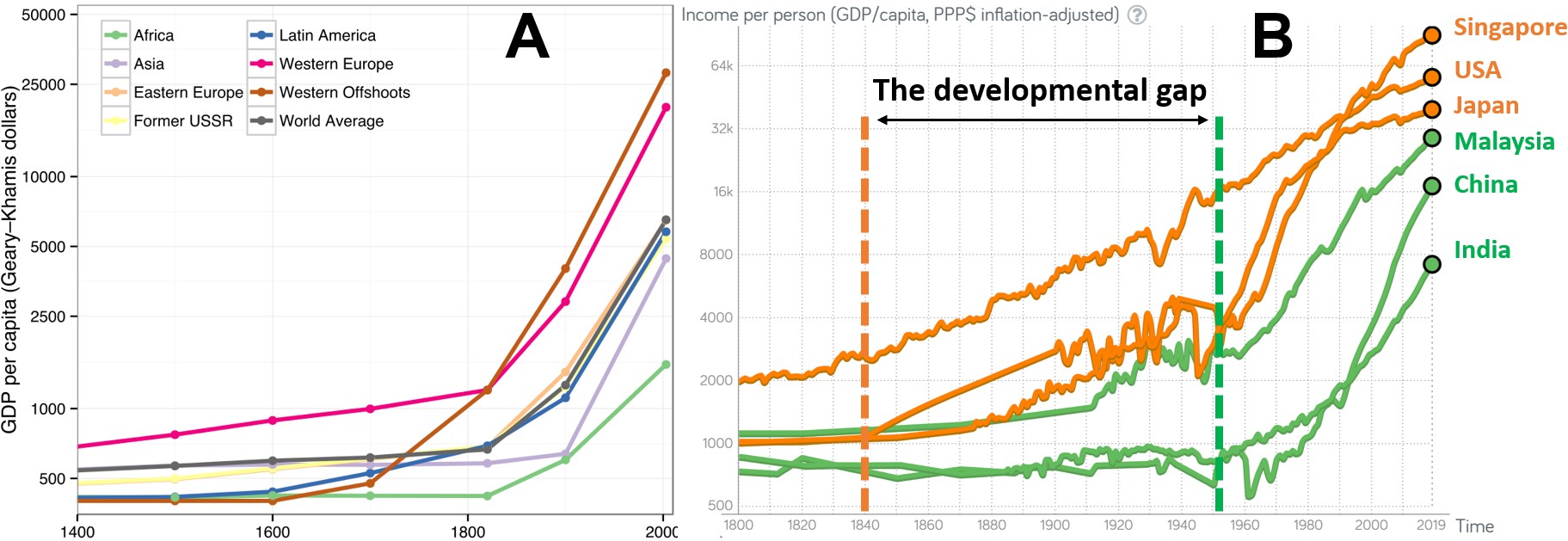
Democracy wasn’t problem free either. Even though ‘free market competition’ should in-principle correct itself, the realities of monopolization and government lobbying by the behemoths, seemed to offer a “perceived” version of democratic choice. New innovations which break these cycles of monopoly are becoming increasingly infrequent, especially with the liberalization of corporate mergers and take-overs. The epic tales of Tesla versus Edison ring similes; history seemingly replete with examples even more relevant today. Income-inequality seems to be at historic highs in this “free world”. It is no surprise therefore that some believe in a socialist solution, that enshrines more regulation and re-distribution of resources, since those at a better vantage point never seem to recognize their pre-existing privilege (the rich get richer). Nothing brings fore this argument better, than the climate crisis we face today. Two centuries of energy-hungry progress benefitted the developed nations; a cost that they now want everyone to incur by regulating responsibly, going forward. Having benefited from a much smaller piece of the fossil-fuel pie, mid-income countries like India particularly feel disadvantaged. In the last 30 years of globalization, when the country seems to have finally gotten a foothold, the ‘privileged’ (class?) don’t seem to recognize the spoils they stand on, and give us our due. Have we missed the development bus? Is it too late?


Figure 1: Graphical representation of GDP growth: (A) across world economies from 1400 – 2019 (source: Wikicommons), (B) selected comparison of three large (orange) and medium (green) sized economies from 1800-2019 (source: GAPminder). Note: Since the Y-axis in both graphs is logarithmic, the differences are much larger than they appear to the eye.


Science in modern India

Unsurprisingly, from Charaka to Bhaskaracharya, scientific contributions in ancient India came from the ‘educated’ cream of the Varna system. Mathematical treatises developed largely for religious purposes found applications in trade and agriculture; rather than to objectively derive fundamental laws of the universe. Cycling education among the elite top of the caste pyramid, limited the diversity of ideas, evident today as voids in the historical continuity of scientific thought. Three millennia later, having lost its material riches to centuries of invaders and 200+ years of colonial rule, post-independent India had a huge poverty problem at hand. Socialistic policies tried to ensure that school education be practically open to all. Some elites did benefit by seeking institutes of higher learning abroad. Albeit its socialist grain, in order to produce high quality science, earlier governments stressed the need to focus its limited resources into a handful of research institutions. These however stayed functionally disconnected from the broad university base, that housed the doyens of classroom teaching, what I would qualify as bookish or even rote. This served to rapidly ‘educate’ and create the much-needed manpower. As a philosopher once said, “Tell me and I forget, teach me and I may remember, involve me and I learn”. This separation of the practice of science from the larger ambit of education not only created a populace largely lacking the expertise to innovate, but also dwarfed their ability to query with an open mind, limiting our understanding of the scientific method. Further fueled by our cultural context where hierarchy is revered and textbooks become dogmatic truth, a youngster who questions senior authority is looked down upon as being disrespectful, or even deviant. Breaking free off these shackles of centuries of conditioning (a slew of reasons, impossible to cover in this discussion) is not easy. With limited access to higher learning, we never really generated the critical numbers of scientists that a developed nation could achieve. Having been deprived off new role models to look up to, such societies began to look inward, taking respite in their glorious past. With limited resources and little to celebrate, nationalistic fervor clung to historical reverence and empirical method of the ancients. It seems, the time is ripe, to recall one of the eleven constitutional duties enshrined for every citizen of India – to maintain scientific temper. How long can we remain victims to cycles of privilege? India opened-up to a global free-market economy, slowly losing its socialist grip – Could we recreate the American dream at home?


The free market and science funding:

Science can be broadly classified into one that is fundamental in nature and largely curiosity driven (blue sky research), while the other is utilitarian, where the taxpayer gets tangible benefits in return. The connection is often not apparent to policy makers: By asking Fundamental or sometimes even uncomfortable questions, basic scientists discover new principles, which are then used in innovative ways by applied scientists to design novel technologies that help drive capitalist markets. Many such technologies in turn, enable basic researchers with new tools, making discovery and innovation interdependent; the two crutches of scientific progress. The problem is that the applications are often different or too far-reaching than the basic research it originally stemmed from. Did Newton think “….just maybe, if I know why this apple fell from the tree, I will figure out how to colonize Mars!!!”? …in all humility, I would say, probably not! It is this incongruent connection, that makes fundamental research ever more vulnerable to getting hacked off-the-list by free-market funding, typically driven by capitalistic demand. Public funding is therefore critical to create this balance. It is this seemingly undemocratic treatment of science funding by a democratically elected government that defines their vision and the future trajectory of their people. Keeping these aspects and limited resources in mind, one can now introspect; how did independent India’s gamble pay off?


Socialist policies in education and development from the 1960’s to mid-80’s laid the foundation for a ready manpower towards IT and globalization policies. As a result, in the next four decades, India’s per-capita GDP steadily went up. As the pie grew, net science funding did increase, but the percent contribution of the pie did not change. Not only did it fluctuate around a meagre 0.7% for 70 years, of late it has been at a low of ~0.6%; about 4-5 times lower than China or US and almost eight times lesser than South Korea (which handled COVID-19 quite effectively). As demands for higher learning in India keep increasing, will the concomitant decrease of adequate funding per researcher reinstate brain-drain? The Indian problem is further exacerbated with abysmally poor investments from the private sector. Compared to every government dollar that is matched by $6.3 invested by the US and $4.9 by the Chinese market enterprises, private investments in Indian science appear puny ($0.66). In hindsight one can either blame the lack of policy/tax-incentives for the private sector or an even deeper anathema of bookish education, that probably left Indian capitalists clueless of how basic research fuels economies. Scientists stayed in their academic cocoons, failing to cross over and communicate the scientific method to the masses. In this ignorance, science careers are still looked upon largely as fringe, or purely as academic exercises (with hardly any monetary future). Privilege would allow a few to seek better opportunities abroad thereby benefiting the west, instead of the Indian taxpayer’s toil that
educated them.

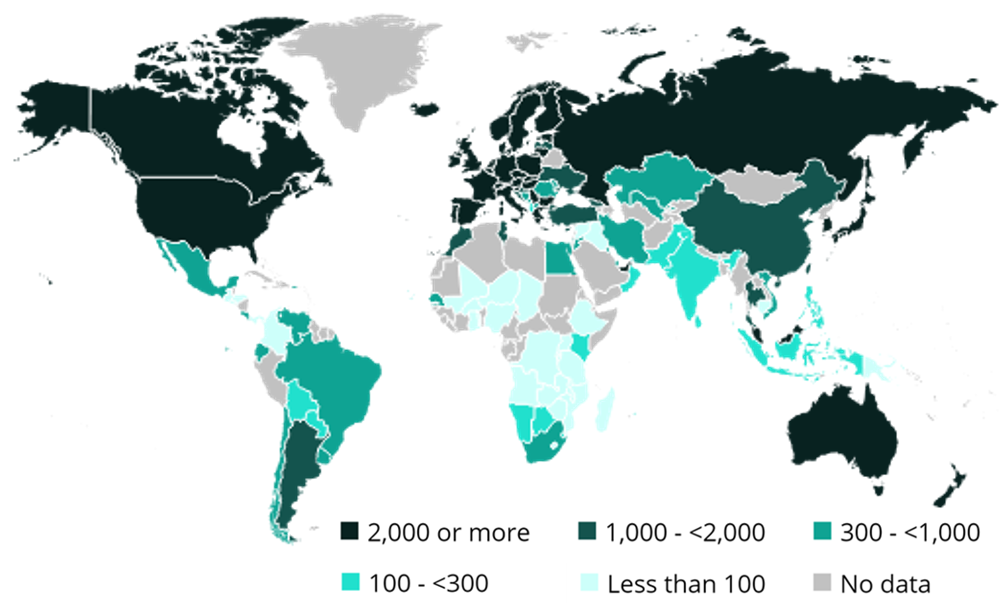
Figure 2: A color coded world map representing full-time researchers in each nation normalized to per million of the population (Source: UNESCO.org).


Yet, all is not gore. India prides itself in low cost alternatives as the messiah of underdeveloped nations. “Jugaad” has been an integral part of all things done, including pharma which does not invest on discovering new drugs, but rather makes mimics of existing ones. This helps bypass patent laws and provides cheaper alternatives to a large majority. Young english educated Indians have become our USP for human resource, a service industry for technology that we pride in. Thanks to Homi Bhabha’s vision, all governments have supported India’s space and nuclear program, which has many indigenous products under its wings. However, among all this ‘applied’ pride, the thread of underlying fundamental discoveries that builds Nobel Laurates here, are few. This leads us to a darker side of this debate! Unable to generate fundamental intellect, breaks one of the two crutches of scientific progress – Discovery! Does this make us subservient to new science and technology that is only being developed by the west? One must stop and ask, what will it take to break this cycle?


Part II – The Scientist as a COVID warrior

Evolution: the evidence at play

“Change is the only constant” – a discourse often attributed to the Greek philosopher Heraclitus, reminds us to keep our anthropocentric ego in check when we claim perfection. The human species is only a piece of the puzzle in the continuum of evolution, and change we will. Falling prey to popular misinterpretation, science-critics and faith-based believers often ask, “Is evolution real? still occurring? ….we don’t see monkeys turning into Humans”. Often, we do recognize the visible battle between predator versus prey on National Geographic; and know, that the industrial and green revolutions have helped us tap our environments. Yet, one fails to recognize that the same evolutionary battle of ‘host versus invisible parasite’ unfolds amid us as a battery of diseases. This has always maintained a threshold on human life. Something changed in the 1920s. From a prior life expectancy of ~25-30 years (on average), to a whopping 70-90yrs today, we owe this solely to the scientific discovery of antibiotics and innovations in modern medicine. But are we winning this battle? Of late, we hear of multi-drug resistant bugs that leave us bare to disease attack. Overuse of antibiotics has allowed microbes to evolve against this blockade. Even at the macro level, overuse of natural resources has increasingly narrowed the divide between the land occupied by agriculture versus the wilderness. The delicate containment of microbial infections within their isolated ecosystems was disturbed, when exposed to human endeavor. Species and their microbiomes are fighting back for survival, with diseases making proximal jumps into human societies ever so often: HIV, Mad Cow disease, Swine Flu, Nipah Virus, Bird Flu, SARS, MERS, to mention a few. The ugly face of this evolutionary evidence couldn’t have been starker than the emergence of COVID-19, that brought the world to a standstill.


Understanding this would mandate that scientists discover the principles of ecosystem biodiversity, and then innovate on sustainable development that preserves this balance. Ranking sixth among the 12 mega-biodiversity centers in the world, and with a population density of 455 people/km2 (world average 60), the need for corrective measures in India doesn’t escape anyone. Due to historic sub-compartmentalization of the sciences into zoology and botany, documenting our ecosystems has been largely qualitative or of taxonomic interest. Adding microbiologists to the furor, the modern era of genomic and metagenomic strategies make it possible to have a quantitative birds-eye view of our ecosystems, along with the invisible microbiomes therein. This creates humungous amounts of big-data, that needs synthesis and analyses from multiple angles, so that we can fit this quantitative terrain on to the qualitative jigsaw. Ecologists have stepped out of their silos and collaborated across disciplines with computer engineers, statistical modelers, and even economists! Not known to many, it is unsung public funded efforts like these, that helped to better contain the previous six jumps betacoronaviruses have successfully made into humans: 229E, OC43, NL63, and HKU1, besides SARS and MERS. Ecological discoveries of such fundamental nature should help not only to predict, but even innovate methods to contain future outbreaks. Are funding mechanisms in India able to arm university researchers towards a diversity of such collaborations? Are we enabling science students with an appreciation of such interdisciplinary platforms?


The elusive magic bullet against COVID-19

Why is there no cure; Aren’t scientists doing enough? From the first report in China, to sequencing the entire blueprint of the SARS-CoV2 genome, took less than two months. A pace never-before achieved in the history of science, only prior investments in infrastructure and technology development could have helped achieve this. Yes, Rome wasn’t built in a day! One of these genome sequencing technologies, took an Indian-born British scientist, Sir Shankar Balasubramanian, two decades to develop! Having invented Sequencing by Synthesis (SBS) and merging it with the Swiss cluster-amplification of DNA colonies, his group established Solexa/Illumina, a sequencer that could read even the entire human genome in under two days. In sharp contrast, the first attempt to sequence the complete human genome took public funding from six countries, almost 13 years to complete (in 2003). As technology grows, the infrastructure for fundamental research also needs to be spruced up. Broadly grouped under NGS (next generation sequencing), every major University in the US possesses multiple such sequencers. In contrast, even the major state funded University of a megapolis like Mumbai, has none.


With a growing population density whose age structure is fast changing, and a tropical climate conducive to a variety of human diseases, new zoonotic jumps will likely become a harsh reality in post-COVID India. We face a diversity of gaps that need to be tackled scientifically. Paucity of funding and a lack of impetus in rebuilding university spaces, leaves the average Indian researcher ill-equipped to delve deeper into many such issues. So, it echoes, India cannot be built in a day either! Stagnating universities are stuck with technologies of the bygone era that takes years to get to a solution, rather than updated high resolution methods invented by “the west”. To recall the vicious cycle, a lack of new fundamental discoveries leaves us vulnerable to these “economic masters” of progress, who will continue to ride their inherited privileges. To add to the saga, our bureaucratic systems are extremely resilient to change; to match the pace at which problems are emerging today. Even senior scientists who have been through the rigmarole, tend to throw their hands up and blame the “system”.


But the system is us! Just as ‘evolutionary change’ allows new diseases to pop up, if our funding strategies and enabling systems do not evolve fast enough to fight back, we will be left behind. It’s common knowledge that one needs a Bio-safety-level III (BSL-3 and above) facility to do any infectious disease research. Yet, we must deal with the reality that such installations are only available in select institutions. Fewer institutions equal fewer researchers: ~156 per million in India, compared to 1089 in China and 4205 in USA. Obviously, this bleeds to a lesser diversity of problems that we can effectively tackle. Although some institutes (IISc, Tata Institutes’, IISERs’, IITs’) have seen a net increase in science funding, they only cater to the crème de la crème students of India. The plateauing size of the GDP pie and this elite focus leaves a larger majority of university students and researchers unattended. A phenomenon, Indian history has witnessed before (the educated elite of the caste pyramid), this in turn limits the diversity of ideas that we can harvest from! Fewer research institutes also mean that they are already executing select “research questions”, which directs their infrastructure and the associated projects. Many ‘central facilities’ are open for other researchers to tap into, but suffer from accessibility and available machine-time, due to the number of users they cater to. The problem is further exacerbated as many have to fend for their own maintenance and material costs. These get passed on to the end user, the common scientist, who often finds it unaffordable. With pressure to publish, pumping in their own hard-earned salaries into work related travel, participating at conferences, striking collaborations or even buying machine-time, has become somewhat normalized. Put together, these seem like a behemoth of a ‘system’ to change. Given that the expertise and infrastructure dictate the flexibility of future research, scientists find it challenging to change course suddenly, to accommodate new problems. Although the SARS-CoV2 genome sequence was made freely available, by the time India announced its first vaccine trial, the UK, US, and China were already in Phase-II of testing their candidates. Russia came under criticism as it had abridged the rigmarole and had already announced its first vaccine. Something must fundamentally change in the way we do science in India! Is the new wave of nationalism helping strengthen our systems from within? Or do we continue to gaze into our glorious past and try to reinvent the wheel?


Figure 3: Graphical representation of average Life Expectancy (aLE) from 1800 – 2019; UK (yellow), USA (green) Egypt (blue) and Asia (red). The black arrow marks Indian aLE at 25.3 years until independence (Source: Gapminder).


Ancient knowledge versus ancient science?

With the internet being everyone’s playground, social media has paved the way for a new wave of “uncensored personalized journalism”. The fringe had now gained a voice. We were happy absorbing short rhetoric via conduits like WhatsApp: ‘our ancestors had long lives’, ‘they knew of miracle cures’, and ‘had technology that would dwarf today’s western thought’! Although nationalistic in some sense, it did morph some misconceptions of “Arabic” numerals, the discovery of Zero, Pythagorean concepts and astronomy, to name a few. At a time when Europe was in the “dark ages”, Ayurveda flourished – a methodology empirically codified over hundreds of years of repeated trial and error. These were followed by similar empirical themes of naturopathy and Homeopathy. How effective were these time-tested systems: does evidence speak otherwise? Having an average life expectancy of only 25-30 years would mean, that we would enjoy a meagre 10-12 years after school education! Thankfully, the empirical method was replaced by the objectivity of testable hypothesis-driven discoveries of modern medicine. Armed with this wisdom of 100+ years of the improved scientific method, can we now discover ‘hidden hypotheses’ in ancient empirical knowledge systems? Or should we just go back to the uncertainty of empirical methods (trial and error)? Who would like to be that scapegoat? Not you, not I. The new Ministry of AYUSH was created in 2014 to streamline exactly such issues. But the same fervor that does not allow us to question our parents, our seniors, our authorities, …also apply to our revered ancient texts! ‘Why should our (ancient) knowledge be put through western tests’!? The answer stares at us, in one clear fact: in less than a hundred years, modern medicine increased the average Indian’s life expectancy to 70+ years, a number that had otherwise remained stagnant for millennia. It is obvious, that modern scientific method is not only rigorous and corrective, but also highly fruitful. But even the best scientists today, do not have all the answers! COVID-19 has bared this underbelly again! With no magic bullet at hand, the desperation to protect ourselves has driven many to reinstate faith in home remedies as the cure – but strangely enough, even for a disease that mankind had never encountered before? Who suffers from this fake information? Despite their beliefs, the privileged reap the benefits of modern medicine in the nick of time, that saves lives. The dogmatic uninformed, people who live in socially influenced cluster communities, remote villages, etc. rely heavily on home remedies, not only out of sheer faith, but also economic disparity of resources. They pay the price!


History repeats itself. Ancient medicine has been with us for millennia! But what we didn’t have when the 1918 Spanish flu hit us, was modern medicine! A hundred years ago, people behaved exactly the same: the Flu spread along the major trade routes (railways), possibly because of migrant laborers who fled the diseased metros. India saw a first wave of the flu in the summer, but a much larger and lethal wave by December. Wouldn’t it be prudent to revisit all the factors that left us vulnerable to the second peak, rather than fund the testing of dogmatic benefits propagated by social-media-medicos?


The way forward

Why are we always playing catch-up? History of India’s science funding highlights three problem areas: (1) The small percentage of public-funding (% of GDP); (2) Poor academia-private partnerships; and (3) A change of focus to enable the larger university system with updated research facilities and training. For every dollar cumulatively spent by the Chinese, we invest less than $0.14 towards science. Factoring in the number of scientists per million who get these funds, each Indian scientist should’ve been almost three times richer than their American counterparts. Clearly that is not the case! Does this point to an “income-inequality” in granted funds among Indian researchers: i.e. science funding really goes to a focused (privileged?) few! Are they just building on their privileges – better publications attract better funds? Or does both government vision, as well as amount of science funding, need a deeper overhaul?


Over the last two decades, governments have instated awards like the prestigious INSPIRE, Wellcome-DBT Alliance, Ramalingaswami, and Ramanujan fellowships, to reverse brain-drain. Of particular mention in the past two decades, is the rapid expansion of technology hubs like the IITs and the establishment of new fundamental research institutes like the IISERs, NISER to mention a few. Although fewer laurels go to discovery, thanks to the service industry, India emerged as a world leader in vaccine production. Once the designs by UK/US labs are validated, many eyes will turn to India for ramping up production. Early on, Indian companies produced PPE kits, while scientists developed modern technology for indigenous detection kits (LAMP, CRISPR etc), that are awaiting ICMR approval.


The question though, is not about a few beacons of glory. India has been projected to become the most populous country by 2024, while nature’s vehemence of climate change and global warming, keeps altering disease landscapes in unpredictable ways! “Are these efforts enough for a good future?” – a pertinent question in the post-COVID era. I argue that the key is in increasing the diversity of research areas, and achieving a critical mass of well-funded researchers across the country, which will trigger discovery! This would call for targeted funding of research infrastructure of state-owned universities or even private universities, that are currently no match to their American counterparts. Recent models like CEBS-Mumbai are being tested to reinstate a research environment within the archaic university ecosystem. Maybe we can achieve such middle ground, by adding enabling mechanisms that require established research institutes to adopt a few smaller university systems and help rebuild them from within. If successful, can that be quickly replicated across Indian universities? Can COVID-19 imposition of electronic connectivity help us to think out-of-the-box?


Tangible solutions?

There is no such thing as Ancient Science and Western Science. We need to act in sync with our constitutional responsibilities and evaluate every claim, based on a common benchmark of scientific temper! Education should be enabling us to question, what we deem scientific. Based on deeper introspection and the discussions presented here, I list a few suggestions that might help going forward:

(a) Increase public funded research to at least 3% of GDP, maintaining a large impetus on much needed basic research: Build evaluation procedures for blue sky research on the merit of their ideas, uniqueness and experimental implementation towards building on their hypotheses – does their research push the boundaries beyond existing knowledge? These checks will likely arm us with avant-garde discoveries, and therefore have the potential to generate new IP/technology; (b) Build attractive propositions for private investors to match funding in government aided institutes – with different incentives towards blue sky versus applied research; this will aid the much needed crosstalk on: How market expectations can be fulfilled by university graduates; (c) Evaluate applied-researchers for vertical projection of their research, and not just for publication-heavy output which keeps expanding laterally without achieving fruition at the marketplace; Encourage vertical collaborations with industry with high-risk:high-reward patent funding; this will encourage free-market entrepreneurship and start-ups. (d) Restructure administrative policies: With increasing average age of the population, age restricted policies and archaic guide-ship rules in most universities need overhaul. With longer life-expectancy and inter-disciplinary careers, 35+ year old academic researchers find themselves ineligible for many funding programs or find it difficult to shuttle back from non-academic spaces; we have to remember, ideas aren’t limited by age or origin. (e) Fill up the faculty vacancies abundant in university systems, which forces them to employ stop-gap teachers with lesser experience, further lowering the standards of research and education. Provide attractive funding packages to reverse brain drain at these posts. (f) Enable the underprivileged with scholarships/funds, especially women and the economically marginalized, to help bridge both social and gender-sexuality divide in science.


Last but not least, there is one crucial nail in the coffin, that I believe will help in achieving the above: engaging scientists in all fields of policy making! Bureaucrats are great at bringing information and analyses to the table, but scientists are good at using objectivity for building new hypothesis, and testing them. Most importantly, when 9 out of 10 experiments do not work, scientists do not look at them as failures. In fact, failing is an integral part of the scientific process, because each failure will cut-off an unwarranted diversion early on, thereby steering the path towards fruition. Constitutionally speaking, we should base all decisions on evidence; not dogmatic ideologies or flair filled projections. Let open debate become a part of the process once again! Of course, this is not going to be cakewalk! It will require diversion of funds from existing resources, towards scientific research. That is where bureaucrats, politicians and scientists really need to scour the evidence at hand. I would envisage a future, where lawmakers and scientists come together to shape a body of “Science governance”: a lawfully abided by independent governing body of scientific method that will oversee all branches of science: from inductive reasoning to deductive methods, from molecular medicine to alternative approaches. Unless we abide by a common benchmark of scientific temper, pseudoscience and WhatsApp medicos will continue to flourish and create harm.


Our Honorable Prime Minister’s clarion call for an ‘Aatmanirbhar Bharat’ can only be realized by planning for self-reliance in the vision. Yes, we have a long way to go, but all is not lost! ….For now, COVID-19 has caught us by our tails! How quickly we can turn the situation around, really depends on how we develop a strongly funded backbone that is yet bureaucratically flexible enough, to turn and fight back!


Subhojit Sen is a Ramaligaswamy Fellow and a faculty hosted by the UM-DAE Centre for Excellence in Basic Sciences, Mumbai. Views expressed are personal.

This article is part of a series called “Academics Post COVID-19”. The other articles in the series can be found here.

Sexual harassment at higher education institutes: what needs to be done?

I have been working in the field of social development for more than twenty years. I am associated with the Pune-based organization ‘Nari Samata Manch’ which works on the issues of violence against women. I have been working on the issue of sexual harassment of women at workplace since the times of Vishakha guidelines. I work as an external member in the internal committees at a few workplaces in Pune including higher education institutes, government as well as corporate workplaces. All these years, I have been engaging in creating awareness on the law related to sexual harassment at workplace. Much of what I have to say below is based on my personal experiences in dealing with these issues over the last two decades.


The Vishakha guidelines came in 1997 and later the law was enacted in 2013, but the issue of sexual harassment at workplace really came into debate with the ‘Me Too movement’. Soon the silence on sexual harassment in academia was broken with a google spreadsheet created by an Indian law student (now in US). The list consisted of the names of persons in both Indian and foreign universities accused of sexual harassment. This created a storm of debate in academia. The list was condemned by many, as the claims were unverified. The female student who floated the list justified her act. She wanted to alert female students about the abusers because nothing happened even when the complaints were raised many times in some of the cases. What was the response of concerned universities to this ‘Name and Shame list’? Unfortunately only a handful of institutions/universities took cognizance of this, conducted inquiries and took action against the accused based on the inquiry.


This throws a light on the state of response from the administration to the complaints raised by students. UGC had come up with the Saksham report in which sexual harassment at Universities or Higher Education Institutes (HEI) is discussed extensively and clear guidelines are issued. India got the law related to sexual harassment of women at workplace in 2013; before that we had Vishakha guidelines operational since 1997. But the guidelines were rarely implemented in its spirit. There were repeated incidents of sexual harassment and  redressal was seldom achieved. Hence in 2012, a Public Interest Litigation was filed in the supreme court highlighting a number of individual cases of sexual harassment in academia and other sectors and arguing that the Vishakha Guidelines were not effectively implemented. Supreme court gave the directive that State functionaries must put in place sufficient mechanisms to ensure effective implementation of the Vishakha Guidelines until the enactment of the bill.


In 2013, the Sexual Harassment of Women at Workplace (Prevention, Prohibition and Redressal) Act came into force.  In 2014-15, Indian universities reported 75 complaints of sexual harassment. These figures were from a report received by UGC from 84 universities about cases of sexual harassment against women lecturers, professor and research scholars. While looking at these numbers, we need to keep in mind that the issue of sexual harassment has a stigma and many incidents go unreported.


In 2016-17, 149 complaints were reported from Universities/HEIs. The latest report on the UGC website (April 2018-March 2019) consisting of data for only 188 universities mentions 171 complaints of sexual harassment. The total number of universities/HEIs (including private universities) is 945 as per UGC data. Out of 188 universities who filed a report, 29 universities have replied as ‘Nil’ to the question whether internal committee is constituted as per the Act, although constitution of the committee[1] is mandatory after enactment of the said law. Creating awareness is one of the mandates given by the said law but only 417 awareness/sensitization sessions were organised in these 188 universities, which shows how poor the efforts of outreach are.


Along with this, time and again, many issues were flashed in media with respect to implementation of the law and inquiry process. One major issue is no response or poor response from management/administration on the concerns raised. The student behind ‘Name and Shame list’ stated the same reason for her act. Many students have alleged that administrations protect the accused and turn a deaf ear to their grievances. Many a times, complaints were not registered as the complainants were asked offending questions when they tried to report their grievance; such as “What did you wear?” “Who was with you?” “Why did you go there?” These are the usual reactions of our society in cases of sexual harassment or rape. But the ‘responsible’ persons at the universities/HEIs in these cases reflected same misogynist attitude.


About the enquiry process, many students have shared their experience of victimization. To some, committee members advised not to follow the case as the accused has a brilliant career or have higher standing; it will bring defame to the institute/university and so on. In some instances, students had to approach police rather than the internal committee. This shows that there was perhaps a lack of confidence on the committee by the aggrieved persons for (obvious) reasons such as the accused being member of the committee, perception that committee members would be in favour of the accused, perceived fear of impact on work/career and sometimes ignorance of students for such internal redressal mechanism. The onus of this ignorance is again on the administration since it is their responsibility to make all the concerned aware about it.


What needs to be done at the universities and HEIs?

The UGC  guidelines on how to deal with sexual harassment are very clear. In view of the Act and these guidelines, Universities/HEIs must do the following;

  • Set up the committees as mandated by the law
  • Organise regular training for committee members to handle the complaints properly
  • Organise sensitization sessions for students, faculty and the staff
  • must treat sexual harassment as a misconduct in service rules and initiate action for such misconduct
  • must have guidelines for ‘ethics for research supervision’ as research students are more vulnerable to sexual harassment.


In case of non-compliance, UGC can withhold grants or may withdraw the recognition to receive the grants from UGC.


Universities/HEIs are primarily the spaces for students and their wellbeing should be treated as a priority. Sexual or any harassment generally arises through power relations. Patriarchy normalises sexual harassment of women. But it needs to be looked as human rights violation and should be treated sensitively. Not just female students, male students may also face sexual harassment owing to the power relations especially in case of research students where their supervisors have the power. Considering this, UGC has directed that students of all genders can complain if they face sexual harassment at their college/university. Queer voices are almost missing from our campuses. UGC amended the definition of ragging to include discrimination based on sexual orientation and gender identity.  UGC guidelines to this particular law of sexual harassment at workplace have made the redressal available to students of all genders. But much remains to be done on this front as well.


Along with students; women faculty and women staff members can make complaint of sexual harassment. This law is not gender neutral, it recognizes the patriarchal bias and power imbalance among men and women. It specially came into force to deal with sexual harassment of women at workplace as women are more vulnerable to sexual violence than men. Understanding the spirit and purpose of this law, universities/HEIs should treat it as a priority.  Our ecosystems certainly need to be improved in terms of gender and social equality. Recently there was a debate on casting couch and many women actors openly talked about it. A famous and powerful Indian television producer made a statement that new comers are also ready to make compromises to get the work. But is it a bargain? And is it between the equals? If the ecosystem is of compromises and leaves no other ways; what would a struggler do? So certainly, a larger burden of shaping the world is on senior, powerful and responsible people in every walk of life.


Notes:

1. Internal Committee is an internal redressal mechanism which has to be constituted as mandated by the said law whether there is a complain or not. The committee has to conduct a proper inquiry in the complaints of sexual harassment.


Preeti Karmarkar is associated with the Pune-based organization ‘Nari Samata Manch’ which works on the issues of violence against women. She has also been a part of several internal committees over the years. Views expressed are personal.


This article is part of a Confluence Series called “Under-represented groups in academia: issues and way forward”. The remaining articles can be found here

NEP 2020 on Higher Education: Wishing Away Structural Problems, Wishing a Magical Solution

Of the astonishingly large number of those who have given approving nods to the National Education Policy (NEP) 2020, one remains unrecorded. That is a beaming nod from the nether world, where the soul of George Nathaniel Curzon, 11th Viceroy of India (1898-1905), would surely be exulting in the realization of his own unfulfilled dreams for higher education in India. At least three of Curzon’s aspirations are addressed, directly or indirectly, in this document: entrenching centralized state control in the governance of education; fixing the problem of affiliating colleges; and restraining the political activism of students.


There is of course a lot more in the NEP 2020 that is deserving of comment, but the scope of this essay is restricted to four issues: the process followed in formulating this policy and, in substantive terms, three aspects of its recommendations relating to higher education: the regulatory architecture, university governance, and educational content.


The policy process: Limited consultation and transparency

It has taken the government four years and as many draft reports, ranging from 55 to 484 pages to come up with a new National Education Policy. Even so, this policy, unlike its predecessors of 1968 and 1986, has not been through an extensive consultative process with experts, parliamentarians, and the states.


In 1967, the central government constituted a committee of 30 members of parliament (MPs), representing all political parties, to prepare a draft of the National Policy of Education based on the 1966 Kothari Commission’s recommendations. The commission’s recommendation of selective admission to universities was rejected by the committee of MPs, with Jagjivan Ram even threatening to launch a satyagraha if it was accepted. Nine members wrote minutes of dissent, running into 23 pages appended to a 26-page report. This report was considered by the Central Advisory Board of Education (CABE) and by the Vice-Chancellors’ Conference. Most vice-chancellors opposed Kothari’s idea of developing half a dozen universities as major universities comparable to the best in the world. Opposition to what were perceived to be elitist tendencies resulted in the rejection of some and stymying of other aspects of the policy’s implementation. This was enabled by the very effort of building consensus around it in an incredibly democratic process (Naik 1982, 34-40).


The 1986 National Policy on Education had a strong policy champion in Prime Minister Rajiv Gandhi, who wanted the new policy drafted in one month and, if possible, for implementation to begin even before it had been completely formulated. This impatience derived from his vision of propelling India into the 21st century and the age of information technology. This techno-managerial vision, in no small measure informed by the World Bank’s advocacy of education as human resource development, found expression in the renaming of the Ministry of Education as the Ministry of Human Resource Development. (The rollback of this nomenclature in the NEP 2020 would be a welcome step, if only name changes—for which the ruling dispensation has a special fondness—could produce real change.)


Rajiv Gandhi’s enthusiasm for speedy education reform was reined in by a secretary who persuaded him that such an exercise required widespread consultation with a range of stakeholders, including and especially the states. The process of consultation was conducted over 18 months, under the leadership of a new minister, PV Narasimha Rao (who had earned his education spurs as an effective minister for education in Andhra Pradesh). Sifted—sometimes postcard by postcard—compiled and analysed by the National Institute of Educational Planning Administration, the consultations yielded 18 reports that became the basis for the formulation in 1985 of The Challenge of Education: A Policy Perspective. This document was discussed at a meeting of state education ministers at the CABE, and of chief ministers at the National Development Council. It was after this extended process that the policy was adopted by both houses of Parliament in May 1986. As many as 23 thematic task forces were then constituted which developed a Programme of Action, that was once again considered by the education secretaries of the states (Ayyar 2017, chapter 3).


Both the 1968 and the 1986 policies—the first while education was still a state subject, and the second after it had entered the concurrent list—were thus put through extensive consultative processes. By contrast, the consultative process of NEP 2020 appears to have been limited and anodyne.


The origins of the latest policy lie in four previous documents. First, the 2016 report of the Committee for Evolution of the New Education Policy (henceforth the TSR Subramanian committee), all of whose members (bar one) were bureaucrats. Second, the draft National Education Policy of 2019, formulated by a 10-member committee headed by K. Kasturirangan, and followed by, third, an abridged 55-page version of it. Finally, after the 29 July press conference announcing the policy, two apparently identical documents came into circulation within a couple of days of each other. Both carry the official logo, both are undated, and both purport to be the NEP 2020. Neither has the usual covering letter, suggesting an in-house production. I refer to them as NEP 2020 v.1 and NEP 2020 v.2. The latter is on the official website and it is six pages longer than the first1. The reason both find mention here is because there are notable differences between them.


A single slide projected at the press conference announcing the NEP 2020 offers a cryptic overview of the platforms on which consultation was conducted around the Draft NEP 2019 – on mygov.in; in panchayats at all levels; and with MPs from seven states, apart from CABE and the Parliamentary Standing Committee. But, with characteristic opacity, it offers no account of consultations with the states. Nor is it clear as to how exactly the “unprecedented process of consultation that involved nearly over 2 lakh suggestions from 2.5 lakhs Gram Panchayats, 6600 Blocks, 6000 ULBs, 676 Districts” and the “unprecedented collaborative, inclusive, and highly participatory consultation process” was conducted and to what effect.


The response of most of those who welcomed the NEP 2020 was qualified by a “but what about the implementation?” clause. There are, however, substantive shortcomings in the policy, which include but are not exhausted by the lack of pathways to implementation. Past practice also indicates multiple steps between union cabinet approval for a policy and its implementation. Here, however, the 29 July press conference announcing cabinet approval was followed on 17 August by presidential approval for the name change of the ministry. On 19 August, the government announced a test run of the students’ ‘credit bank’ by December 2020.


There is no word yet on whether the new policy will be placed before or adopted by Parliament. Since the states do not appear to have been an integral part of the consultative process, how much control and flexibility will they have in adopting and implementing NEP 2020? Will the acts governing central and state universities be modified by Parliament and the state assemblies, respectively? The process followed so far falls considerably short of the standard mechanisms of consultation and transparency.


What ails higher education and what will it take to fix it?

The NEP 2020 offers a diagnosis of the challenges in the field of higher education and a vision for overhauling and re-energising it. The lists of 10 problems and 9 solutions are wide-ranging: the educational ecosystem is fragmented, hence large multidisciplinary universities are called for; there is too much specialisation, hence a multidisciplinary undergraduate education is needed; there is a lack of access to higher education in socio-economically disadvantaged areas, hence a range of measures for increased access and inclusion are required; the lack of emphasis on research in colleges and universities calls for the creation of a National Research Foundation to actively seed research and to fund outstanding peer-reviewed research; and so on.


The responses to some deficiencies are manifestly meaningless: the solution to the problem of limited teacher and institutional autonomy is “moving towards faculty and institutional autonomy”; to “inadequate mechanisms for merit-based career management and progression of faculty and institutional leaders” is “reaffirming the integrity of faculty and institutional leadership positions through merit-appointments and career progression based on teaching, research, and service”; and to “an ineffective regulatory system” is “`light but tight’ regulation by a single regulator for higher education” (NEP 2020, 33-34).


The core of the plan for the overhaul of higher education is its structural reorganisation into large, multidisciplinary universities and colleges (at least one in or near every district), many of these offering instruction in local languages. In an effort to streamline the plurality of nomenclatures, such as ‘deemed to be universities’ or ‘affiliating technical universities,’ it proposes to have only three types of universities: Research-intensive Universities, Teaching-intensive Universities and Autonomous degree-granting Colleges.


Existing colleges (a daunting 40,000) will gradually become Autonomous Colleges or else get phased out. It is not clear whether some of these or altogether different institutions will become Model Education and Research Universities, or MERUs, on which little detail is offered beyond stating that they will set the highest standards for multidisciplinary education and attain the highest global standards in quality education (NEP 2020, 38). Or might these be the grown-up form of the much-vaunted ‘Institutes of Eminence’?


The policy is similarly short on specifics for the Higher Education Institution (HEI) clusters or the Knowledge Hubs that it envisages as buzzing with artistic and creative energies in “vibrant multidisciplinary environments,” and as harbingers of a fundamental change in the “conceptual perception/understanding of what constitutes a higher education institution” (NEP 2020,34). Some of these clichés recur with a grating regularity that is suspiciously evocative of empty vessels.


On the whole, the recommendations are less about fixing the problems in existing institutions and repurposing them; they are more in the nature of reimagining the entire system. There is a cheerful anticipation that existing problems will magically vanish by just restructuring and reorganising the edifice, out of which will emerge an altogether new and creative higher education system in a mere 15 years. This is a bit like putting an unhappy joint family in a glitzy new building and expecting its tensions, accumulated over generations, to dissolve and disappear.


Many of the structural problems that plague higher education are altogether ignored. For instance, the policy ignores the large number of faculty vacancies: 77,912 in the central and state universities. In the central universities alone, there are 6,688 vacancies, approximately one-third of a total of 18,243 sanctioned teaching posts.2 In the Indian Institutes of Management and Indian Institutes of Technology, vacancies stand at 22% and 41%, respectively. The University of Delhi presently has reportedly 5,000 teachers without tenure—the labels of `ad hoc teacher’ or ‘guest lecturer’ are clear pointers to casualization. Across India, the exploitative conditions in private colleges, where teachers are present on multiple payrolls and actually paid by none, are well known.


It does not take a lot of imagination to estimate the impact of these working conditions on the quality of education imparted or on sustaining a full-time academic programme, but they are evidently unworthy of the attention of the NEP 2020. Unless the plan is for all teaching to be robotically delivered, where will the appropriately trained teachers be conjured up from for these vibrant multidisciplinary clusters and Knowledge Hubs?


The regulatory architecture

The statement on the intent to transform the regulatory system of higher education begins with disarming candour: “too much has been attempted to be regulated with too little effect. The mechanistic and disempowering nature of the regulatory system has been rife with […] heavy concentrations of power within a few bodies, conflicts of interest among these bodies, and a resulting lack of accountability” (NEP 2020, 46). Nobody could disagree with this diagnosis of the disease, except that the cure proposed is about as convincing as hydroxychloroquine administered to a Covid-19 patient.


The architecture of governance for the entire higher education system envisages an umbrella institution, the Higher Education Council of India (HECI), which will have four ‘independent verticals’ under it: one each for regulation, accreditation, funding and academic standard setting, of which all but funding are currently performed by the University Grants Commission (UGC).


The four institutions will be the National Higher Education Regulatory Council (NHERC), the single point regulator for the entire sector (excluding legal and medical education); the National Accreditation Council (NAC), a much more autonomous and powerful version of what exists; the Higher Education Grants Council, responsible for financing (though no mention is made here of the fate of the recently established Higher Education Financing Agency (HEFA), a non-banking financial institution that gives public universities loans that are projected as grants); and the General Education Council that will frame ‘graduate attributes,’3 or the expected learning outcomes. The GEC will frame a National Higher Education Qualification Framework in sync with the National Skills Qualification Framework to integrate vocational education with higher education. In addition to these, all the existing professional and research councils, in fields ranging from agricultural research to architecture, will now be called Professional Standard Setting Bodies setting standards in particular fields of learning.


Together, these culminate in the certainty that “such a transformation will require existing structures and institutions to reinvent themselves and undergo an evolution of sorts.” (NEP 2020: 48). Grand, sweeping, and invariably optimistic statements of this kind are, in their frustrating vagueness, pervasive. Which structures and institutions will need to reinvent themselves and to precisely what effect? What will be the substance of the “evolution of sorts”? Given that education is a concurrent subject, how will this regulatory structure affect the states?


The one thing on which there is no ambiguity is that accreditation will be the powerful central pillar of this regulatory system, adjudicating the evolution of a college into an Autonomous College or into a Research- or Teaching-intensive University; deciding the movement of institutions from one category to another; and even determining the basis of public funding. The new NAC is envisaged as a ‘meta-accrediting body’ specifying benchmarks and setting levels of quality. It will therefore perform not just the role of the current National Assessment and Accreditation Council (NAAC), but also the current standard-setting role of the UGC. It will also determine the basis of funding, even if the actual funding is assigned to a separate body.


This profusion of institutions qualifies significantly the idea of a single regulator facilitating ‘light but tight’ regulation, whatever that means. The policy maintains an intriguing silence on the composition of the umbrella HECI and its four verticals, and the relationships (not to mention potential conflicts) between them. There is nothing to suggest that these agencies will not be packed with government appointees, bureaucratic or political.


Nor is any rationale provided for how the reconfiguration of ‘verticals’ and the creation of new agencies would fix the tough and longstanding problems that bedevil the higher education system. It is not hard to imagine our poorly funded and thinly staffed universities being consumed by the task of negotiating this thicket of bureaucratic acronyms and trying to render accountability to multiple institutions with conflicting requirements.


The assumption that new agencies will inherit a clean slate on which to mark their ‘light but tight’ regulatory presence is also delusional. For instance, there is no mention of a whole gamut of issues relating to academic corruption—in, for instance, licensing, accreditation, recruitment, and ghost written theses.


The TSR Subramanian report at least openly acknowledged political patronage and corruption in the appointments of teachers, the conduct of examinations, educational management, and the grant of approvals and recognitions. That libraries and laboratories are rented and shipped post haste from one college to another when the inspectorate is on its way is common knowledge. In announcing a voluntary process of faceless self-disclosure for accreditation, the NEP 2020 seems committed to the pretence that such problems do not exist. Is then the platitudinous reassurance of a new regulatory structure as the panacea anything more than a sedative?


The most notable aspect of the regulatory architecture in the latest iteration of the education policy is the mysterious disappearance of the controversial Rashtriya Shiksha Aayog (RSA), which merited a full chapter in each of the three previous drafts. Even NEP 2020 v.1 provides a detailed account of the RSA, an apex advisory body for every level of education in India replacing the CABE. In these proposals, it was variously headed by the prime minister or the union education minister, and overloaded with ministers and secretaries from the centre and the states, apart from eminent educationists and leading professionals from the arts, science, and business. But NEP 2020 v. 2 suggests strengthening, remodelling and rejuvenating the CABE. Only time will tell if the disappearance of this section from the present version of the policy is a considered change or a last-minute response to the adverse feedback it received or whether it lies waiting to be re-introduced at an opportune moment when the NEP is no longer in the spotlight.


Another happy omission from the NEP 2020 is the idea of reintroducing the short-lived colonial experiment of the Indian Education Service. This was first mooted in the TSR Subramanian report (for both teaching and managerial positions), went missing in both versions of 2019, reappeared in the NEP 2020 v. 1 (as a managerial cadre only), but is mercifully missing in NEP 2020 v.2.


Architecture of university governance

Two aspects of university governance in the NEP 2020 call for special consideration. These are, first, the issue of autonomy and, second, the proposed restructuring of internal university governance.


In the Indian educational context, autonomy is a Janus word: alluring for members of the university community but one that, emanating from the state, generally means its own opposite. Both faculty autonomy and institutional autonomy have been imperilled in recent times, unlike how the Radhakrishnan Commission (1948-49), invoking the spirit of free inquiry as necessary for intellectual progress, made a strong case for state aid “not to be confused with State control over academic policies and practices” (p 42).


In contrast, the TSR Subramanian committee, the direct ancestor of the NEP 2020, adopted a cautious and even disciplinarian approach to free speech and freedom of association, to be balanced against the “primary purpose” of universities. While Curzon would have been overjoyed by this, even he might have balked at the directive by the Gujarat government to universities to ensure that doctoral students write their PhD theses on topics chosen from a list of 82 subjects prescribed by the state secretariat.


In the NEP 2020, autonomy is something to be desired but circumscribed and controlled, for it is ultimately in the gift of the state. In terms of faculty autonomy, it promises autonomy to design curricula and pedagogical approaches “within the approved framework” (NEP 2020, 40). It is not hard to imagine the fun that educational bureaucrats could have with those four innocuous words empowering them to curtail and restrict the very freedom that is promised. In institutional terms, autonomy here applies primarily to affiliated colleges who could use it in unspecified ways to move gradually to become ‘Research-intensive’ or ‘Teaching-intensive Universities’ (ibid: 35).


The most sinister change contemplated is to the institutions of university governance. What the new policy puts in its place is an egregious violation of the fundamental principles of self-governance that are integral to the functioning of a university.


As at least formally self-governing institutions, universities typically have Boards of Studies and Academic Councils to regulate academic matters and maintain standards of instruction, education and examination; Executive Councils or Syndicates to decide on matters pertaining to the general management and administration, revenues and properties of the university; and University Courts or Senates, supreme authorities and oversight institutions that hold the university accountable to society. Faculty members occupy both ex officio (deans and chairs) as well as elected offices in the statutory bodies of the university.


It is nobody’s case that these institutions have been exemplary in their functioning. But they have served as fora where university faculty can debate and disagree (sometimes violently) before arriving at a consensus on a wide variety of academic issues that lie at the heart of what the university sees as its purpose.


None of these bodies finds even a passing mention in the NEP 2020.


Instead, we are informed that HEIs will be headed by an Independent Board of Governors, consisting of “a group of highly qualified, competent, and dedicated individuals having proven capabilities and a strong sense of commitment to the institution” (NEP 2020, 49). The brief description of its role—“empowered to govern the institution free of any external interference, make all appointments including that of head of the institution, and take all decisions regarding governance” (ibid) (emphasis added)—suggests that it would, apart from becoming the appointing authority for the vice-chancellor, essentially perform the role of an Executive Council.


What the name-change signals is the elimination of the elective principle and of the established system of representation of faculties and departments of the university. The policy does not indicate how and by whom these highly competent and dedicated individuals will be chosen. It says only that they will be accountable to “the stakeholders” (an undefined category) and upwards to the HECI through the NHERC.


In other words, the board of governors will be an unrepresentative body, independent of and unaccountable to the university community. There are no safeguards provided against its potential use of unaccountable power to, for instance, impose restrictions on academic freedom or on freedom of association or indeed on legitimate protest.


This new architecture seems to dispense with faculty participation in the governance of the university altogether. The days of the university as a community of self-governing scholars are clearly numbered.


Teachers and students: Exclusion from participation in university governance

The NEP 2020 heralds the likelihood of faculty exclusion and the certainty of student exclusion from participation in university governance. It has all of seven lines on Student Activity and Participation that effectively infantilise university students, promising them opportunities for participation in “sports, culture/arts clubs, eco-clubs, activity clubs, community service projects” (NEP 2020, 40). Apart from the studied silence about student societies that deliberate on issues of society, politics and social justice, the singular absence of any mention of students’ unions or indeed any form of student governance or student participation in the statutory bodies of the university, is ominous.


The abhorrence of student politics straddles a wide spectrum from Curzon to TSR Subramanian. Curzon’s perspective was comprehensible because student politics offered resistance to imperial rule. But given the stellar role played by students in India’s freedom movement, and the fact that the legal age of voting is 18 years, it is less easy to understand the aversion of the Subramanian committee and its successor, the NEP 2020.


The seven lines devoted to student activity are followed by as many paragraphs devoted to Motivated, Energized, and Capable Faculty. The critical role of faculty in achieving the goals of higher education is acknowledged, and faculty motivation is recognized as being lower than it should be. There is a vague mention of “various factors” that underlie this low motivation. But these remain unspecified, though a range of solutions is offered to address them: from infrastructural improvements to some curricular freedom to rewards and recognition to ensure that every faculty member is “happy, enthusiastic, engaged and motivated towards advancing her/his students, institution, and profession.” (NEP, 2020, 40).


Infrastructure improvement is an encompassing category that in the same breath covers everything from clean working toilets to libraries. That this is only one of two mentions of libraries in the context of higher education is indicative of the devastating remoteness of the new policy from the real world of higher education: of the extent to which teaching and research depend on decent library resources; of the abysmal state of university libraries and the funding cuts on journal subscriptions; and of the fact that India has the dubious distinction of hosting the largest number of predatory journals in the world. This last is a salutary lesson for the policy, as it was devised to game a well-meaning UGC initiative for Academic Performance Indicator scores to make recruitment and promotions merit-based.


The existing recruitment process is endorsed with a caveat: “a ‘tenure-track’ i.e., suitable probation period shall be put in place to further ensure excellence” (ibid: 40). This effectively makes the ‘permanent post’ impermanent. In other countries, this has been identified as a core feature of the neoliberal university, reinventing fee-paying students as consumers and rendering the labour of teachers precarious. In India, the high-sounding notes of “multiple parameters for proper performance assessment, for the purposes of ‘tenure’” (ibid) will, on the one hand, introduce further arbitrariness and politicisation and, on the other, worsen the large-scale casualisation that has already come to characterise our universities. This demeaning conception of what teachers do and how they should be treated is unlikely to result in a realisation of the grand vision of Multidisciplinary Education and Research Universities.


Finally, there is the question of what are coyly referred to as “leadership positions,” which would arguably include principals and vice-chancellors. The NEP 2020 promises that such positions will not be kept vacant for long periods (as is indeed often the case) and that outgoing and incoming vice-chancellors will overlap for some time. There is absolutely nothing in the policy about raising the standards of such appointments or doing away with the clientelism, corruption and politicization that variously afflict this process, none of which can be addressed merely through timely appointments.


The system of election by faculty that is a feature of many western universities would admittedly be vulnerable to gaming in the Indian context. But there could have been an honest attempt to design robust methods to make heads of institutions more accountable to the university community and to prevent the exercise of arbitrary power in the day-to-day functioning of the university. Even a quick survey of the substantial body of case-law on universities would have acquainted the authors of the policy with how frequent and intensely contested such abuse of executive power has been.


Reclaiming the Liberal Arts: IIT weds Vishwa Bharati?

Mentioned 70 times in 66 pages, often in conjunction with the word ‘holistic’, the word multidisciplinary is like a ritual incantation in the NEP 2020. It is also apparently seen as coterminous with a liberal arts curriculum. Without going into the questionable prescription that all HEIs should be multidisciplinary, let us examine the policy’s understanding of what constitutes multidisciplinarity and the liberal arts:


India has a long tradition of holistic and multidisciplinary learning, from universities such as Takshashila and Nalanda, to the extensive literatures of India combining subjects across fields…The very idea that all branches of creative human endeavour, including mathematics, science, vocational subjects, professional subjects, and soft skills should be considered ‘arts’, has distinctly Indian origins. This notion of a ‘knowledge of many arts’ or what in modern times is often called the ‘liberal arts’ (i.e., a liberal notion of the arts) must be brought back to Indian education, as it is exactly the kind of education that will be required for the 21st century. (emphasis added) (NEP 2020, 36)

The teaching of multiple disciplines in India’s ancient universities could be described as multidisciplinary but to apply to them the label of the liberal arts appears anachronistic. In the mediaeval European university, the liberal arts were defined as the trivium of grammar, rhetoric and logic; and the quadrivium of geometry, arithmetic, music and astronomy. More recently, the conceptualisation of the liberal arts curriculum in the American academy straddles the humanities, the social sciences, and the physical and biological sciences and mathematics. There may well be superficial similarities with the subjects—philosophy, mathematics, astronomy, literature and so forth—that we know to have been taught in our ancient universities, but the outstanding intellectual achievements of these traditions of learning are diminished, rather than dignified, by mechanistically applying to them a borrowed label like the liberal arts.


In any event, the endorsement of the idea of liberal arts in an environment of conspicuous animosity to the word liberal and the philosophy of liberalism is puzzling. It is also evidently innocent of the simple fact that liberal arts teaching and research require a liberal social and political environment. They cannot thrive in an environment where basic liberal values like freedom of speech and expression are stifled; or within a governance structure that demolishes the principles of liberal democracy in mission mode. Are the values of critical thinking and intellectual doubt genuinely acceptable to those who advertise the NEP 2020 as teaching the young how to think and not what to think? The censorship of extra-mural activities on campus, the deteriorating condition of academic freedom in India (Spannagel et. al., 2020), as well as the intimidation of teachers who do indeed teach young people how to think: none of these are testaments to the freedom to think, teach, or learn.


Conclusions

Two of the many issues that this essay has not dwelt on, neither of which is confined to higher education, are the controversial questions of language and funding. On the first, it is worth remembering that instruction in the mother tongue was first mooted in the Tenth Quinquennial Review of the Progress of Education in 1934. Any discussion of it in 2020 must acknowledge that it has the potential of entrenching class and caste-based exclusions from employment and opportunities for social mobility.


These would no doubt also be reflected in the composition of the foreign universities that are being invited in, presumably for students who have the social and cultural capital of which the language of privilege is a core component. The NEP’s recommendations as to language might have been more sensitive to our socio-economic context if only the authors of the policy had pondered on the findings of the 2017-18 National Sample Survey on education4, which show how social inequalities are reflected in the choice of medium of instruction as well as the choice of courses across different caste and class groups.


Secondly, the Kothari Commission had also envisaged an increased investment in education with a projected growth of national income at 6% every year. The fact remains that public investment in education as a share of central government expenditure has been steadily declining. IndiaSpend estimates that “between 2014-15 (actuals) and 2019-20 (budget estimates), the share of education expenditure in the total Union budget fell from 4.1% to 3.4%.” The new policy claims to resolve the tension between state and market in funding universities through a new category of Public-Philanthropic Partnership, without indicating how this might be realised.


Finally, while the word ‘quality’ figures nowhere on the list of the deficiencies of higher education, it is mentioned 156 times in 66 pages and appears to be the animating desideratum of the NEP. In the 20 pages devoted to higher education, the word quality is mentioned 32 times, with exactly half of these prefixed by the word high. The path to quality however is through a Legoland model of rearranging the blocks to give the impression of a transformative vision. What we actually get is a superstructure of a clutch of excessively empowered regulatory institutions, both within and without the university, that will incessantly intone the mantras of high quality, the liberal arts and multidisciplinarity without a deeper comprehension of their meanings.


Compare this with the Radhakrishnan Commission’s account of universities as organs of civilisation, sites of intellectual adventure, enabling an integrated way of life in which wisdom and knowledge complement each other. For Radhakrishnan, democracy, justice, liberty, equality and fraternity had to inform our philosophy of education, encompassing everything from the art of human relationships to social harmony, from training wise administrators and judges to providing equality of opportunity in education. The ink may have dried on that injunction aeons ago, but it could scarcely be more urgent.


References:

Ayyar, R.V. Vaidyanatha. 2017. History of Education Policymaking in India 1947-2016. Delhi: Oxford University Press.

Government of India. 1962. Report of the University Education Commission, 1948-49

Kishore, Roshan and Abhishek Jha. 2020.“Mapping education inequalities,” Hindustan Times. 1 August. Accessed on 22 August 2020.

Naik, J.P. 1982. The Education Commission and After. New Delhi: Allied Publishers Pvt. Ltd.

National Statistical Office. Household Social Consumption on Education in India. NSS 75th Round (July 2017-June 2018). Government of India.

Spannagel, Janika, Katrin Kinzelbach and Ilyas Saliba. 2020. The Academic Freedom Index and Other New Indicators Relating to Academic Space: An Introduction. V-Dem Institute, University of Gothenburg, Sweden.


Notes:

1. This version is not on the website of the ministry of education. It is however on the website of the National Institute for the Empowerment of Persons with Intellectual Disability under the Department of Empowerment of Persons with Disability, Ministry of Social Justice and Empowerment (Accessed 29 August). This version has also been discussed by some commentators, as for example, in the commentary by Anita Rampal.

2. Report of the Parliamentary Standing Committee on Human Resource Development of the Rajya Sabha. Demands for Grants 2020-21 (Demand No. 59) Presented to both Houses of Parliament on March 5, 2020.

3. The idea of ‘graduate attributes’ emerged about a decade ago and every university – from Canada to South Africa to the UK – that has adopted this nomenclature defines ‘graduate attributes’ for itself. There is no standard definition that applies to all universities even in one country.

4. The data of the National Sample Survey of 2017-18 have been analysed by Roshan Kishore and Abhishek Jha (2020).


Niraja Gopal Jayal is Professor at the Centre for the Study of Law and Governance, Jawaharlal Nehru University, New Delhi.


This article originally appeared on India Forum and has been reproduced here with permission.

The many kinds of underprivileging: women's lives matter, from root to STEM

Women in natural science academia were/are not prominent in mainstream feminist movements in any country, including India. Women’s movements demanding equal rights and status for women have been ongoing organised efforts since the nineteenth century. In India they began with the push to prevent the burning of widows on their husbands’ pyres, and then, slowly, to educate women. With those efforts, while the social status of women in urban India has improved a lot since those days, in many parts of rural India that is not the case. Inevitably then, any conversation about women in academia is effectively a conversation about women in urban India. Additionally, institutions of higher education, especially in the natural sciences, are still rarities in rural India. So is it at all worthwhile to think about the status of the small group of urban, educated Indian women in natural science academia? Yes it is, in part because all justice matters, but more because the constraints of such a relatively ‘privileged’ group provide a measure of just how far justice still remains for their far more underprivileged rural sisters.


The question is also interesting because, while the women’s movement in India has developed strong roots and a noticeable presence, the difficulties and discrimination faced by women in the natural sciences, – teachers, researchers, technologists, entrepreneurs, businesswomen or those who are unemployed, – are not a major consideration for the mainstream feminist movement. The major reason, as I see it, is that these women, at least when employed, are economically not as underprivileged as women from other sections of society are. Women with natural science education are well-educated, urban women from the middle to upper middle classes.


Yet, they remain underprivileged, they lag professionally behind their men colleagues and do not have the same opportunities for fulfilling their aspirations, even when they have very similar educational as well as social backgrounds. Is this a less important question? No; the fulfillment of aspirations is at the core of being human. So what are the critical issues that contribute to trained women lacking opportunities?


Women in STEM [Science, Technology, Engineering and Medicine (or Mathematics)] : a fashionable topic or a real concern?!

The first ever publication on ‘women in science’ in PubMed (a free full-text archive of biomedical and life sciences journal literature) appeared in 1910 titled ‘Eminence of women in science’. A search today for the same phrase comes up with 401 listed publications. They are mostly in the form of letters or commentaries. A further analysis of the dates of publication provide for an interesting pattern (Figure 1). Between 1910 to 1990, only 33 publications are recorded. From 1991 onwards there is a clear increase in the frequency. In the last 5 years, the frequency has really jumped up. But it is peculiar that ‘women in science’ and ‘India’ as keywords throw up only 5 publications, the first of which appeared in 1994 when Kalpana Sharma wrote a commentary on women scientists in India. Even more peculiarly, the next set of 4 references pop up in 2018 and 2019! For nearly twenty-five years in between, there were no publications, which appeared in PubMed listed journals. Even in bioRxiv, there are currently about 20 publications listed on the topic, of which only one is from India. It must be noted here that my focus on PubMed and bioRxiv clearly shows my bias as a researcher in biomedical sciences. However, the proportion of women scientists has always been maximum in the biomedical field amongst natural sciences and hence there is some justification in analyzing what biomedical women scientists think about their status and ways to improve it.

Figure 1. Number of publications on Women in Science globally and in India. Data source: PubMed.

While women’s presence in scientific circles was noted more as an exception than a routine event from the early 1900s, it was in 1971 that the Association for Women in Science in the US was established. Indian Women Scientists Association was set up in 1973. With an increasing global awareness of sidelined trained human-power in the form of women scientists, there were discussions taking place, more amongst women scientists themselves and in different disciplines of natural sciences. An outcome of that is still seen in the form of holding seminars about issues concerning women professionals in Science, Technology, Engineering and Medicine (or Mathematics). In India from mid-1990s, for nearly a decade and a half, there seemed to be serious thought given to the status of professional women in STEM. In my opinion, that seriousness has gone down over time, though discussions continue to take place, and the reasons are worth thinking about.


After the initiation of economic neo-liberalisation in the early nineties, funding levels for scientific research (or ‘R&D in S&T’ as it is called) began to increase slowly, and this slow but by and large steady increase continued into the early years of this century. While the increases were never large, there certainly were no major budget cuts and the amounts of money available for STEM research, at least in the major public sector ‘national institutions’, went up. In this context and background, there were two distinct ways in which empowerment of women in STEM progressed during this period. The first was the passive ‘trickle-down’ effect. The standard argument for this has been (and continues to be) that, if there is more money, it becomes available to everyone, from the top of the ladder to the bottom. The amount of money will, of course, differ, and those at the ‘top’ will get more than those at the ‘bottom’. Nonetheless, everyone will benefit, and therefore, it is assumed that no active steps are needed specifically to improve matters for the underprivileged. They get more, too! This is the capitalist mode of ‘taking care’ of everyone in society. A consequence of the funding situation of that period, for example, was the creation of quite a number of new national STEM institutions. Naturally, this increased job opportunities for scientists and technologists, and of course, some women also got in. This was the ‘trickle-down’ effect, which benefited some professional women in STEM.


The alternative approach to addressing specific underprivileging would be to undertake an active effort for correction of the disadvantages that are driven by prevalent patriarchal social structures. For this, active steps would need to be taken so that more women will have opportunities. For this, the women that are already in STEM need to be made more visible as role models, and the difficulties in achieving the same goals as men need to be removed in the best possible ways. During this period of about fifteen-odd years, active efforts were made to bring more and more women into research and academia. Various committees were constituted for data collection and providing recommendations. Discussions about sidelining of women colleagues were taking place with participation at the highest levels, such as ministers and Secretaries of various government departments.


At about the same time, there was another separate thread of discourse converging into these conversations. This was the issue of sexual harassment at the workplace, which was being discussed more and more prominently. While very few women – from students to senior faculty members – had formally complained, it was clear from anecdotal information that universities and research institutions were not free from sexual harassment. A result was the formal recommendations of legal provisions against sexual harassment, in the form of the ‘Vishakha judgement’ of the Supreme Court of India. Again, this provided further nuance as well as urgency to the issue of the underprivileging of women in STEM.


A result of all these activities was that many recommendations were made. Government funded research institutions and universities were expected to start implementing the recommendations. And it sometimes feels as though that is where more or less the matter ended!


The recommendations themselves, for implementations in the public-sector setups where highly trained women work, were not an easy achievement. One example of such an effort was the work of the ‘Task Force for Women in Science’ constituted by the Ministry of Science and Technology in December 2005. While there was active participation by women, by teachers, researchers and scholars in gender and women’s studies to frame the recommendations, they were obviously submitted to the ‘appropriate authorities’ in S&T. These authorities were almost invariably men, since positions of power are mostly occupied by men. Inevitably, efforts to criticize and to dilute the recommendations began immediately. The committees had arrived at their recommendations based on meeting working women, collecting data on education and employment, studying the ground realities of women’s working lives. It was clear to the members of the committee that improvements, when they happen, will be slow and uncertain, and that very sustained efforts will be needed. Building supportive infrastructure for encouraging women’s participation will be a critical practical first step that can perhaps be achieved if governments implemented the recommendations of the committee. The other necessary component of change, changing the patriarchal mindset of society at large, is a slow process, and requires sustained social activism rather than committee recommendations to government officials.


What the government can do best in the short term is top-down work, so it should be no surprise that the committees kept the focus of their recommendations on practical issues of building a supportive infrastructure for women in STEM. However, these recommendations of the committee (See Box 1 below), – suggestions for making crèches, clean toilets / restrooms available to women at the workplace, – were considered ‘minor’ and superficial by government authorities (mostly men sitting in positions of power!). This led to two gains for the decision makers and both resulted in strengthening the culture of patriarchy. One was that the government did not take seriously even the work that was at least possible for the government to do. The second was the bonus of being able to imply that women (committee members!) simply do not have the ability to ‘dream’ or to ‘think big’ to demand ‘transformational’ social changes!


‘Gender equality’ is an amorphous concept and making rules to achieve it at the workplace are hard to make and harder to follow, even with carrot and stick approaches. Discrimination of women, subtle or overt, intended or unintentional, exists in any professional setting when men are the majority in decision-making bodies. Discrimination that gender minorities face, while more stark, will not be directly addressed here.  Bringing gender parity even in faculty selection and promotion review committees has been hard to achieve. Similarly, when pushing against prevailing norms, it is important to keep track of what has actually been achieved on the ground. Nonetheless, when strong recommendations were made by the Task Force for Women in Science for gender budgeting and data gathering; and display of men and women employee numbers at each level in order to monitor yearly ‘progress’ in gender parity, they were not considered seriously and have not been implemented.


However, some after-effects of those years of efforts are still visible. One is the constitution of committees in research and academic organisations to address the problem of sexual harassment in the workplace. The law notified in 2013 addressing sexual harassment of women in the workplace has resulted in making these committees legally mandatory, even though every committee thus set up does not function optimally. A mandate for these committees is to work to increase awareness in the community regarding sexual harassment. As a result, some efforts in the area continue. Another gain of sorts is that, every now and then, a workshop or a symposium or a special session in a mainstream meeting on ‘Women in STEM’ gets organised, though none of these are given great importance and are mostly treated as ‘fashionable’ events. But even this much inclusion, howsoever marginal, is useful.


Possible reasons for setbacks

The visible push in the nineties for women’s empowerment in STEM was meant, among other goals, to increase the number of women in every position of public sector STEM employment, – teachers, researchers and academics in public sector research organisations, – and at every level of the power hierarchies involved. Notably, there was no active effort made at that time to push for such changes in organisations in the private sector, although it was hoped that women in the private sector will also benefit with peer pressure (as a bystander effect!). One reason why these efforts petered out is, clearly, the lack of political will. Another reason was that the effort, which depended quite a bit on ‘trickle-down’, faded due to the tightening financial situation of STEM funding in the country. Over the past decade or so, the real value of S&T funding is just about keeping pace with inflation at best, and quite frequently not even that. So the passive effect of higher funding inflows waned. There were major setbacks to new academic employment. In such a situation of job scarcity, whatever permanent jobs were available went to ‘regularize’ people who had worked as contract employees for years, as in the case of universities. While job opportunities for men also went down, the impact on women as the underprivileged group was inevitably more severe. A World Bank report published in 2017 on female participation in the labour force in India, while not specifically talking about women scientists, does clearly document a decrease in women’s employment from 2004–05 to 2011–12 by 11.4%.


In addition, a number of socio-political reasons can and do contribute to trained women in STEM not finding jobs, or losing jobs, or not performing well enough for promotions in the eyes of the review committees. The obvious social reasons take a heavy toll on women. These include, but are not restricted to, marriage, child bearing, child rearing, household responsibilities, looking after the elderly and the sick in the family etc. Interviews of single women scientists who do not have to worry at least about marriage, child bearing and child rearing have shown that this particular personal choice has been helpful to them in doing well in the profession. On the other hand, married women in STEM, whether doing a job or not, have mentioned the responsibilities that they have to shoulder as a very significant cause for their not making as much progress in the field as they would have liked to.


Another aspect of this ‘reverse trickle-down effect’, in which adverse circumstances affect the underprivileged even more than they affect the privileged, has recently become prominent. Natural disasters such as tsunamis, cyclones, floods, droughts adversely affect all life including in the workplace. Inevitably, they increase the load on women’s already overburdened shoulders even further, with obvious sad consequences for the abilities of women in STEM to continue to do their professional work. The current glaring example of this is, of course, COVID-19. As we struggle to survive lockdowns, many traditional womanly chores fall back on women otherwise working full time. Some face loss of jobs, others struggle to do justice to work-from-home situations in the absence of help in domestic labour, unavailable crèches, etc. School-going children need help and attention because not only they are at home instead of being at school but they have online classes. Working couples are not accustomed to being together 24×7, that too in presence of economic tensions. As a result, instances of increase in domestic tension and violence are reported. There has been extensive reportage of such tensions in the print and electronic media. In this scenario, maintaining professional connections and fulfilling responsibilities such as online teaching and/or research commitments becomes incredibly hard for women in STEM. Men are not immune to any of these, of course, but many surveys indicate that, when both husband and wife are working and have been forced to stay home for prolonged periods, it is the woman’s professional work which suffers much more. A recent online survey conducted by a NGO in Pune is interesting in this context. While it was not specifically focused on women professionals in STEM, its context makes it likely to be quite applicable to them. It shows that more than 50% of the male respondents (out of ~370 men participating in the survey) acknowledged the fact that the woman of the house spends disproportionately large amounts of time in household work. About a third of the men also acknowledge a critically important role for paid domestic labour, which goes missing during complete lockdowns. And, interestingly, at least half the men respondents, who have been helping their partners in home maintenance over this period, said they would continue to help their partners even after the lockdown.


Similarly, these prolonged COVID-19 periods of lockdown and of life periodically coming to a standstill have other adverse consequences. For researchers in natural sciences, whether they are theoreticians or experimentalists, the setback to the pursuit of research is enormous. For younger people pursuing doctoral or postdoctoral work, either finding a promising post-doctoral position or finding an interesting faculty position will become harder due to delays in getting work done, writing manuscripts, publishing work and so on. They may not be able to start or continue as post-doctoral researchers because of the inevitable funding constraints. Early career researchers may not be able to cross the Rubicon to get their major grants funded and to build a sufficiently sound track record to be sure of a permanent position. Among these groups of young STEM scientists, because of the age-related coincidence of marriage and associated responsibilities including young children, young women are a lot more vulnerable to these career breaks; even more than they already are in more normal non-pandemic circumstances. In fact, there are already studies, both papers and ‘pre-prints’, reporting that women researchers in medicine and biology are publishing much less as compared to what they did in the same period a year ago. There are anecdotal stories of women declining to work as peer-reviewers, as members of or evaluators for committees, as a result of not having help for household work, babysitting, and child care. A group of women (‘500 women scientists’) has described how scientist mothers face extra challenge during COVID-19 and that is just one among many such articles which have found their way in scientific journals.


There are other, sometimes local, reasons for the setbacks as well. While people in India outside of Jammu and Kashmir (J&K) are experiencing lockdown and curfew since March 2020, people in J&K have been experiencing ‘lockdown’ since August 2019, ever since article 370 of the Indian Constitution was revoked, converting the state of J&K into union territories. The restrictions have not yet eased back to normalcy. This disproportionately affects young women in STEM in J&K because they are the ones who have stayed back in the State. Conversations with the students and faculty members in J&K, especially in the valley, bring out the fact that families are willing to send the boys out of J&K for education and career opportunities, but are reluctant the send girls. Thus, highly educated women are a common feature in the valley. Thus they have faced the brunt of lockdown, near absence of internet connectivity etc. over the years, but certainly so in the pandemic situation.


What efforts will be needed? Traditional ones? New, innovative ones?

Tremendous efforts will be needed globally to bring the economy back on track in the post-COVID-19 era. As mentioned above women, from their marginalized position in the society, have been pushed in more marginalized positions due to downturn of economy. This is likely to be accentuated in the post-COVID-19 scenario.


The Task Force for Women in Science in 2008 had come up with strong recommendations that will help improve status of women scientists. Most of the recommendations are relevant even today and many have not been implemented. A brief summary of those are quoted in the box below.


=========================================

 BOX 1. Brief summary of recommendations of the Task Force for Women in Science (2008)

I. FOSTERING AND SUPPORTING WOMEN RESOURCES IN S&T

(1) Affirmative action to improve women’s ratios

  • Introduce Time-bound Recruitment Target System (TRS)
  • Women’s representation in search/hiring committees
  • Addressing proactively the unwritten, irrational barriers on employment of spouses
  • Women-friendly proceedings of search/selection/hiring committees
  • Priority to women candidates in part-time jobs, jobs with flexible working hours and those workable from home

(2) Enabling measures for career advancement and re-entry

  • Targeted research programmes for women scientists
  • Refresher training and mentorship programmes for women scientists for re-entry in R&D careers after a career break

(3) Breaking the glass ceiling

  • Promote Women scientists as science planners and managers

(4) Support-related issues at work place

  • Financial support for improvement of overall generic facilities such as crèches, toilets, campus housing and safe transportation for post-docs and scientists
  • Compliance of the Supreme Court Guidelines
  • Separate procedure for handling complaints of harassment by women scientists against the heads of the institutions
  • Provision for air travel even for women who are not eligible, particularly in difficult/far-flung/isolated areas


II. MEASURES TO ATTRACT GIRLS INTO SCIENCE CAREER

  • Summer/winter science camps for girls who have opted for science
  • Well-planned role model programme with successful women scientists
  • Special fellowship scheme for girl toppers in university examinations
  • Safe hostel accommodation for girls in towns and cities
  • Free/subsidized residential science schools for girls
  • Opportunities for closer interaction for school or college students with women scientists during scientific conferences
  • Educational reforms
  • Re-enforcing representation of girls and women in science text books


III. NEW POLICIES, RULES AND INITIATIVES

  • National level Gender-segregated data collection, annual upgradation and processes monitoring
  • Institute Transformation Award
  • From ‘maternity leave’ to Family leave
  • Salary-linked child-care allowance in the absence of crèche on campus
  • Gender Unit in all the State Councils for Science, Technology and Environment
  • Establishment/augmentation of infrastructure of women’s universities
  • Promoting entrepreneurship and self-employment for women scientists


IV. STANDING COMMITTEE ON PROMOTING WOMEN IN SCIENCE

  • The Task Force recommends setting up of a Standing Committee under the Ministry of Science and Technology. This Committee should be vested with administrative and financial powers and also a dedicated secretariat.
  • The Standing Committee would take proactive measures to correct any imbalances that still persist and hinder women in science. These would help in formulating plans to ensure the gender justice and support the women in becoming strategic stakeholders in the society.

===================================


As will be obvious, some of the recommendations, at least in part, have been implemented. For example, over the past decade most search /hiring /selection committees have at least one token woman member, if not more. Most government funded or government aided educational or research institutions have a committee to address instances of sexual harassment at workplaces. Number of crèches in general have increased, especially in urban areas, and hence working women with young children find it as a great help. Some special schemes such as WOmen Scientists (WOS) schemes from the Department of Science and Technology or Biotechnology Career Advancement and Re-orientation Programme (BioCARe) from the department of Biotechnology are implemented as re-entry schemes for women who left the job and career due to family responsibility, but such schemes are really very few in number and opportunities very limited.


Equally obvious is the fact that many recommendations have not seen the light of the day. Even today, a decade later, search /selection /hiring committees are not necessarily friendly to women. While gender-segregated data collection for employment in every educational and research institution is feasible, it is often not implemented. Time-bound recruitment target system has remained only on paper. The idea behind expanding the scope of ‘maternity leave’ to ‘family leave’ was to encourage both partners in caring for the family – looking after kids and the elderly. While it got implemented, the thought-process behind it got left behind and only women started using this leave. The recommendation back-fired to an extent because when women avail the leave, their male colleagues treat it as a privilege that women misuse instead of acknowledging extra burden as ‘care-givers’ that they handle. Many other recommendations need changing of the mindset of the society and any such change is hard to evaluate when implementation of the recommendation itself has not taken place.


COVID-19 has forced work-from-home situation on men and women scientists. As “500 women scientists” write:

‘The pandemic has made clear that many of the accommodations that employers are now willing to make could have been made sooner. For years, #DisabledandSTEM advocates asked for the ability to work from home and flexibility of assignments, but met resistance. These are the same accommodations that scientific institutions are now making for all staff. The pandemic is making it abundantly clear how scientific institutions can make science more inclusive and accessible for everyone, parents or not.’.


One can live in hope that the dark days brought about by the COVID-19 pandemic may lead to a silver lining for women in STEM after all.


Vineeta Bal is a Visiting Faculty at the Department of Biology, Indian Institute of Science Education and Research (IISER) Pune. Views expressed are personal.


This article is part of a Confluence Series called “Under-represented groups in academia: issues and way forward”. The remaining articles can be found here

Teaching through tragedy: How teachers can cope with the virtual classroom

Across all walks of life, the Covid-19 pandemic has caused unprecedented changes. All sectors have been  affected, and people around the world have been thrown into a variety of social and economic crises. Around 1.52 billion students have been stranded at home, and over 60.2 million teachers remain out of schools (UN Secretary-General, 2020, March), making the education sector one of the most deeply affected. In a bid to adjust to the crisis and to ensure that classes continue, the digital classroom has emerged as the most viable option available to academic stakeholders. Following the endorsement from international bodies such as UNESCO and national bodies like the Ministry of Education, most schools and higher educational institutions have shifted their teaching online to ensure ‘learning never get disrupted’ for during the isolation.


The Indian education sector has over 1.3 million recognized schools including primary, upper primary, secondary, and senior secondary schools (AIES, 2002). Also, we have over 789 universities, 37,204 colleges, and 11,443 stand-alone institutions (UGC, 2017). UNESCO reports that the coronavirus crisis has adversely affected over 320 million Indian students.


The digital platform is new for both teachers and students. Due to the suddenness of the pandemic, there was no training intervention to empower teachers with digital skills before or immediately after the nation-wide lockdown. Many teachers who are skilled in teaching in a face-to-face classroom are unfortunately crippled by the digital shift and are struggling to learn new techno-pedagogies required in order to teach online. In spite of spending more time to attain the required mastery in a virtual classroom, many teachers are digital immigrants who feel uncomfortable in the ecosystem of online classes.


Further, many teachers have expressed a deep worry about the effectiveness of teaching-learning process in digital classes (see here and here). Problems related to online teaching differ across various parts of India. States like Himachal Pradesh (mountainous areas), Rajasthan (sparsely deserted areas), and Madhya Pradesh (forested areas) have poor connectivity, and this is a concern for country-wide outreach of e-learning. Students from poor economic backgrounds and from remote villages in the states like Uttar Pradesh, Maharashtra, Bihar, and Chhattisgarh etc. have also been crippled by the shift online.


The Northeast part of India is geographically less accessible with several obstacles varying from lack of development and infrastructure to socio-political unrest. The schools of this region are mostly located in rural areas and do not have necessary digital infrastructure to deal with the current challenges of online classes. In spite of that, the educational institutions in the different cities of Northeast India have done a great job in terms of online teaching. For examples, Mahatma Gandhi University (MGU), Ri-Bhoi, Meghalaya, has taken several initiatives to teach its students online using its own Learning Management System (LMS) and the Zoom app. Similarly, Assam Down Town University (AdtU), Guwahati, Assam has established connection with its students over virtual platforms amid the crisis.


However, students living in marginalized urban ghettos as well as in rural areas of Northeast India are in dire straits in the context of online education. Their parents are mostly daily wage labourers, vegetable vendors, small traders or subsistence farmers, most of who find it difficult to purchase smartphone/tablets/laptops for their children. Besides, the internet penetration in this region is also limited as compared to other Indian states. The region of Assam & other northeastern states has 38 percent internet penetration against the mainland states Delhi NCT (69%), Kerala (54%), Punjab (49%), and Maharastra (43%) etc. States such as Arunachal Pradesh and Manipur are in a critical situation in terms of internet accessibility and digital outreach; the effectiveness  of digital learning amid Covid-19 crisis is a matter of  concern.


Nevertheless, the state governments have taken several initiatives to overcome these barriers to bring the online education to students across the poor and marginal sections of the society. Sikkim is enabling students to access online education using online networking applications like WhatsApp and Zoom. Similarly Assam is also using individual calls and WhatsApp for sharing e-contents and study-related assignments with students. Besides, in the rural areas of the states like Arunachal Pradesh and Manipur, the governments are planning to use radio broadcast and Doordarshan as means to outreach e-ducation to those areas having no internet establishments.


Online Education: The issues

The discourse on online versus face-to-face classes has brought out some intrinsic limitations of online teaching like issues related to instructional designs, students’ online discipline, learning engagement in the virtual classroom, teacher-taught relationships, online assessment, non-cognitive developments of students, and so on. Many questions have also arisen in the teachers’ minds, from how to start online classes to make use of available e-resources to creating a supportive learning environment. The focus of the present article is to address all these queries about how to make online teaching worthwhile in the times of the pandemic despite having a range of challenges and issues.


Setting optimal class size for online teaching

It has been observed that educational institutions do not put any upper or lower limit on online class size. However, experts have asked stakeholders to limit the class size even for online teaching as one has for offline teaching in the conventional classroom. According to the Economic Survey (2017-18), the country has an average Student-Classroom Ratio (SCR) of 30 in face-to-face classroom teaching. Also, the RTE Act, 2009 mandates Pupil-Teacher Ratio (PTR) of 30:1 for primary and 35:1 for upper primary level. However, for the digital classroom, there are no such established guidelines. The published researches showed a varying size of online class from small to large depending on the purpose of course designations. According to a research project, a large size online class with 40 or more students’ enrolment is ideal for ‘foundational and factual knowledge acquisition’. On the flip side, a small class size with 15 or even fewer is better ‘to develop higher order thinking, mastery of complex knowledge, and student skill development’.


Designing online course materials using multiple strategies

Online teaching has put new demands on teachers in terms of curriculum reconstruction and teaching content design, given the requirement to provide enriched ‘human and non-human resources’ and pertinent ‘animated and unanimated’ study-material. In a traditional classroom, the teacher acts as both an instructor and as a guide, but this changes in online teaching. A teacher is now no longer just an instructor but is also a content developer and designer of online curricula. She or he will also need skills in content-communication online. UNICEF has recommended that video-lectures need to be kept short, around 30-45 minutes at most  with a recommended format. Teachers should also ensure appropriate video and voice qualities and if needed, some enrichment of the content before sharing them with students – all of which make online teachers “super”teachers!


Making teaching more interesting to students

Good teaching always requires the teachers’ full-engagement in the students’ learning through explanation, illustration, question-answer sessions, or group discussions. However, there are concerns that online teaching cannot sustain the students’ interests in a virtual classroom. While it depends to some extent on the teachers’ instructional materials and students’ attitude, in online teaching, a teacher must ensure his or her strong presence in the virtual classroom. Also, it is important for the teachers to make students feel connected to the classroom lectures. While avoiding monotonous presentation, the teacher should also blend his or her lectures with thought-provoking incentives and humour. The aim is to make students feel empowered in the virtual classroom to have the space for virtual interaction and to provide collaborative learning assignments to students for a meaningful participatory-learning. This can be a challenge.


Making use of existing online resources

Developing e-contents is not a simple task. Teachers who have difficulty in computer-based preparation of PPT or other content can consider using widely available platforms such as NCERT, DIKSHA, SWAYAM  and NPTEL These can help teachers to have swift access to respond quickly to students’ requirements.


Assisting those who are unresponsive and slow learners in e-classes

In online classes, there are no backbenchers or frontbenchers, but there still are about 10% slow-learners, many of who may not be able to understand the teachers’ lectures in the first attempt. Teachers need to ensure the availability of video-lectures online immediately after classes are over. There should be a space for repeating some of the taught topics too or teachers may think of organizing remedial sessions for slow learners.


Developing socio-emotional aspects through e-teaching

Critics of online teaching often argue that online teaching stresses cognitive development at the expense  of the socio-emotional development of children. Online teaching promotes a ‘banking system of education’ , depositing knowledge-based instruction in children’s minds. Due to the intrinsic limitation of online teaching, it is difficult to implement the so-called “3-H” principle (Head-on, Hands-on, and Heart-on). Teachers may consider using group-based tasks to encourage collaborative learning to develop the students’ social-emotional skills in virtual settings. Besides, the use of various incentives, creating opportunities for play-based activities, listening to students’ feelings, and valuing their opinions are invaluable for the learners’ progressive development.


Establishing home-school online partnerships

Since online classes are taken mainly in the home, teachers need to ensure that every family has the support needed for effective study. Both teachers and parents need to work together through the ‘home-school online partnerships’ to ensure better learning opportunities, creative experiences, better time management, and safe learning. They should establish ‘spontaneous collaboration’ and ‘hands-on supports’ with parents to regulate online classes for students. Also, teachers should help in better mentoring learners to stay positive and manage stress in this time of crisis.


Nawaz Sarif is a Ph.D. scholar and a UGC fellow at the School of Education, North-Eastern Hill University (NEHU), Shillong, India. Views expressed are personal.


This article is part of a series called New Directions in Higher Education in India after COVID-19. The remaining articles of the series can be found here.


Invisibility of Disability in Academia

“Disability is everywhere in history, once you begin looking for it, but conspicuously absent in the histories we write” (Baynton 30). “The eugenic notions of normativity” (Davis 11), “biological determinism” (Davis 11) and utilitarian notions have led to systematic erasure of the individuality of the disabled in particular and disabled community in general. Our day-today conversations are replete with casual reference to disability metaphors. The remarks such as “have you gone mad?”, “why don’t you turn your blind eye” flow plentifully from our mouth. Popular media keeps disability imagery afloat in order to invoke pity and sympathy. Literary texts devise disability as “narrative prosthesis” (Mitchel and Snyder 224) to reach their resolution. The wheelchair users, blind persons walking with cane, persons in crutches fall upon the sight of the abled individuals without fail. However, the agency of the disabled has never been acknowledged in the histories that we write (Beynton 30). The disabled have been eliminated from the categories of “thinking beings”, as the deviance of their bodies is taken to be the marker of their underdeveloped cognitive capabilities (Ghai 75-91). The eradication of the disabled from epistemological realm is advocated by philosophers and is sustained by various institutions be it religion or science.


Even the academic institutions, which are founded on the premise of producing and disseminating knowledge, legitimize their discriminatory attitude, and fail to recognize different ways of learning and knowing of the disabled by producing and reproducing the discourses of normalcy (Ghai 75-91). The present article attempts to bring to the fore the invisibility of disability in academia, the measures  that have been taken to address the issues pertaining to disability  and suggest the measures that can be taken in order to render the academia conducive to academic, social and cultural development of the persons with disability.


“State of the Education Report for India: Children with Disability” 2019 (UNESCO) suggests that three-forth of the children with disability at the age of five  years and one-fourth between 5-9 years do not attend school. The report also suggests that the number of dropout students has increased in successive years. As per the survey conducted by NCPEDP (The National Centre for Promotion of Employment of Disabled People) (reported in Daily Pioneer), only 0.5 percent of the persons with disability have been enrolled in higher education institutes. It is to be noted that a robust legislative framework has been introduced in order to ensure inclusion and full participation of the persons with disability. Chapter 3 of the RPWD act 2016 has provision for imparting inclusive education to the children with disability. In order to ensure their academic and social development which is consistent with the goal of inclusion, it insists on providing them with opportunities for sports and recreation.  The act lays emphasis on creating buildings and campuses barrier free and accessible to persons with disability in order to achieve their full participation. Thus, social inclusion and inclusive education are enshrined in the acts and policies for persons with disability. Some of the higher education institutes have made attempts to comply with the policies and schemes for the persons with disability and have made the buildings and campuses accessible by building ramps, accessible toilets, procuring assistive devices and so on.   However, as per All India Survey of Higher Education 2015/16 conducted by the Ministry of Human Resource Development, the enrollment of students with disability in higher education continues to be low as compared to SC, ST and OBC students. It suggests that accessibility is only one of the factors which keeps persons with disability away from academic institutions.  Sankalpa Satapathy in her article “Attitudinal Barriers in Education: Experiences of Women with Disabilities in Odisha” posits that not only disabling physical environments, but  disabling social environments also cause educational exclusion of the disabled people. According to Srilatha Juvva, Professor at Centre for Disability Studies and Actions at Tata Institute of Social Sciences, for inclusion to take place, both physical as well as attitudinal access are required. Apart from persistent gap between policies and their implementation, the institutional reluctance for recognition of the disabled as social, cultural aesthetic and political beings emerges as a huge attitudinal barrier in the way of students with disability.


The academia, which has scientific temper and rationality at its core, has failed in assigning agency to the disabled. Instead of encouraging disabled to unleash their curiosity, fostering their inquisitiveness, evolving tools to enhance their learning, allowing them to emerge as knowledge producers, the disabled themselves become the objects of gaze, curiosity and amazement due to their difference (Ghai 78). Due to the absence of level playing ground, the disabled grapple with becoming knower, and end up becoming the objects of knowing.


I, being a person with vision impairment, had not fully grasped my bodily deviance, until I was left bewildered, clueless and embarrassed, when I heard some giggles and laughter when I went close to the blackboard to identify white letters written on it with my residual vision. Despite my blindness, I was admitted in a regular school. I have used the word “despite” with a purpose, as my observations suggest that admitting students with special needs in special schools has been the norm. This very norm has fostered the strategic ignorance of the “abled bodies about the disabled. This particular incident forced me to take my difference as defects, and the urge forgetting it repaired grew stronger and stronger. I wanted to be the part of the rest of the group and hence, I began efforts to pass as abled. These efforts kept me away from articulating my needs, difficulties I faced in adapting to the curriculum which could not accommodate my ways of learning and perceiving. Participating in co-curricular activities remained a far cry. Mass-drill classes used to bring spells of anxiety, as my drills hardly match with the group, and my drills were reduced to center of attraction for others and embarrassment for me. These unsuccessful efforts of passing as abled relegated me to social isolation. The futile hours spent in the school had to be compensated at home and family members engaged themselves in giving lessons.


Most of the academic institutions hold a view that admitting students to the colleges and universities ensures inclusive education (Ghai 80). However, they do not fully grasp the challenges posed by societal attitude. The disabled students encounter new sets of challenges while transitioning from schools to colleges and universities, as they are away from home or rehabilitation centers. They have to grapple with numerous challenges, from meeting expenses of assistive devices, finding accessible accommodation, getting access to information in suitable mode to socializing with other students. It becomes all the more challenging for students sharing other marginal identities such as caste, gender, sexual orientation or religion. Social isolation emerges as a huge attitudinal barrier in the way of acquisition of the knowledge and academic performance. The ignorance and curious gaze of the so called abled in universities and colleges result into exoticising of the disabled and the disabled are plunged into social exile. The disabled end up answering or responding to the questions loaded with stereotypes, flurry of shock and amazement. Due to the absence of accessible buildings, laboratories, libraries, toilets, canteens, hostels, transport, the disabled students have to be confined to limited space. Their time and energy are spent in working out the ways for overcoming the barriers either by pleading, taking endless rounds of the offices or by taking favors of the abled bodies. Their academic achievements cannot be at par with their abled counterparts, as time continues to be the criterion of assessing academic excellence. Moreover, to prove their academic excellence, the disabled have to run on the track which is designed as per the needs of majoritarian abled bodies, as academic institutions do not hold Paralympics.


Ignorance and silence continue to exist when it comes to disabled employees engaged in academia. The invisibility of disability prevails at administration and academic level in most of the academic institutions. Apart from physical barriers such as inaccessible infrastructure, inaccessible modes of communication, the disabled employees encounter attitudinal barrier and are subjected to social isolation. My experience of being a person with disability and my interaction  with persons with disability allow me to posit that the absence of the knowledge about the lived experiences of the disabled and the preconceived notions about normalcy allow to attach different social meanings to impaired bodies and these meanings question the knowledge of the disabled . Hence, the contribution made by the disabled people is hardly recognized by the institutions. The lack of willingness to accord equal status to disabled academicians pervades in academia too and hence, the disabled are ignored sidelined and are rendered invisible in decision making. As professor Anita Ghai observes: “the academia at large usually knows very little, if anything, about knowledge of disability, preserving discrimination against disability (80).” In her view, the equal opportunity cells in the universities engage with concessional issues (81). However, disability as knowledge system is not yet a part of academia. Moreover, it has been observed by the disability studies scholars that the interdisciplinary courses that are offered in humanities and social sciences do not account disability studies as an integral component. In their view, the courses that are exclusively designed to engage with the experiences of the marginal identities, do not acknowledge disabled as having shared identity in culture, politics, economics and so on (Ghai 75-91).


Conferences, workshops, seminars play a vital role in enhancing one’s skills, enriching knowledge and networking. However, they remain difficult terrains to travel for the disabled. The disabled participants grapple with numerous hurdles ranging from inaccessible venue, inaccessible transportation, and the absence of human assistance to exhausting schedules of various academic programmes, socializing over lunch and dinner and so on. As a result, the academicians with disability prefer to avoid attending various academic meets, which subsequently hampers their academic growth and their academic profile in the larger context.


The world at present is teetering because of the invasion of unanticipated dreadful disease Covid19 in all walks of life. The current pandemic has confiscated personal, political, social space of all individuals and has rendered every individual economically, socially and culturally disabled. The work from home is no more a perk; rather it has become the norm. Various institutions are working hard in order to reduce disability by catering to the needs of their employees in order to keep disruptions and disturbance at bay. Incessant training sessions are being conducted on the usage of various applications on different online platforms. However, the disabled students and employees as usual are abandoned in this wonderland, and they have been knocking the doors of NGOs and civil societies. Their very right to education is at stake. The issues pertaining to accessible reading material, the availability of assistive devices and human assistance, accessible websites and applications are not paid adequate heed. These disabling circumstances and the absence of adequate support and guidance have aggravated the disability of the persons with disability.


Susan Wendell is of the view that disability is relative to person’s social, cultural and physical environment (37). In her view, a great deal of disability can be reduced by doing away with the preconceived notion that “everyone is healthy, non-disabled, young but adult (37).” The need of the hour is to bring about the change in familial and societal attitude towards disabled and academia can contribute to serving the cause. The academia should encourage disability studies to emerge as an academic discipline, as it can help, in Professor Anita Ghai’s words, create a body of knowledge to make us reflect about the experiences of the disabled. Moreover, the academic institutions by collaborating with various government and non-government organizations can organize various sensitizing programmes to promote accessibility, spread awareness about the challenges faced by the persons with disability and to promote tolerance for difference. Moreover, strengthening of database through research can contribute to filling up the gap between existing policies and their implementation. It can also provide useful insights on charting out effective plans for achieving inclusion. The academic institutions can provide mentorship to persons with disability to identify their individual needs such as dealing with the stigma attached to disability, having suitable modes of communication, modes of transport, access to information, suitable curriculum and so on, thereby improve their academic performance. The institutions can also strive for helping persons with disability with networking and socializing by holding cultural events, get-togethers and so on. Networking helps not only in improving inter-personal relationships but inculcates a sense of belonging among persons with disability. Moreover, visual representation in form of sculptures, graffiti, posters and paintings can also contribute to increasing the visibility of the persons with disability.


To sum up, it is high time to recognize disabled as social, cultural, political, economic and aesthetic beings. It is to be noted that socially and culturally constructed disability relegates the persons with disability to social isolation and creates a vicious cycle of irresolvable challenges. Further, disability is not a homogeneous category. If disability is coupled with other marginal identities such as caste, gender, race, sexual orientation and religion, it poses complex sets of challenges, and addressing them asks for more nuanced approaches and analysis to study disability.


References:

Baynton, Douglas. “Disability and the Justification of Inequality in American History” (17-33). Disability Studies Reader. Taylor Francis Group New York And London, 2013. Print.

Davis, Lennard. “Disability, Normality and Power” (1-17).  Disability Studies Reader. Taylor Francis Group New York And London, 2013. Print.

Ghai, Anita. “Ignorance of Disability: some Epistemological  Questions” (75-91). Disability Studies in India an Interdisciplinary Perspectives Springer Singapore, 2020. .  Print.

Mitchel, David and Sharon Snyder. “Narrative Prosthesis” (222-235). Disability Studies Reader. Taylor Francis Group New York And London, 2013. Print.

Satapathy, Sankalpa. “Attitudinal Barriers in Education Experiences of Women with Disabilities in Odisha” Economic and Political Weekly Vol. 55, Issue No. 32-33, 08 Aug, 2020

Wendell, Susan. Rejected bodies: Feminist Philosophical Reflections on Disability. New York: Routledge, 1996. Printt.


 Zarana Maheshwari is an Assistant Professor at the Center for Comparative Literature and Translation Studies, Central University of Gujarat (Gandhinagar). Views expressed are personal.


This article is part of a Confluence Series called “Under-represented groups in academia: issues and way forward”. The remaining articles can be found here

Research after COVID-19: The Crises of the Body and the Mind

The worldwide COVID-19 crisis is posing unforeseen hurdles for the academic community just as in many other sectors. A colleague discussed with me how he was not able to access the archives for the last four months, which was much needed for his study on media history. Another colleague in fashion communication explained how online resources are not enough for academic work on something like applied photography as it requires time spent in studio settings.


The need to protect our bodies and lives in these times made it necessary for us to restrict our research to our senses of seeing and hearing digitally. In several social science disciplines such as Anthropology, fieldwork is central to research. What does the transition to the digitized field, in the place of an evolving uncontrolled living field, mean conceptually for social science research?


The unfeasibility of conducting research in real life settings leaves the researcher with the option of collecting materials through mediated means such as telephonic and online interviews, surveys, etc. In media studies, accessible materials are confined to contemporary representative practices other than online methods. Numerous possibilities that may arise from being in the field are currently out of bounds for now. Limited methods for gathering materials also reduce analytical possibilities. For instance, analytical frameworks which uses embodied affects in the field as central to their research are difficult to conceive due to restrictions on actually being in the field with people.


Indeed, one cannot approach the field as it was before the crisis. The field itself has changed drastically after the global crisis caused by the COVID-19 pandemic. For a researcher conducting media ethnographies, there is no chance to be back in newspaper/ television offices anytime soon. Except for a few technical crew, most of the print/digital media journalists are working from home. The field of labour studies and informal labour is another discipline which may need to address multiple questions and new strategies for research because of the emerging situation. How does one even begin to understand the inhuman conditions that labourers had to go through after the lockdown was announced in the country? What are the ethics of attempting to conduct research among informal sector labourers such as domestic workers at a time when most of them have lost their jobs?


Maybe another way to think about these questions is to alter our research questions considering how the field itself has changed in these unanticipated circumstances. This means adopting an active ethical sense that social science researchers must stick to in order to understand the pulse of the field and begin posing questions from there. Does this mean that philosophical and theoretical questions would cease to become significant or are undermined? Not necessarily! For instance, the precarious lives of the labourers at this point cannot be reduced entirely to the crisis caused by the pandemic. Instead, it may be a continuation of the existing precarity which made them more vulnerable during this time. Uttar Pradesh’s suspension of labour laws for three years at this time has to be understood in terms of a continuing dilution of labour laws since the 1990s.


Similarly, the field of media has also undergone many changes in the last four months. For instance, the study of cinema and television may have to register how digital platforms have become the main means of entertainment during the last several months and how it will impact these media forms. Again, as we discussed in the case of labour studies, we may need to closely examine the specificities of this changing media forms and viewership.


The Current Crisis as a Continuum

Existing polarizations of caste, religion, gender and class also shape the repercussions of the current crisis in many ways. The switch to online education has amplified the manifestations of caste, gender and class divisions among students. On June 1, 2020, a 14-year-old Dalit girl student committed suicide in Kerala because her family could not afford a smart phone for her to attend online classes. There are many incidents of domestic violence against women reported during the lockdown. Thus, changes in the field are very much mediated through these existing structures. The researcher may need to identify this moment not in isolation, but as informed by traces from the existing structures. Otherwise, analyzing this moment as an independent crisis may miss the larger picture and the continuities specific to each region.


In this regard, one may also keep in mind that social science research in India was already facing several challenges including political interventions before the virus struck. Last year, India has also scored abysmally low in the International Index of Academic Freedom (0.352/1). Indian universities known for their social science research such as Jamia Millia Islamia, Jawaharlal Nehru University and University of Hyderabad were already facing unprecedented political turmoil over the last few years. The new challenges of conducting research today have to be understood in this background. Increased surveillance due to the spread of the COVID-19 virus, will also aggravate the issue of freedom to think and analyze social problems in an effective manner. In other words, the already existing lack of freedom of the mind caused by political reasons and now, the need to isolate one’s body due to the COVID-19 crisis, are leading to a constrained situation for researchers to work freely.


When one considers a way forward for research amidst this crisis, as the whole world embraced online education and research, India has also adopted online mode for educational activities. Internet connectivity across India is quite uneven due to lack of facilities in different geographical terrains and, sometimes, due to political reasons as in the case of Jammu & Kashmir. So, the transition to the online mode in research is also fully possible only if the researcher happens to be located in the ‘connected’ part of the country. To add to it, the crisis for social science research does not start with prevention measures against COVID-19. Instead, researchers were already facing a crisis when the world went under the lockdown. Anand Teltumbde, a prominent scholar, was arrested on April 14, 2020, during the lockdown period for his alleged involvement in the violence on January 1, 2018 at Bhima-Koregaon (1). Despite the several pleas from national and international scholars, the 70-year-old scholar remains in prison.


In some sense, research in social sciences is not just bound by the physical boundaries set to prevent viral infection, but also restrained intellectually by the constraints of political  interventions. The way forward from these crises also involves not just figuring out the technicalities of conducting research without bodily presence, but also thinking about diverse strategies to free the mind from looming, often organized political threats.


Notes

(1) Violence erupted at the annual celebratory event of Dalits at Bhima-Koregaon on Janury 1st, 2018 as a result of clashes between different groups. Several activists were arrested in June the same year over allegations of instigating the violence in their speeches. Anand Teltumbde’s arrest is also connected to the same case though several civil society members have questioned the arrest of activists and scholars in relation to the case.


Carmel Christy K.J. is an Assistant Professor at the Department of Journalism, Kamala Nehru College, University of Delhi. Views expressed are personal.


This article is part of a series called “Academics Post COVID-19”. The other articles in the series can be found here.


Update (26-08-2020): The last sentence of the article was incomplete and the sentence after that was inadvertently not posted. The two errors have now been corrected.

Update (08-09-2020): The unfortunate event of a Kerala student committing suicide happened in 2020 and not in 2018, as erroneously mentioned earlier. The error has now been corrected.

Unlocking the universe during the lockdown

2020 was off to a good start for our “STAR Lab” – the Space Technology and Astrophysics Research lab at IIT Bombay. Briefly put, we develop instruments for astrophysical research. Our “GROWTH-India” telescope in Ladakh had just obtained its camera back after long repairs, and we were ready to start hunting for explosive events in the cosmos again. Daksha – a highly ambitious project to build the world’s most sensitive high energy transients telescopes – had been well-received by the international community. Funding to heavily upgrade the lab was on the verge of getting approved. And being in a teaching institute, we were counting on summer as the time when we would power ahead with maximum momentum to get all this work done.


Then in mid-March, COVID-19 hit the country. At first, the institute decided to suspend instructions for two weeks and encouraged students to go home. The nationwide lockdown started during this period.


There was no doubt in our minds that these actions were necessary for the health and safety of all the STARs – the students and postdocs in the lab. As they returned home, we took a couple of weeks for people to settle into a new, albeit uneasy, equilibrium. Our group has a wide range of members from undergrads to postdocs, each having a different set of personal concerns and social responsibilities. But all of them are united by an intense passion for their work. And they wanted to be back in action – some because they had time and wanted to complete their duties, their work gave them a focus and purpose, helping them take their minds off the uncertainties surrounding them.


When I reconvened everyone for our first virtual meeting, we discussed their individual situations and found that most of them had their laptops, a good enough internet connection, and the luxury of time to continue research. A few, unfortunately, had more responsibilities and could not continue working from home. We all decided that we will continue research as we wait for things to renormalize. But this research thrust would have to be balanced against the newly imposed work conditions and uncertainties. We would have to keep everyone interested and excited, without adding any pressure in these already trying times.


So how do we accomplish our research goals? There was no point pining for a lab that you could not visit. The only solution to this was to redefine our goals. Building hardware on project timelines often involves a lot of “we need this right NOW” – a series of quick responses to problems that keep cropping up. That can mean important long-term projects get put on the back burner. As the lockdown put the brakes on our normal activities, we opted to shift the focus to the long-term: wrapping up “almost complete” papers, reading review articles that had been bookmarked to read “someday”, teaching undergraduate students the theoretical underpinnings for data analysis, and so on.


We shifted the focus of every group member from their primary project to a closely aligned data analysis project. These projects had tangible short-term goals, so that students can see progress through summer and not have the frustration of stagnation added into their list of pandemic-induced problems. Background reading was recommended, and details were left to them. Everyone was paired up with one or more group members, so they always had someone to discuss things with. At the same time, each person had a well-defined piece of the pie, which was theirs to cherish and relish. The sporting challenge to each person was to see if they could publish a paper before the start of the fall semester.


To make up for the physical interactions in a lab setting, we set up regular group meetings multiple times a week. Everyone presented their work updates, followed by either a journal club or a presentation about someone’s ongoing research. Even the junior-most undergraduates took part in these activities. All students also had one-on-one meetings with me each week, to resolve doubts and eliminate obstacles in their work to the extent possible. The group meetings and individual calls also were the venues of a diverse set of discussions including presentation and writing skills, science leadership, mentoring, career paths, the role of science in society, and so on.


It was important that we didn’t create an all work and no play situation. Our group has always been well-connected, we had to find a way to continue this. The formal group meetings were interspersed with “unstructured” meetings, where students would just get together and do whatever they wanted – chatting, playing games, and enjoying each other’s company. Continuing our group’s tradition of having parties to celebrate each achievement, we have racked up a long list of “deferred” parties, which will be celebrated after everyone returns to campus.


The pandemic shock left many feeling powerless: what could a bunch of astrophysicists do to help? We made sure people could open up to and support each other on this front. Some started volunteering with the “Indian Scientists Response to COVID”, helping spread awareness about the disease. There was even comfort to be found in just talking about it to friends. It has also been very important to talk to everyone about their well-being, and to ensure them that they can always catch up on work later.


The approach has worked well. We have a happy, healthy and motivated group, that has accomplished a lot in summer. We have published two papers, and have a few more submitted and in preparation. The impact on group members varied by career stages. Postdocs were quite comfortable working remotely. Graduate students were happy with the opportunity of continuing work while being able to focus more on the long-term learning aspects. A graduate student stated that regular group interactions gave a sense of solidarity, and work provided a sense of purpose in an otherwise chaotic period. Another graduate student found a new meaning to work-life balance. An undergrad who had joined the group just as the lockdown started thoroughly enjoyed the introduction to research. People learnt to give and receive frank feedback during presentations, and everyone’s presentation skills improved. An undergrad preparing a research presentation for the first time understood the effort that went into making a good one. Several members commented that they were more content in the lockdown than their friends who were not doing projects or were not connected to their groups. As for the few group members who could not work remotely – they seem to be doing okay too. For instance, one found new activities to focus on, and used the summer for personal growth. Another effectively shouldered family responsibilities. But, we missed them, and are eager to have them join in when they can. Overall, I think we did fine – I am happy with the growth seen in group members, as well as what they have managed to accomplish during the most chaotic period they have experienced in their lives.


IIT Bombay has decided to move the coming semester online, and our group will continue the same mode of operation. We are comfortable with this new way of working to the extent that this month, we welcomed seven new undergraduates to start working with us on various projects. This is new ground for us: when we entered the lockdown, our group members already had a strong rapport with each other, but most group members have never met the new entrants. We will have to come up with new methods get the whole machine running smoothly. But we handled the previous challenge successfully, and are confident of doing well here too. COVID-19 has undoubtedly hampered our hardware work, but the institutional and national precautions have kept our STARs safe, and they continue to unlock the mysteries of the universe. Isn’t that what matters most?


Varun Bhalerao is an Assistant Professor at the Department of Physics, IIT Bombay. Views expressed are personal. 


This article is part of a series called “Academics Post COVID-19”. The other articles in the series can be found here.

Article Series: Academics Post COVID-19

Essays in this series discuss the plausibility of turning the crisis created by the ongoing COVID 19 Pandemic into opportunities while reorganizing academic research. The papers in this series will identify the problems and potential solutions to the current  academic uncertainties and think aloud about ways of reimagining knowledge production practices. What difficulties do researchers face during primary data collection? Has COVID 19 transformed data collection practices? How would fieldwork practices change in the post-covid era? How do the Pandemic reconfigure ‘archives’, ‘fields’ and research laboraories? What are the challenges in accessing and the transformations undergone by libraries, museums and archives? What is the future of research collaborations and networks? What  are the challenges before researchers in communicating their research (seminars and conferences, journal publication etc.)? How does ‘working from home’ shape research and writing practices? Is the  nature and expectations of research funding and infrastructural support from external agencies and parent institutions changing? In which direction does this orient research concerns and practices in natural and social sciences, and Humanities  epistemologically, ethically and politically? The series presents  different aspects of the theme from a wide array of personal, disciplinary, institutional and regional perspectives.


Articles in this series:

  1. Unlocking the universe during the lockdown by Varun Bhalerao
  2. Research after COVID-19: the crises of the body and the mind by Carmel Christy K. J.
  3. Hindsight is 2020: science funding versus focus in the COVID-era by Subhojit Sen

The Holism versus Reductionism Conundrum

Whenever the question of juxtaposing Ayurveda with modern medicine arises, it is posited by some influential commentators as a case of placing holism side-by-side reductionism (1)(2). Such a view is an overstatement of facts and this essay seeks to put things in perspective.


Reductionism is the endeavour to understand a thing by a knowledge of its constituent parts. In the context of medicine, it is the application of physics and chemistry to the study of life-processes. This approach is valid inasmuch as these are the most basic tools we have to study natural phenomena. If these tools are illegitimised, the human mind would have no means at all of making sense of the random facts of nature. As such, reductionism generates the knowledge that holism must synthesise, contextualise and apply.


How reductionist knowledge ripens to deliver holistic patient care is best explained with a clinical example. A middle-aged obese woman, working as a school teacher, with the complaint of swollen feet towards the end of her workday, is a typical everyday case in primary care settings. The commonest cause of swollen feet in a case like this is the incompetence of valves in the leg veins in preventing the back-flow of blood. As a result, blood pools in the veins of the feet, seeps into the surrounding tissue fluid and swelling ensues. The age-related incompetence of venous valves becomes more pronounced in the context of the woman’s obesity and work-related prolonged standing. Emotional eating being a common cause of obesity in such patients, her swollen feet might eventually be recognised to have their cause in her low moods!


It must be clear from the above description that unless the functional anatomy of veins is properly understood, there can be no way of assessing what has gone wrong in the case. Swollen legs can be due to several causes ranging from infections to heart and kidney disorders. Unless the functions of these body-parts are understood in their normal and abnormal conditions, no sense at all can be made of the patient’s signs and symptoms. Such an understanding of the underlying pathophysiology of illnesses is the result of reductionist studies and research. Needless to add, this is the most basic knowledge a clinician has to equip oneself with. But, this is hardly enough. As in the case illustrated above, there is generally a psychological and social context to a patient’s illness. When these contexts are ignored, the treatment would be partial and often counter-productive. If in the present illustration, the patient is merely advised compression bandages and swelling-relieving drugs, the treatment would be both partial and unsustainable. She will have to be educated about the root cause of her illness and a collaborative strategy drawn up to manage her work-related and emotional issues too. Such an approach would be synthetic, contextualised and therefore, holistic.


How would Ayurveda approach a case like this? The classical Ayurvedic understanding of anatomy and physiology is understandably primitive. It tries to make up for it by employing the dosha theory to explain and categorise ailments. But, because the dosha model is far from being a robust framework to explain pathological observations and make therapeutic predictions, not all aspects of the disease would be cogently adjustable within the categories allowed by this model (3). Consequently, an Ayurvedic approach that is uninformed by current sciences, would be foggy and suboptimal in both diagnosis and management.


The singular importance of reductionist studies in the making of a holistic medical science was well understood by the pioneers of Ayurveda. It is this understanding that mandated cadaveric dissection as a course for medical students during the times of Sushruta, the Ayurvedic colossus (4). Such studies in the basic medical sciences are now greatly advanced and Ayurveda must renew itself in their light. True holism can result only from such a renewal.


Holism that is not supported by products of reductionist studies would only be a mystical abstraction. Sadly, such abstractions, supported by weird New Age fancies, dominate the current rhetoric on Ayurveda. That these fancies have zealous takers within the Ayurvedic academia is worrying. An editorial in an Ayurvedic peer-reviewed journal even suggested that such primitive concepts as mahabhutas and doshas can be correlated with quantum spin types and super-fields! It went on to propose that these ideas of quantum physics be introduced into the Ayurvedic curriculum (5).  The habit of fossilising ancient theories by super-imposing current scientific understanding upon them has throttled straight-thinking in this field (6).  Sooner the Ayurvedic ecosystem recovers from such flights of fancies, the better it would be for the revival of this ancient science. Millennia-old philosophical speculations cannot be a substitute for today’s concrete scientific observations. The view of the Ayurvedic orthodoxy that the dosha theory can make up for deficient anatomical and physiological knowledge (7) does not, in this sense, hold water.


It is true that Ayurveda’s thrust upon salutogenesis (health-generation) rather than on pathogenesis makes it a medical system oriented constitutionally towards holism. When the focus is upon health-restoration rather than merely on illness-conquest, the uni-pronged ‘pill for an ill’ approach would naturally take a backseat. The thrust would shift towards whole person healing.  But this holism, unbacked by reductionist knowledge, remains mostly aspirational.


It is upon us to realise this aspiration by approaching and reforming Ayurveda scientifically. Charaka’s paradigm-shifting spirit of yukti-vyapashraya (evidence-based reasoning) can be our guiding light here.  Clinical observations meticulously documented in the Ayurvedic classics would acquire greater clarity and value if refined by science and evidence. This process of refinement might even stretch the frontiers of biology and medicine. As a vital first step, researchable observations documented in these texts are to be sifted from implausible speculations and outdated conjectures. The current approach of assuming that fundamental Ayurvedic theories are perfect and unalterable (8) would only perpetuate the intellectual mishap of expecting rough-and-ready models to function as sophisticated scientific laws (3). Armchair researchers can afford such mishaps; practising physicians cannot.


This essay has hitherto considered holism in its most usual connotation in the context of medical practice. A brief allusion to its newer connotation in medical research would not be out of place.  There is a recent trend in this field that emphasises upon holism as the fundamental interconnectedness of all things. This trend, called the systems biology approach to medicine, is contrasted with the reductionist molecular biology. Although it might not be as much of a conceptual shift as it appears, its tenet that “cellular and organismal constituents are interconnected, so that their structure and dynamics must be examined in intact cells and organisms rather than as isolated parts”, might indeed promote a more holistic understanding of life-processes (9). Needless to clarify, the suggestion that ancient Ayurvedic theories are the result of such an approach is too overblown to merit attention. Only this much is a reasonable claim: the idea that a full knowledge of the whole can scarcely be acquired from an isolated study of its parts has clear philosophical antecedents in the Ayurvedic classics (10). This idea has antecedents in Aristotelean thoughts too! But, philosophical antecedent is one thing; real world science is quite another.


References

  1. Patwardhan, Bhushan. 2014. Ayurveda and Systems Biology. Annals of Ayurvedic Medicine, 3 (1-2), 5-7.
  2. Shankar, Darshan. 2018. Directions for revitalisation of Ayurveda in the 21st century. Journal of Ayurveda and Integrative Medicine 9, 245-247
  3. Krishna, G L. 2019. The Ayurvedic Dosha Theory : A Deconstruction. Confluence.
  4. Sushruta Samhita, Sharira-sthana, chapter 5
  5. Sharma, Hari. 2018. Correlation of Physiological Principles of Ayurveda with Spin Types of Quantum Physics. Annals of Ayurvedic Medicine Vol-7 (3-4)
  6. Krishna, G L. 2019. The history of a superstition. Current Science 117 (1), 9
  7. Thirumalpad, Raghavan. 2011. Ayurveda-parichayah. Samskrita-bharati, New Delhi
  8. Patwardhan B. 2014. Traditions, rituals and science of Ayurveda. J Ayurveda Integr Med. 5(3):131-3.
  9. Fang, Ferric C and Casadevall, Arturo. 2001 Reductionistic and Holistic Science Infection and Immunity 79(4) 1401-1404
  10. Charaka Samhita, Vimana sthana, chapter 4


G L Krishna is an Ayurvedic doctor practising in Bengaluru. He may be contacted at gl.krishna@yahoo.com.